Languages
Sunday, November 22, 2026



News and Views from the Global South
Civil Society

As a Humanitarian Crisis Engulfs Afghanistan, Education Cannot Wait Makes Urgent Appeal for Access to Quality Learning for All Children
After leading a landmark, first-ever all-women mission to Afghanistan last week, Yasmine Sherif, Director of Education Cannot Wait, the United Nations global fund for education in emergencies and protracted crises, says that schools must reopen for all children and that girls, in particular, must be able to return to secondary school classrooms.
In Glasgow, Indigenous People Pound the Table for Their Rights
"For my people, the effects of climate change are an everyday reality. The rainy season is shorter and when it rains, there are floods. And we've suffered droughts." said Hindou Oumarou Ibrahim, a member of the Wodaabe or Mbororo pastoral people of Chad.
Combating Energy Poverty in Chile with Community Inclusion
More than 90 percent of Chile's 17.5 million people have access to electricity. But many live in energy poverty because they do not have access to hot water, have unsafe connections, houses without thermal insulation and with indoor pollution, or can't afford to pay the monthly bill.
From Taliban to Taliban: Cycle of Hope, Despair on Women’s Rights
Secondary schools have reopened for boys but remain closed to the vast majority of girls. Women are banned from most employment; the Taliban government added insult to injury by saying women in their employ could keep their jobs only if they were in a role a man cannot fill—such as being an attendant in a women’s toilet. Women are mostly out of university, and due to new restrictions it is unclear when and how they can return. Many female teachers have been dismissed.
COP26: the Heat is On, But Climate Leadership is Off, Warns UN Report
When over 100 political leaders meet in Scotland next week for the UN Climate Change Conference, the very future of our planet seems to hinge on the outcome of the summit which is scheduled to take place October 31-November 12.
COP26: The Roadmap Plotting the Way to a Historic Meeting – Or Not
The climate summit in Glasgow, Scotland, the most important since 2015, may go down in history as a milestone or as another exercise in frustration, depending on whether or not it resolves the thorny pending issues standing in the way of curbing global warming.
COP26: Rich Nations Have Not Shown Leadership in Their Fair Share of Emission Cuts
It is well-known that all the Nationally Determined Contributions (NDCs) added together, even those that have been updated, will not help to place the world on a 1.5 degree C pathway.
How the Social Sector Thinks About Tech Is Wrong
Today, technology has become integral to almost all aspects of work—from implementing and standardising processes and collecting data to monitoring and evaluation and helping an organisation scale. This was increasingly apparent during the COVID-19 pandemic, when all organisations turned to technologies like WhatsApp and Zoom to stay connected and deliver their programmes to communities. And yet in the nonprofit sector, tech is viewed as an overhead rather than being fundamental to the functioning of an organisation.
COP26 Could Get Hot, but Southern African Region Needs it to be Cool and Committed
COP26 is almost upon us, and dire warnings abound that it’s boom or bust for a greener future. Meanwhile, everybody boasts about what they will do to cool down our planet, but there is a disjuncture between talk and action. Even Queen Elizabeth II of the host country, the United Kingdom, has grumbled publicly that not enough action is taking place on climate change.
Latin America Heads to Glasgow Climate Summit with Half-Empty Hands
Latin America and the Caribbean are heading to a new climate summit with a menu of insufficient measures to address the effects of the crisis, in the midst of the impact of the covid-19 pandemic.
For Girls, the Biggest Danger of Sexual Violence Lurks at Home
"During the pandemic, sexual violence against girls has grown because they have been confined with their abusers. If the home is not a safe place for them, what is then, the streets?" Mía Calderón, a young activist for sexual and reproductive rights in the capital of Peru, remarks with indignation.
We Heard Public Development Banks, but Will They Have the Guts to Deliver?
Public development banks have committed to ramp up action to tackle climate change, to protect biodiversity, to promote human rights, to align their investments with the SDGs and the Paris Agreement, and to create spaces of dialogue with civil society, farmers, indigenous peoples, and communities affected by the projects that they, as banks, finance.
Bringing Quality Education to Syria’s Most Vulnerable, Crisis-Impacted Children – Their Education Cannot Wait
In war-torn Syria, the support of Education Cannot Wait (ECW) – the United Nations global fund for education in emergencies and protracted crises – is bringing positive, life-changing educational opportunities tailored to children like 11-year-old Ali.
COP26: Building Climate Resilience Will Require a Focus on Those Furthest Behind
As the United Nations Climate Change Conference, also known as COP26, approaches (31 October -12 November in Glasgow, Scotland), climate action is more urgent than ever. Yes, we need climate change mitigation.
Fair Tax Plan Could Prejudice Global South
An agreement between 136 countries aimed at forcing the world’s biggest companies to pay a fair share of tax has been condemned by critics who say it will benefit richer states at the expense of the global South.
10 Days to Defeat 2547 Miles of Pain
They call it the Tlaxcala-New York Route. Between one end and the other, there are 2547 miles. An infamous road that today is one of the most important channel for human trafficking gangs. And a route seemingly impossible to destroy because of its million-dollar profits.
Turning Carriers of Water into Managers of Water
Each morning, Langelihle Tshuma checks her taps to confirm the water supply before preparing for the day ahead. Despite living in the city, the married housewife and mother of four has become accustomed to what in most cities would be considered an essential service.
Guess Who’s Behind Paralysis on COVID19 in the UN Committee on World Food Security
‘COVID 19 has multiplied hunger and malnutrition challenges. We need transformative action!’ The first speaker at the UN Committee on World Food Security’s (CFS) 49th Plenary Session, the Secretary-General of the United Nations, turned the spotlight on the disastrous impacts of the pandemic that have afflicted communities around the world for close to two years.
We Will Never Give Up the Slavery Reparations Fight, say Caribbean Rastafarians
The Rastafarian organizations in the Caribbean are determined that the issue of slavery reparations will emerge from the eclipse of COVID-19. As the world deals with the impacts of efforts to contain the virus’ spread and regional governments tackle vaccine hesitancy and a wave of misinformation, issues not directly related to COVID-19 have had to be temporarily shelved.
Table Banking Helping Women in Kenya to Put Food on the Table
Pascaline Chemutai’s five acres of land located in the country’s breadbasket region of Rift Valley recently produced 115 bags of maize, each weighing 90 kilograms. She tells IPS that of these, 110 bags will be transported to traders in Nairobi and neighbouring Kiambu County at a negotiated price of $23 per bag.
Argentina’s Small Farming Communities Reach Consumers Online
"The biggest problem for family farmers has always been to market and sell what they produce, at a fair price," says Natalia Manini, a member of the Union of Landless Rural Workers (UST), a small farmers organisation in Argentina that has been taking steps to forge direct ties with consumers.« Previous Page — Next Page »


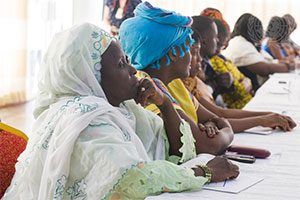 Representatives of Civil Society, Sierra Leone. Credit: UN Photo/Eskinder Debebe
Civil society faces mounting threats worldwide, even as it remains essential for democratic accountability, especially in countries struggling with economic instability and social inequality. However, at the same time, nations with weak democratic governance structures also systemically suppress the power of civil society. Human rights activists across the Global South frequently challenge issues such as political persecution and gender oppression, but in return face state-sanctioned punishment for their advocacy. Imprisonment and exile are common mechanisms of punishment that seek to erode the strength of civil society. The 2026 World Press Freedom Index has reached its lowest level in 25 years, with more than half of the world’s countries now falling into the "difficult" or “very serious” category for press freedom. IPS seeks to highlight the work of civil society across the Global South as well as the challenges that they face.
Updated by Yilan Batista and Shuli Wong August 2026

The Week with IPS

NEXT STOP - SDGs
Tracking global progress towards a sustainable world
Tracking global progress towards a sustainable world
