Languages
Saturday, October 10, 2026



News and Views from the Global South
Conferences

African Countries Feeling Exposed to Extreme Weather Changes
Extreme weather conditions, an impact of climate change faced by African countries despite contributing the least global emissions, is attracting the attention of many as the clock ticks towards the start of the 2015 United Nations Conference on Climate Change (COP21).
“Paris Is Not the End of a Climate Change Process but a Beginning”
Chilean President Michelle Bachelet says the climate summit in Paris “is not the end of a process but a beginning,” and that it will produce “an agreement that, although insufficient with respect to the original goal, shows that people believe it is better to move ahead than to stand still.”
Uganda, Tanzania Need Gender Sensitive Climate Change Policies
Climate Change needs to be at the top of the country’s agenda, according to a project examining Uganda’s policies. It says the country hasn’t paid enough attention to climate change in national development and agriculture plans and this needs to be turned around before it’s too late.
Climate Refugees and a Collapsing City
With multiplying impacts of climate change - increasing floods, cyclones, and drought - thousands of climate refugees are migrating to Dhaka. And the city, well beyond its carrying capacity, is bursting at the seams.Africa’s Climate Change Funding May Hit 100 Billion by Mid-Century
When the Climate Summit opens in Paris next week, one of the biggest issues facing world leaders is funding: how best to raise the billions of dollars needed to prevent the devastating consequences of global warming worldwide.
Sinking into Paradise: Climate Change Worsening Coastal Erosion in Trinidad
As unusually heavy rainfall battered Trinidad's east coast a year ago, a lagoon here was overwhelmed, flooding a major access road to the island’s south-eastern communities. As the flood waters poured over Manzanilla beach, they washed sand away, caved in sections of road and collapsed a seawall at a tourist beach facility. Further damages were also incurred with the flooding of homes and agricultural plots.
Against the Odds, Caribbean Doubles Down for 1.5 Degree Deal in Paris
Negotiators from the 15-member Caribbean Community (CARICOM) are intent on striking a deal to keep the global temperature rise at 1.5 degrees of pre-industrial levels, but many fear that a 10-year-old agreement to buy cheap petroleum from Venezuela puts their discussions in jeopardy.
Private Nature Reserves in Latin America Seek a Bigger Role
Private voluntary nature reserves in Latin America should be seen as allies in policies on the environment, climate change mitigation and the preservation of biological diversity in rainforests, say experts.
Latin American Legislators Find New Paths to Fight Hunger
With eight specific commitments aimed at pushing through laws and policies on food security and sovereignty, family farming and school feeding programmes, legislators from 17 countries closed the Sixth Forum of the Parliamentary Front Against Hunger in Latin America and the Caribbean.
When the Rains Came in Dokolo and Karamoja
Households in Northern Uganda are recovering from a prolonged dry spell which has devastated harvests and led to food shortages. Long-awaited rains are expected to replenish pastures, and communities are being encouraged to plant short-term crops. But those that can, fear losing their produce again, when the rains stop.
Latin America to Push for Food Security Laws as a Bloc
Lawmakers in the Parliamentary Front Against Hunger in Latin America and the Caribbean decided at a regional meeting to work as a bloc for the passage of laws on food security – an area in which countries in the region have show uneven progress.
Africa Clinches Mega Development Prospects
The Week of the Programme for Infrastructure Development in Africa (PIDA) in Abidjan, Ivory Coast, focusing on the continent’s infrastructural development ended today with resolutions that could catapult huge advances for Africa.
Zimbabweans Align with Climate-Smart Agriculture Amid Food Deficits
With droughts wreaking havoc in vast areas of Zimbabwe, a majority of people here are fast falling in line with climate-smart agriculture (CSA) as food deficits continue.
Parliamentary Forum to Set New Goals Against Hunger
Undertaking the challenge of pushing for new legislation to guarantee food security in their countries, legislators from Latin America and the Caribbean, together with guest lawmakers from Africa and Asia, will hold the Sixth Forum of the Parliamentary Front Against Hunger Nov. 15-17.
Open Data – Still Closed to Latin American Communities
Open data policies in Latin America have not yet enabled communities to exercise their right to access to information, consultation and participation with regard to mining or infrastructure projects that affect their surroundings and way of life.
Central America Seeks Recognition of Its Vulnerability to Climate Change
For decades, the countries of Central America have borne the heavy impact of extreme climate phenomena like hurricanes and severe drought. Now, six of them are demanding that the entire planet recognise their climate vulnerability.
Opinion: India’s Compact with Africa
The third India-Africa Forum Summit to be held in New Delhi later this month – in which 54 African countries will participaate – is expected to result in a deeper engagement between India and Africa. This summit takes place at a time when both need each other more than ever before. Both remain bright spots in a bleak and blighted growth landscape. Out of 189 countries, only 63 are expected to grow by 4 per cent and more this year, 36 of which are in Africa. But many countries there are adversely impacted by China's diminishing appetite for commodities and shrinking trade. India is currently one of the fastest growing economies in the world.A New Framework in an Age of Migration
With the worldwide numbers of displaced people at all-time highs, migration has become the watchword for humanitarian crises.
Minorities Speak Out in Latin American Population Conference
“The countries of Latin America have not fully committed themselves to the international conventions and have not given indigenous peoples access. Nor have their contents been widely disseminated,” to help people demand compliance and enforcement, said Guatemalan activist Ángela Suc.
Healthy Oceans Key to Fighting Hunger
Seafood offers a large amount of animal protein in diets around the world, and the livelihoods of 12 percent of the global population depend directly or indirectly on fisheries and aquaculture.
The Global South Will Make Its Contribution to Fighting Climate Change
Seen for years as passive actors in the fight against global warming, more than 100 countries of the Global South have submitted their national contributions to reducing greenhouse gas emissions and decarbonising their economies.« Previous Page — Next Page »





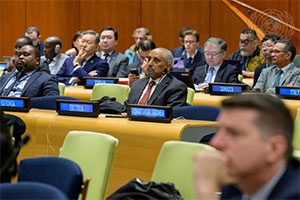 General Assembly Meets to Hear Briefing on UN80 Initiative. Credit: UN Photo/Manuel Elías
Global development conferences are continuing to produce critical frameworks for South-South cooperation and multilateral reform. In January of 2024, the 3rd Global South Nexus (GSN) International Conference was held in Odisha, India, with its theme being “Creating Responsible Professionals for Advancing SDGs: Inputs from Global North and South.” The 2025 UN SDG Report provided a midpoint assessment of the 2030 Agenda, with only 35% of targets on track and 18% having reversed. The 2025 UN Climate Change Conference (COP30) in Belém, Brazil, agreed to mobilize $1.3 trillion annually for climate action by 2035, operationalize the loss and damage fund, triple adaptation finance, and launched the Belém Mission to 1.5°C. In 2025, the Partnership for Economic Policy (PEP) convened its annual Policy Conference in Nairobi, Kenya, addressing the issue of “Financing and Inclusivity in Green Energy Transition in the Global South.” As the Global South advocates increasingly for a South-South framework alongside North-South cooperation, international conferences on sustainability aim to bridge economic and social divides between developed and developing countries in achieving the UN SDGs. Furthermore, to mark the UN’s 80th anniversary, the UN80 Initiative was launched to reshape how the UN system works so that every mandate, dollar, and decision creates greater impact for the global system.

The Week with IPS

NEXT STOP - SDGs
Tracking global progress towards a sustainable world
Tracking global progress towards a sustainable world
