Languages
Sunday, November 15, 2026



News and Views from the Global South
Crime & Justice
UN Day: Another Day, Another 34,000 Refugees
Oct. 24 is not just another day on the calendar. It is United Nations Day, an excellent time to take note of one of the accomplishments the world body has achieved in its 72-year history.
Rohingya Crisis Stokes Fears of Myanmar’s Muslims
In a quiet street, the sound of children's voices can be heard from an open window. They are reciting verses of the Koran in unison. The small Islamic school lays hidden in a walled neighborhood where only Muslims live. This is an island of tranquility in Mandalay, the second-largest city of predominantly Buddhist Myanmar.
Lack of International Action on Rohingya Crisis Called a “Disgrace”
As the crisis in Myanmar reaches unprecedented levels, frustration is at its peak as the international community remains slow to respond and act cohesively.
Good Men Should Not be Quiet Spectators in Sexual Assaults
The pain and anger of more than a million people who tweeted #MeToo in the last week have crowded social media with personal stories of sexual harassment or assault.
Peace and stability must be restored in the Middle East and North Africa so as to alleviate poverty
On the occasion of the 2017 International Day for the Eradication of Poverty, the Chairman of the Geneva Centre for Human Rights Advancement and Global Dialogue H. E. Dr. Hanif Hassan Ali Al Qassim observed that the unprecedented rise of violence and insecurity in the Arab region combined, breed poverty and societal decline.
Driven to Extremes–How Poverty Fuels Extremism, and How to Help Africa’s Youth
Poverty is a blight, and one that disproportionately affects sub-Saharan Africa. It is a vast and complex issue whose tentacles reach into many areas, including climate change, sustainable development and–crucially–global security. The link between poverty and violent extremism is compelling, and means that if we want to address extremism, we must fight inequality too.
After 13 Years, UN Peacekeeping Mission Closes Doors in Haiti
The UN peacekeeping mission ended its operations in the Caribbean nation of Haiti after 13 years on October 15. The UN Stabilization Mission in Haiti (MINUSTAH), which aimed to bring stability to a politically chaotic Haiti of 2004, will transfer power to the UN Mission for Justice Support in Haiti (MINUJUSTH), a much smaller successor mission that is going to assist the government on security issues.
Despite Odds, Women Gain Stature in African Politics
Once in a while, Africa produces talented women politicians who, despite the odds, overcome the obstacles that impede their success in the political arena.
Can the Kenyan Lion Kick High Enough to Be the South Korean Tiger of Africa?
In 1953 South Korea emerged from the ravages of a debilitating war, yet the total gross domestic product in nominal terms has surged 31,000 fold since 1953.
Rohingya Refugee Women Bring Stories of Unspeakable Violence
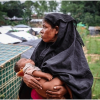
Yasmin, 26, holds her 10-day-old baby, who she gave birth to in a crowded refugee camp in Cox’s Bazar, a southeastern district bordering Myanmar.
Need for Inclusive Peace Efforts in South Sudan: No More ‘Compassion Fatigue’
“Peace is not a one-day affair or event, it requires our collective effort,” said South Sudan’s Vice President, General Taban Deng Gai, while addressing the General Assembly at the UN.
Non-violence and lasting peace are key to secure the long-term stability of the Arab region
The Chairman of the Geneva Centre Dr. Hanif Hassan Ali Al Qassim is calling on the international community to address the surge of extremist violence exacerbating the volatile security situation in the Arab region. This appeal was made by Dr. Al Qassim in relation to the commemoration of the 2017 International Day of Non-Violence observed on 2 October 2017.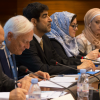
Gender Equality and Women’s Empowerment in the Arab Region: Where Do We Stand?
Women’s empowerment and gender equality should remain a central objective of the world community. The recently adopted Sustainable Development Goals (SDGs) includes specific provisions to member States of the United Nations – notably through SDG 5 - to commit to enhancing gender equality and to give women a stronger voice in the fight for equality. The Preamble of the 1948 Universal Declaration of Human Rights calls for “equal rights” to be enjoyed by “men and women”: 69 years later, gender equality has not only been recognised for what it is: a fundamental human right, it is also becoming a guiding principle in the efforts of States to attain the highest ideals of a just and inclusive society and the highest rate of growth.
Where Do 50 Million Tonnes a Year of Toxic E-Waste Go?
Each year, the electronics industry generates up to 41 million tonnes of e-waste, but as the number of consumers rises, and the lifespan of devices shrinks in response to demand for the newest and best, that figure could reach 50 million tonnes this year, according to specialised studies.
Crisis in Cameroon Spurs Govt Crackdown on Press
“For too long we have been afraid to speak out against injustices and all sorts of atrocities happening in Cameroon, thinking it [the silence] will protect us. If I were to repeat what I have done on Canal 2 English [television], I will do it again. I now stand ready for any eventuality,” says Cameroonian journalist Elie Smith.
Gov’t Actions, Not Religion, ‘Tipping Point’ for African Youths Joining Violent Extremism
Government action, rather than religious ideology, is a stronger predictor for radicalization in Africa, according to a two-year landmark study by the United Nations Development Programme (UNDP).
Torturing Detainees Is Immoral and Ineffective, Says UN Human Rights Chief
A Manual for Investigative Interviewing to abolish torture among detainees suspected of crime is in the pipeline, UN High Commissioner for Human Rights Zeid Ra'ad Al Hussein said today.
The Crisis of Refugees and Their Sufferings Call for a Solution
The pursuit of international peace and security has been on the agenda of international decision-makers ever since the establishment of the League of Nations on 10 January 1920. There has been a constant ambiguity about the way this commitment has been translated to practice. The Covenant of the League of Nations committed itself “to promote international co-operation and to achieve international peace and security”: nevertheless, the eruption of violence and geopolitical confrontations lead to another major confrontation two decades later. This reinforced the determination of the world community to redouble its efforts to promote peace and security. The Chairman of the Geneva Centre for Human Rights Advancement and Global Dialogue said that the UN Charter - adopted on 26 June 1945 - did not prevent the atomic bombings of Hiroshima and of Nagasaki less than two months later. The disastrous consequences of the Second World War was a terrible reminder of humanity’s ability to bring the world close to apocalypse. Partly for such reasons more than 60 million people continue to be forcibly displaced today and peace continues to be so elusive.
A Trump Doctrine of Hypocrisy
In his first address on the global stage of the General Assembly, United States’ President Donald Trump touted an “America First” approach at the very institution that is meant to inspire collaboration between nations.
Macron Defends Globalist Approach at UN General Assembly
French President Emmanuel Macron delivered a sombre speech at the United Nations General Assembly yesterday, denouncing Myanmar’s “ethnic cleansing,” and calling for better protection of refugees in the world.
Aung San Suu Kyi: A Leader in Denial?
After finally breaking silence with a much anticipated address on the ongoing crisis in Rakhine State, Myanmar’s de facto leader Aung San Suu Kyi has disappointed the world as she refuses to acknowledge the plight of her country’s Rohingya community.« Previous Page — Next Page »


Issues of crime and justice are as pertinent to development as they have ever been. The struggle for abolition of the death penalty is not over, and penal reform is desperately needed in many countries around the world. From violence to religious persecution, white-collar crime to police brutality, we keep you updated with reports from around the world. IPS correspondents focus on the causes of crime, attempts to prevent it, and the process of bringing those who commit crimes to justice. We also cover the campaign against capital punishment, and for legal and prison reforms that would give prisoners the right to life, and also to justice and decency.

The Week with IPS

NEXT STOP - SDGs
Tracking global progress towards a sustainable world
Tracking global progress towards a sustainable world
