Languages
Sunday, November 29, 2026



News and Views from the Global South
Economy & Trade

Anti-Poaching Operation Spreads Terror in Tanzania
Ali Nyenge, a resident of Iputi ward in Tanzania's northern Ulanga District, woke up as anti-poaching security officers surrounded his home. He says they accused him of illegal hunting and in front of his 11-year-old son, made him take his clothes off, poured salt water on his body and whipped him with a cane.
Women Farmers in Chile to Teach the Region Agroecology
An organisation that brings together some 10,000 peasant and indigenous women from Chile is launching an agroecology institute for women campesinos, or small farmers, in South America.
More Vehicles in Latin America – More Deaths
The family of Susana Suárez, a 35-year-old Venezuelan dentist, are still in shock over her death in a traffic accident in May. She and a friend were killed on their way back from the beach, and became just two more of the 130,000 victims who died on Latin America’s roads in 2013.
Hospitality, Agriculture Firms Vulnerable to Human Trafficking
Shareholders are calling on 15 U.S.-based multinational corporations to ensure that their global supply chains are not facilitating human rights abuses, particularly labour and sex trafficking.
Seedpods Worth More than Gold in Argentina’s Arid North
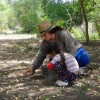
Tired of the drought driving away their men and killing their livestock, the women of Guanaco Sombriana, a town in northern Argentina, have found a new source of income by using the seedpods of native trees that up to now merely provided shade in this arid landscape.
Keeping the Grass Greener for African Plant Breeders
For the few plant breeders in Africa like Vivian Oduro, working for an international research institution is an obvious choice, with prestige and benefits any agricultural scientist would find hard to decline.
Farm Forecasts Try to Decode a Capricious Climate
In the southwest peninsula of Cedros, one of Trinidad’s driest areas, Jenson Alexander grows the cocoa used for many years by the British chocolate giant Cadbury.
Mexican Communities On Guard Against Thirst for Oil
The Terra 123 oil and gas well in the southeastern Mexican state of Tabasco was in flames since late October, just 1.5 km from a community of 1,500 Oxiacaque indigenous villagers, who were never evacuated.
Pakistani NGOs Fear New Year Constraints
A new policy by the Pakistani government to regulate foreign-funded non-governmental organisations (NGOs) has come in for sharp criticism from the social sector, with many saying it could stifle rights-based groups and affect crucial services provided to the needy.

Cuba’s Reforms Don’t Believe in Tears
The landscape is changing in Cuba’s cities and towns, with political slogans giving way to lighted signs advertising the best of local and international cuisine and air-conditioned lodgings – signs of an emerging private sector that was inconceivable until recently.
Barren Fields Recover From Taliban
Ahmed Nawaz, a 55-year-old farmer in northwestern Pakistan’s Swat valley, rues the day the Taliban arrived in his beautiful land, known for its rolling mountains, lush fields and blossoming orchards. “The earth became barren,” he says.
Baka Caught in the Maze of Modernism
Essomba Dominique, a Baka man from Mindourou in Cameroon’s East Region, sits dulled-eyed in front of his hut, known in the Baka language as the ‘mongoulou’.
OP-ED: NAFTA’s 20 Years of Unfulfilled Promises
Twenty years after it took effect, NAFTA has failed the vast majority of Mexicans.
Palestinians Face a Route to Nowhere
The full moon sets; another dawn rises over Route 443. For over 40,000 Israeli residents and settlers commuting daily between Jerusalem and the Tel Aviv metropolitan area, it isn’t yet rush hour.
Every Eucalyptus Felled Equals Gallons of Water
Sabina Shey Nkabiy, a farmer in Cameroon's North West Region, moves around these days with a million-dollar smile on her face. The mother of six, who used to trek 10 kilometres a day to farm, now harvests food in her backyard.
Farmers in Mozambique Fear Brazilian-Style Agriculture
Rodolfo Razão, an elderly small farmer in Mozambique, obtained an official land usage certificate for his 10 hectares in 2010, but he has only been able to use seven. The rest was occupied by a South African company that grows soy, maize and beans on some 10,000 hectares in the northeast of the country.
The Legacy of 2013
At this time of hope for what the new year may bring, it would be useful to look at the legacy we carry with us from the year we leave behind. It was a year full of events - wars, rising social inequality, unchecked finance, the decline of political institutions, and the erosion of global governance.
Coal Trains Run into Stiff Resistance in U.S.
Citizens and activists in the U.S. Pacific Northwest are fighting three different proposed coal terminals, including one in Oregon and two in Washington.
Rebuilding Lives Skilfully
Farhat Bibi, 43, was left to fend for her three young sons after her husband was killed in a bomb attack in Pakistan’s Federally Administered Tribal Areas (FATA) three years ago. A few days later, she landed at a camp for people displaced by violence. “The camp proved to be a blessing in disguise,” she says.
GMO Test Trials Prove Divisive in Ghana
A battle over genetically modified organisms (GMOs) is building in Ghana after the government recently completed regulations that could allow modified cowpeas and other selected crops to be grown following confined field trials (CFT).Need for Firewood Raises Threat for Georgia’s Christmas Tree Trade
The South Caucasus country of Georgia is a source of much sought-after Christmas tree seeds. But its own forests are now under threat, as firewood is in increasing demand as a cheap source of heat for homes, schools and hospitals.« Previous Page — Next Page »


 UN Commission on International Trade Law Holds Colloquium on Harmonizing Law in Age of Digital Trade and Finance. Credit: UN Photo/Manuel Elías
Trade has historically been a geopolitical tool that can both be used to propel development as well as entrench inequalities. In various nations in East Asia and Latin America, increased trade, as often seen in export booms, has allowed them to achieve influential standings within the global economy. On the other hand, many low-income countries in Sub-Saharan Africa, Asia, and Latin America struggle to maintain a robust trade performance, and oftentimes are subjugated to exploitative trade dynamics through intense extraction of their natural resources. In recent decades, international trade has reached a new era as emerging economies across the world are rising in economic preeminence. Stable international trade is crucial to world peace as global interconnectedness facilitates reliable diplomacy. Nevertheless, significant challenges are on the rise. Notably, a major wave of United States tariff escalations in January 2025 lifted US import taxes to their highest level since the 1930s, changing market dynamics and forcing renegotiations with global trading partners.These articles are aimed at informing readers about the complexities of trade and its varying effects on development, with a special focus on the consequences of the global economic crisis, the potential of fair trade and the gender implications of trade policies.
Updated by Yilan Batista and Shuli Wong August 2026

The Week with IPS

NEXT STOP - SDGs
Tracking global progress towards a sustainable world
