Languages
Friday, October 16, 2026



News and Views from the Global South
Energy

Growing Mobilisation Against Introduction of Fracking in Spain
Thousands of people in Spain have organised to protest the introduction of “fracking” – a controversial technique that involves pumping water, chemicals and sand at high pressure into shale rock to release gas and oil.
Bahamas Builds Resilience Against a Surging Sea
Small Island Developing States (SIDS) have championed the phrase “1.5 to stay alive” in demanding that global temperature increases be kept as far below 1.5 degrees C as possible to limit the anticipated devastating effects of climate change on the world’s most vulnerable countries.
Opinion: A Critical Moment to Fortify Nuclear Test Ban
The 2015 Nuclear Non-Proliferation Treaty (NPT) Review Conference wrapped up last week in New York without agreeing on an outcome document. While this is unfortunate, it is important to remember that the future of the nuclear non-proliferation regime will be determined by more than whether the Review Conference participants produced a document addressing all that currently ails the NPT-based regime.
Iran Sanctions Regime Could Unravel with Failed Nuclear Deal
Internationally supported sanctions against Iran could begin to crumble if talks over Iran's nuclear programme fail to produce a final deal, according to Germany’s envoy to the United States.
Failure of Review Conference Brings World Close to Nuclear Cataclysm, Warn Activists
After nearly four weeks of negotiations, the Nuclear Non-Proliferation Treaty (NPT) Review Conference ended in a predictable outcome: a text overwhelmingly reflecting the views and interests of the nuclear-armed states and some of their nuclear-dependent allies.
Climate Change: Some Companies Reject ‘Business as Usual’
When it comes to climate change, business as usual is simply “not an option”.
Opinion: Universalisation and Strengthening Nuke Treaty Review Need to be Qualitative
"Strengthening the Review Process" and "Universalisation of the Non-Proliferation Treaty" (NPT) are distinctly substantive issues, that require consideration with their specificities in view.
U.N., World Bank Set 2030 Deadline for Sustainable Energy for All
Secretary-General Ban Ki-moon, an unrelenting advocate of sustainable energy for all (SE4All), once dramatised the need for modern conveniences by holding up his cell phone before an audience in the Norwegian capital of Oslo and asking: “What would we do without them?”
African Women Mayors Join Forces to Fight for Clean Energy
When some 40,000 delegates, including dozens of heads of state, descend on Paris for the United Nations Climate Change Conference later this year, a group of African women mayors plan to be there and make their voices heard on a range of issues, including electrification.
“Megaprojects” Can Destroy Reputations in Brazil
Megaprojects are high-risk bets. They can shore up the government that brought them to fruition, but they can also ruin its image and undermine its power – and in the case of Brazil the balance is leaning dangerously towards the latter.
Opinion: Edinburgh University Bows to Fossil Fuel Industry
The University of Edinburgh has taken the decision to not divest from fossil fuels, bowing to the short-term economic interests of departments funded by the fossil fuel industry, with little to no acknowledgement of the long-term repercussions of these investments.
Opinion: Clean Energy Access, a Major Sustainable Development Goal
The Sustainable Energy for All (SE4ALL) Forum will take place May 18-21 in New York. Success in achieving sustainable development and tackling climate change challenges requires investment in clean energy solutions.
The Asia-Pacific Region Is ‘Growing’, but Millions Are Living in Poverty
Home to an estimated 3.74 billion people, the Asia-Pacific region holds over half the global population, determining to a great extent the level of economic stability, or chaos, in the world.
The U.N. at 70: Energy Powers Lives, Literally
When, in 2003, Professor Richard Smalley, winner of the Nobel Prize for Chemistry, listed the top 10 problems facing humanity for the next 50 years in order of priority, energy was at the top of his list, followed by water, then food.
NGOs Urge Post-2015 Declaration Include Water, Sanitation as Basic Human Rights
Virtually every major international conference concludes with a “programme of action” (PoA) – described in U.N. jargon as “an outcome document” – preceded by a political declaration where 193 member states religiously pledge to honour their commitments.
Reviving Dignity: The Remarkable Perseverance of Myanmar’s Displaced
In Myanmar’s Western Rakhine State, over a hundred thousand people displaced by inter communal violence that broke out nearly three years ago remain interned in camps on torrid plains and coastal marshes, struggling to survive.
Q&A: Nuclear Disarmament a Non-Starter, “But I Would Love to Be Proven Wrong”
Albert Einstein, the internationally-renowned physicist who developed the theory of relativity, once famously remarked: “I know not with what weapons World War III will be fought, but World War IV will be fought with sticks and stones.”
Opinion: A Development Fairytale or a Global Land Rush?
In our work at Greenpeace and the Oakland Institute around access and control over natural resources, we face constant accusations of being anti-development or “Northern NGOs who care more for the trees”, despite working with communities around the world, from Cameroon, to China, to the Czech Republic.
Caribbean Looks to Paris Climate Summit for Its Very Survival
Caribbean leaders on Saturday further advanced their policy position on climate change ahead of the 21st Conference of Parties, also known as COP 21, scheduled for Paris during November and December of this year.
Opinion: The Bursting of Europe’s Biofuels Bubble
Last week, the European Union reached a momentous decision to finally agree a reform to its disastrous biofuels legislation, signalling Europe’s U-turn on the burning of crops for biofuels.
Opinion: South-South Cooperation Vital for Sustainable Development
Sustainable development is central to a range of key discussions at the United Nations and elsewhere at the moment.« Previous Page — Next Page »





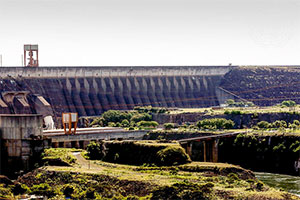 UN Power Plant, Paraguay. Credit: UN Photo/Evan Schneider
Energy has posed a great challenge for economies around the world. As global energy consumption skyrockets throughout the years, so does the need for sustainable solutions. The Sustainable Development Goals are essential in providing people with access to safe, affordable, and sustainable energy sources that minimize harm on the planet. Progress towards these goals opens the door for an advancement in modernization for communities on a global level and allows for a potential mitigation of tensions between nations.
The UN’s Summit of the Future in 2024 offered new initiatives that are being taken to achieve these goals, including a decreased reliance on fossil fuels, a switch to renewable energy sources, and improved climate financing.
IPS is well positioned to provide relevant, insightful, and compelling analysis of recent updates and measures being taken around the world to achieve a cleaner future.

The Week with IPS

NEXT STOP - SDGs
Tracking global progress towards a sustainable world
Tracking global progress towards a sustainable world
