Languages
Friday, November 20, 2026



News and Views from the Global South
Featured

Selling Their Bodies for Fish and a Handful of Shillings
It's Saturday morning and Hafsa Juma* is seated on a traditional mat known locally as a mkeka under the scorching sun outside her homestead, located near Gasi Beach on the Kenyan coast.
UN Security Council Seats Taken by Arms Exporters
Nine of the world’s top ten arms exporters will sit on the UN Security Council between mid-2016 and mid-2018.
The Cuban Revolution Has Lost Its Founder and Leader
Fidel Castro, who survived more than 600 assassination attempts and remained in power longer than any other leader in the history of Cuba, died Friday night at the age of 90.
25th November – International Day for the Elimination of Violence against Women
Each year on November 25, the International Day for the Elimination of Violence against Women is commemorated. A commemoration in essence is an opportunity to reflect on the challenges, prove that progress can be made and celebrate victories. It is also a reminder of the obligations and the responsibility we all must own at both the private and the public level to ensure that every woman, every girl, in all corners of the world lives in a world free of violence and fear. They must be enabled to enjoy their most fundamental right to physical integrity and security.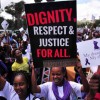
Let’s Unite to End Violence Against Women in Kenya
Consider this. According to the 2014 Kenya Demographic and Health Survey of Kenya, 4 out of every 10 Kenyan women undergo some form of violence, whether physical or sexual. This figure is staggering and should compel us to pause and reflect.
Ensuring Shared Progress for Sustainable Development and Peace
International inequality has grown over recent centuries, especially the last two. Before the Industrial Revolution, between-country inequalities were small, while within-country inequalities accounted for most of overall global income inequality. Now, inter-country income inequalities account for about two-thirds of world inequality with intra-country inequality accounting for a third.
Violence Against Black Women in Brazil on the Rise, Despite Better Laws
Four months in hospital and a number of operations saved the life of Maria da Penha Fernandes of Brazil, but the rifle shot left her paraplegic at the age of 37. When she returned home, her husband tried to electrocute her in the bathroom.
For Women and Girls Who Flee Conflict: Protection & Opportunity
Over the past 18 months, 1.3 million migrants and refugees crossed into Europe. For women and girls particularly, that journey is one of violence and trauma.
Australian Activists, Dissenters and Whistleblowers Feeling the Heat
For Australian activist Samantha Castro, it was her association with the non-profit publishing organisation Wikileaks that brought her to the attention of the Australian Federal Police (AFP).
The Potential Cost of U.S. Climate Inaction
Although U.S. President-elect Donald Trump has hinted he may be softening his stance on climate change, many are still uncertain of what lies ahead concerning climate action within and beyond the United States.
Jamaica’s Culture of Fear Allows Police to Get Away With Murder
The morning her brother was shot dead in January 2014, Shackelia Jackson had slept through her alarm. She woke up to the sound of his name and instantly knew something was wrong. When she ran down to the modest restaurant he operated in downtown Kingston, she noticed the spoon in the rice pot, the flour where the chicken was being fried. Then one of his slippers, and blood marks.
Battle of the Desert (and III): UNCCD ‘s Louise Baker on The Silk Road
Marking this year's World Day to Combat Desertification last June, the United Nations announced the launch of a China-United Nations Convention to Combat Desertification (UNCCD) Belt and Road Joint Action initiative to curb Desertification along the Silk Road.
Speaking Out on Sexism and Violence Through Hip-Hop
Young women are beginning to find their voices around issues such as sexism and violence, including through hip-hop, an art-form which has a long tradition of fighting oppression.
Students Under Siege as Schools Burn in India’s Troubled Kashmir
In the fading light of a November afternoon, 12-year-old Mariya Sareer bends over a textbook, trying to read as much as she can before it gets dark. It's been nearly five months since the seventh grader from Shurat, a village 70 kms south of Srinagar city, last went to school, thanks to a raging political conflict.
Nations Lose Bid to Block UN LGBTI Expert
Following a contentious and close vote, a UN General Assembly (UNGA) committee reaffirmed the right of a newly appointed UN expert addressing violence and discrimination based on sexual orientation and gender identity to continue his work.
Kenya’s Youth Unemployment Challenge Presents Opportunities
Consider this paradox. Every year 1 million young people join the job market in Kenya, yet Kenya has the largest number of jobless youth in East Africa. As the government puts in place measures for addressing the issue of high youth unemployment and poverty, The private sector needs to join forces to sustainably grow its business and markets. Businesses and the societies that they operate in are symbiotic and it is now an established maxim that business cannot succeed in societies that fail.
Children of the ‘Others’, Sons of Minor Gods
In December 1946, “faced with the reality of millions of children suffering daily deprivation in Europe after World War II,” the General Assembly of the United Nations created the UN International Children’s Emergency Fund (UNICEF), to mount urgent relief programmes.
Coal Mine Threatens Ecological Paradise in Chile’s Patagonia Region
An open-pit coal mine in the southern island of Riesco, a paradise of biological diversity in Chile’s southern Patagonia wilderness region, is a reflection of the weakness of the country’s environmental laws, which are criticised by local residents, activists, scientists and lawmakers.
Climate Finance for Farmers Key to Avert One Billion Hungry
With climate change posing growing threats to smallholder farmers, experts working around the issues of agriculture and food security say it is more critical than ever to implement locally appropriate solutions to help them adapt to changing rainfall patterns.This is No Way to Honour Kenya’s Contribution to Peace in South Sudan
The dismissal of Lt-Gen Johnson Mogoa Kimani Ondieki as commander of the UN Mission in South Sudan (UNMISS) comes off as a knee-jerk reaction that fails to address structural limitations of the UN peacekeeping operations. Even more worrying for Kenya is that the action practically eviscerates the country’s unrivaled contribution to peace and stability in Sudan.
Climate: Strong Commitment and New Global Action on Water Scarcity
“No country, irrespective of its size or strength, is immune from the impacts of climate change, and no country can afford to tackle the climate challenge alone.”« Previous Page — Next Page »


The Week with IPS

NEXT STOP - SDGs
Tracking global progress towards a sustainable world
Tracking global progress towards a sustainable world
