Languages
Saturday, November 21, 2026



News and Views from the Global South
Green Economy
Auto Production Roars to New Records
Following a plunge in output triggered by the global economic crisis, world auto production is roaring back to new peaks.
IUCN Puts the Accent on Business
The outcome of the June Rio+20 UN conference on sustainable development was the undisputed inability of governments to come to an agreement on moving ahead to protect the planet. Three months later, the International Union for Conservation of Nature (IUCN) is proposing what can be done as a collective.
China Puts Up a Green Shield Against Sandstorms
The setting sun is still streaming in through the poplars along the shelter belts, but Horquin Lianjun is done with farm work for the day. The desert wind has turned bone chilling.
Small Dams – from Heroes to Villains in Brazil
A recent Brazilian court decision to suspend construction of small hydroelectric dams along the Paraguay River has highlighted the doubts raised about a growing alternative source of energy that until recently was considered one of the most environmentally-friendly sources.
Losing Land, and Finding a Roof
Asmahan Ramadan and her family have taken thousands of photos on the rooftop of their home. Not of themselves, or of the overcrowded Dheisheh refugee camp they see every day.Kyoto Protocol May End With the Year
As government negotiators from the world’s poorest countries ended a round of United Nations climate change talks in the Thai capital, they sounded a grave note about what appears imminent when they assemble in November in Doha – the reading of the last rites of the Kyoto Protocol.Getting Into the Business of Environment
Regulations that stand in the way of conservation programmes lower their likely success, experts warned at the World Conservation Congress of the International Union of Conservation of Nature (IUCN) in Jeju, South Korea.
Small Step to Set Up the Biggest Marine Park
The world’s largest marine park is due to be launched in the Cook Islands located in the Pacific Ocean about 3,000 km from New Zealand. Covering an area of almost a million square kilometres, the park will be three times the size of Australia’s Great Barrier Reef Marine Park and twice as large as the Chagos Archipelago in the Indian Ocean that topped the list of marine protected areas (MPAs) for two years.
U.S.: Government and Industry Partner to Promote Electric Cars
A 120-million-dollar grant from the U.S. Department of Energy to the nationwide Electric Vehicle (EV) Project aims to promote and expand the use of electric vehicles in the United States.
Study Damns Mekong Dams
Impoverished Laos is unlikely to cancel a Thai project to build a mega dam across the Mekong River at Xayaburi, despite warnings from the International Union for Conservation of Nature (IUCN) that it could devastate the region’s rich biodiversity.
Feed Europe, Feed the World
A huge moment for reform of the industrial farming system in Europe has many stakeholders on edge. Farmers who are feeling the crunch of rising input costs – from fertilisers to fuel – believe they can benefit greatly from a transition to more traditional and sustainable farming methods.
Philippines Floods Prompt Climate Action
This year’s floods, one of the worst in Philippine history, destroyed a staggering 57 million dollars worth of crops, pushing this climate vulnerable country to implement disaster risk reduction measures.
Whose Timber is it Anyway?
With Pakistan’s last major stands of deodar (cedar) threatened by a ‘timber mafia’, the local people in the Chitral district of Khyber Pakhtunkhwa province are resorting to direct action to stop the denudation of their picturesque alpine homeland.
“The Truth is That All Problems Have Solutions” – Even Climate Change in Ethiopia
Eight years ago Kenbesh Mengesha earned an uncertain income collecting firewood from local government forests and selling them to her fellow slum-dwellers in Addis Ababa, Ethiopia. She would earn on average about 50 cents a day, if she was lucky.
Activists Protest Shell’s Arctic Oil-Drilling Plans
By mid-September, the Royal Dutch Shell Oil (Shell) group hopes to begin exploratory oil drilling in the Arctic Ocean off the coast of northern Alaska, provided it can secure federal permission from the U.S. government and overcome other logistical obstacles. But a prominent environmental group warns that drilling will do "irreparable damage" to the area.
Riding Towards Sustainable Development, on Bamboo
In Ghana, a country burgeoning with traffic congestion, increasing economic growth, and a stark urban-rural divide, making frames of bicycles out of bamboo could be the key to promoting sustainable development. It also makes stronger, longer-lasting bikes.
Beating the Weather With Sustainable Crops
Narrow, cobblestoned lanes separate the rows of mud houses with cool interiors and mud-smoothened patios, some with goats tethered to the wooden posts. This is Tajpura village, deep in this water-stressed, drought-prone region of northern India.As Green Climate Fund Finally Meets, Funding Remains Uncertain
Five months behind schedule, the board of the newest and largest international financing mechanism aimed at dealing with the effects of climate change, the Green Climate Fund, is finally slated to meet this week, just ahead of a late-summer deadline.
Europe Thinks Again About Food
Present day European farming is based on the Common Agricultural Policy (CAP), which was created over six decades ago by countries emerging from severe food shortages that swept the continent during and after the Second World War.
Biopolymers and the Dream of a Green Petrochemical Industry
Brazil leads global production of biopolymers, an industry that generates fewer greenhouse gas emissions than fossil fuel-based plastic manufacture. But "green plastics" made from sugarcane have a sour aftertaste.Corporate Lobbyists Threaten Democracy
Over a month has passed since the United Nations summit on sustainable development concluded in Rio de Janeiro, Brazil, but the world still appears to be unaware of one of the most important statements made during the conference that drew some 50,000 delegates from all over the world.« Previous Page — Next Page »


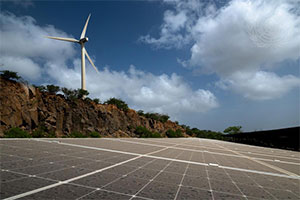 Renewable Energy in Cabo Verde. Credit: UN Photo/Mark Garten
A green economy is an economic model that aims to reduce environmental risks and build a sustainable future. Many of the UN SDGs seek to facilitate a green economy, such as ensuring access to affordable and reliable clean energy, building sustainable cities and communities, and implementing urgent action to combat climate change. Various key negotiations have strived to achieve a green economy, such as the Green New Deal and the Inflation Act of 2022. COP30, held in Belém, Brazil in 2025, agreed to mobilize $1.3 trillion annually for climate action and launched the Belém Mission to 1.5°C. However, the conference was not able to develop a fossil fuel reduction roadmap. Recent years have witnessed a sharp transformation in the geopolitical landscape of international sustainability cooperation. In March 2025, the United States stepped back from formal multilateral support for the SDGs, while China is on the rise as an international leader in renewable energy production. The actions of these global powers may shape shifting alliances on environmental governance. IPS is dedicated to sharing timely news on international developments in building a sustainable future.

The Week with IPS

NEXT STOP - SDGs
Tracking global progress towards a sustainable world
Tracking global progress towards a sustainable world
