Languages
Saturday, November 21, 2026



News and Views from the Global South
Green Economy

Swapping Trash for Fresh Produce in Mexico City
Isabel Becerril has come with some friends to the “barter market” in the Mexican capital, to exchange 40 kgs of recyclable refuse for fresh produce, sweets and plants. “This is the first time I have come here, and I like it,” the university student tells IPS, with her ecological bag in hand.
Trailer Trashing as South Africa Considers Outlawing Bicycle Trailers
The road between Zimbabwe’s Victoria Falls and Livingstone, in Zambia, is a well-traversed one, criss-crossed by bicycle riders towing trailers of bread and other supplies, with their bicycle spokes reinforced to bear the extra weight.DRC Farmers Reap Benefits of Soil Fertility
Just two years ago, rice farmers on the Ruzizi plain in the eastern part of the Democratic Republic of Congo were content to harvest 2.5 tonnes of rice per hectare. The adoption of new techniques has seen their output rise to between six and eight tonnes, with smallholder farmers also increasing their local market share.
Climate-Battered South Asia Looks to Rio+20 Formula
Far-flung South Asian communities, from the high Himalayan slopes to the Indian Ocean coasts, united in the face of extreme and uncertain weather, continue to hold on to the hope that the Rio+20 focus on disaster risk reduction (DRR) will positively influence national policies.
Mexican Communities Fight Mini-Dams
Small-scale hydroelectric dams with a capacity of under 30 MW are seen by the authorities in Mexico as an important alternative for generating energy. But local communities reject them on the argument that they would cause social, economic and environmental damages.
Salvadoran Civil Society Groups Opposed to Carbon Credit Plan
Civil society organisations are asking the World Bank to reject the Salvadoran government's proposal to join a programme for reducing greenhouse gas emissions linked to deforestation, on the argument that it will actually harm the environment.
Trash Collectors Become Zimbabwe’s Unlikely Climate Change Ambassadors
Tomson Chikowero was ashamed of his job. He did not want anyone finding out what he did to earn a living, so he used to wake up early every morning and leave his home in Hatfield, a residential suburb in Zimbabwe’s capital city Harare, under the cover of darkness.
Profiting from Sustainable Forests on Communal Land in Mexico
Mario Guzmán plans to start cutting down trees again in August and September, the last months of the rainy season. “Now the roads are impassable, and the trucks can’t get in to haul out the timber,” the Mexican farmer, whose community is sustainably managing its forests, told IPS.
Africa Must Earn Its Climate Change Adaptation Finance
With the United Nations Climate Change Conference less than four months away, African countries need to present convincing arguments and successful adaptation projects to attract competitive funding for adjusting to changes in global weather patterns, climate finance experts say.
Malaysia’s Green Movement Goes Political
Three years ago, Sherly Hue lived the life of a typical career woman in Kuala Lumpur, working as a marketing executive promoting building materials. But one day, she received a phone call from her worried parents that would forever change her life.
Q&A: Transforming the Way the Global Environment is Managed
The Global Environment Facility (GEF) is ready to be a catalyst for transforming the way the global environment is managed, said the next CEO and chairperson of the multilateral institution, Dr. Naoko Ishii, in this interview with Tierramérica *.
The Bicycle Revolution in Paris, Five Years Later
In July 2007, many Parisians laughed at their mayor, Bertrand Delanoë, when he announced the creation of a public bicycle sharing system aimed at reducing traffic in the French capital.
New Waste-to-Energy Facility Helps Barbados Toward Greener Economy
When it comes to pursuing a greener path to economic development, the tiny Caribbean island of Barbados is not about to allow its small size and limited resources to get in its way.
Thai Farmers Fight ‘Global Warming Fines’
Small farmers in the Baan Pra village of Thailand's southern Trang province have been living in anxiety ever since they were slapped with stiff fines by the government in 2006 and ordered to vacate their ancestral lands for ‘contributing to global warming’.The Guinean Women Who Earn a Little Coin From Gardening
Market gardening in the peri-urban areas of Conakry, the Guinean capital, is growing quickly, bringing in income for groups of women and giving them some autonomy.
Waste Not, Want Not – Providing for South Africa’s Food Security
As South Africa grapples with reducing its sanitation backlog, scientists seem to have found a way to reduce the build up while simultaneously combatting the country’s food insecurity. The solution? Safely using human waste as fertiliser.Eco-Villages Breathe New Life Into Rural Senegal
Eighty-odd kilometres outside Dakar, the Senegalese capital, solar power and an irrigation scheme are transforming a traditional village into what the government hopes will be a model for the future of the countryside.
Green Bricks Pave Future for Female Workers
At first glance the smart young women in white overcoats, black rubber boots and protective face masks seem out of place in impoverished Bangladesh’s dirtiest industry – brick making.Poland Clings On to Coal
Coal has brought its own compulsions for Poland, as it has for many other countries in the call to move to more renewable and cleaner sources of energy.
Corporations See Green in Biodiversity
The gentle hills on the edge of this remote town are lush with tropical fruit trees that yield fine wines for the Broadchem Corporation and also give the agro company a green label.
OP-ED: Expanding Oil Production Poses Environmental Risks
With oil prices on the rise again and geopolitical upheaval in some major oil producing regions, many countries are turning to new and often environmentally damaging sources of oil, including oil sands, deepwater offshore oil, and heavy oil.« Previous Page — Next Page »


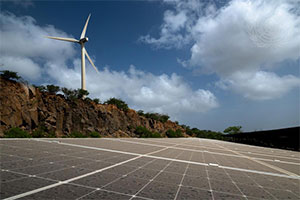 Renewable Energy in Cabo Verde. Credit: UN Photo/Mark Garten
A green economy is an economic model that aims to reduce environmental risks and build a sustainable future. Many of the UN SDGs seek to facilitate a green economy, such as ensuring access to affordable and reliable clean energy, building sustainable cities and communities, and implementing urgent action to combat climate change. Various key negotiations have strived to achieve a green economy, such as the Green New Deal and the Inflation Act of 2022. COP30, held in Belém, Brazil in 2025, agreed to mobilize $1.3 trillion annually for climate action and launched the Belém Mission to 1.5°C. However, the conference was not able to develop a fossil fuel reduction roadmap. Recent years have witnessed a sharp transformation in the geopolitical landscape of international sustainability cooperation. In March 2025, the United States stepped back from formal multilateral support for the SDGs, while China is on the rise as an international leader in renewable energy production. The actions of these global powers may shape shifting alliances on environmental governance. IPS is dedicated to sharing timely news on international developments in building a sustainable future.

The Week with IPS

NEXT STOP - SDGs
Tracking global progress towards a sustainable world
Tracking global progress towards a sustainable world
