Languages
Monday, November 16, 2026



News and Views from the Global South
Natural Resources
Brazilian Environmental Activists Killed in Shadow of Rio+20
Far from the plush surroundings which hosted Rio+20, the most ambitious global conference on the environment of the past two decades, events in a fishing village in the state of Rio de Janeiro show the cost of fighting environmental crime can be as high as life itself.
PERU: Anti-Mining Protesters Shot Amid Climate of Fear
In under two days, five demonstrators were gunned down by security forces in the northern Peruvian highlands region of Cajamarca, where a state of emergency has been declared.
“No Future We Want Without the Ocean We Need”
When South Korea, one of Asia's rising economic powerhouses, decided to host the international exhibition Expo 2012 in the coastal town of Yeosu, it picked a theme high on the agenda of the just-concluded Rio+20 summit on sustainable development: the living ocean.
Q&A: Changing Argentina’s Energy Mix Will Take Intelligence and Time
The recovery of state control over the oil company YPF was a strategic move for Argentina, which is highly dependent on fossil fuels. But the country needs to incorporate cleaner sources of energy, and this will take time, says energy expert Mariana Matranga in this interview.U.S. Sees Greatest Reduction in CO2 Emissions
According to a recent report by the International Energy Agency, the U.S. has seen the greatest reduction in carbon dioxide pollution within the past six years in comparison to any other country, even as global carbon dioxide pollution has reached record highs.
Mining Industry’s Attempts at Transparency Falling Short in Peru
Peru was certified as compliant with the global standard of the Extractive Industries Transparencies Initiative (EITI) earlier this year. However, its achievements have not satisfied the demands of the local population in mining and oil extraction zones.BOLIVIA: From Police Mutiny to Indigenous Vigil
After a 62-day march from Bolivia’s tropical lowlands, over 1,000 indigenous protesters opposed to the construction of a road through a pristine rainforest reserve reached the seat of government Wednesday, just a few hours after the police called off a six-day national strike.
Depleted Chilean Fish Need “A Real Chance of Recovery”
The model of exploiting fisheries that has prevailed in the last decade has driven fish stocks to critically low levels in Chile, which has a 6,435 km Pacific coastline and a wide diversity of marine resources.
Cameroon’s Baka Evicted from Forests Set Aside for Logging
As Lysette Mendum listens to the sound of bulldozers crashing through the forest clearing a road to a mining site near her small village of Assoumdele in the Ngoyla-Mintom forest block in Cameroon’s East Region, she has never been more fearful in her life.
OP-ED: Expanding Oil Production Poses Environmental Risks
With oil prices on the rise again and geopolitical upheaval in some major oil producing regions, many countries are turning to new and often environmentally damaging sources of oil, including oil sands, deepwater offshore oil, and heavy oil.
Explanations Demanded on U.S. Inaction on Conflict Minerals
A U.S. government agency is being questioned on why it is dragging its feet on 2010 legislation that would increase transparency in extractive industries around the world, one aim of which would be to cut down on the global trade in "conflict minerals".
Haiti’s “Gold Rush” Promises El Dorado – But for Whom?
Twenty billion dollars worth of gold, copper and silver hidden in the hills of the hemisphere's poorest country. Investors in North America so convinced of the buried treasure, they have already spent 30 million dollars collecting samples, digging, building mining roads and doing aerial surveys.Biofuels and Hunger, Two Sides of the Same Coin
Despite growing evidence that biofuel production is causing food insecurity around the world, the new European Union policy blueprint on renewable energy ignores the social effects of biofuels. Last week, Guatemalan victims of the food crisis came to Brussels to make European policy makers aware of the problem.Food Safety Up Against Biotech Giants
As the 2012 Farm Bill continues to take shape in the halls of the United States Congress, the immense influence of corporate interests is on display.
Amazon Countries Want Concrete Sustainable Development Goals*
The countries of the Amazon river basin are pursuing definite goals for the region, such as zero deforestation by 2020, even though the Rio+20 conference's outcome document does not include "sustainable development goals".
RIO+20: Promised Green Economy Was a Fake, Say Activists
When the Rio+20 summit on sustainable development ended Friday, there were winners and losers – mostly losers.
‘It Should be Named Planet Ocean, Not Planet Earth’
Oceans, seas and coasts provide over 200 million jobs globally, while 4.3 billion people get 15 percent of their intake of animal protein from the seas. Travel and tourism, ports and energy production use oceans and seas to create jobs and economic and social benefits for millions of people.NIGERIA: Three Boko Haram Leaders Put on U.S. Terrorism List
In its first legal action against the northern Nigerian militant group Boko Haram, the U.S. State Department Thursday designated three of the group's alleged leaders to its global terrorism list.
Agroecology Proves Cheap and Efficient on Brazilian Farm*
An agroecological farm outside of Rio de Janeiro is a testing ground for scientists and agronomists in Brazil, who have worked there for two decades to show that it is possible to produce a wide range of natural agricultural products in a cheap, efficient way that harms neither the environment nor human health.
Get Ready for a World of Nine Billion
As the global population threatens to explode - from the current seven billion to over nine billion by mid-century - the sharp increase in humans not only means overcrowded cities but also increasing demands on food, water, energy and shelter, foreshadowing devastating implications for a sustainable future.
Earth Summits Fail Biodiversity in India
Heads of state and governments are meeting in Rio de Janeiro this week to decide how to renew their pledges made during the first Earth Summit held in Rio in 1992.
« Previous Page — Next Page »


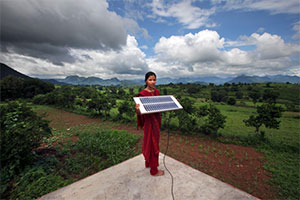 Bringing clean energy to rural India. Credit: Abbie Trayler-Smith / Panos Pictures / Department for International Development
Large reserves of oil, gas and minerals in developing countries generate opulent revenues. They could be used to stimulate economic growth and reduce poverty, but often result in environmental destruction and conflict, benefiting large companies and corrupt governments. Furthermore, competition over natural resources often manifests through geopolitical conflict. For example, before the US-Iraq war, Iraq’s domestic oil industry was nationalized. With US aggression came weakened Iraqi institutions and foreign intervention, thus eventually leading to the privatization of Iraqi oil, leaving the industry now largely dominated by Western companies. As another example, China’s rising investments within the lithium sector in South America are increasing the US-China rivalry across the Western Hemisphere. Notably, Bolivia has the largest reserves of lithium in the world, and the nation’s state-owned lithium extraction firm recently signed a contract with China’s CBC Consortium, while rejecting the entry of Western firms into the nation. In Bolivia’s case, rising Chinese investment in the nation’s lithium sector also raises concerns about environmental sustainability and the sociopolitical rights of Indigenous communities. More broadly, Sub-Saharan Africa holds nearly 30% of global reserves of critical minerals required for low-carbon technologies. Despite this, the region attracts less than 10% of global exploration investment, depicting a critical barrier to both the clean energy transitions and Sub-Saharan Africa’s economic development. Furthermore, resource wealth continues to fuel conflict like Sudan’s civil war, which has led to 9.1 million internally displaced people and is intensely connected to competition over gold, water, and agricultural land. IPS covers news about major oil, gas, and mining projects, their effects on the environment and local communities, and the ideas and actions of the interest groups involved.

The Week with IPS

NEXT STOP - SDGs
Tracking global progress towards a sustainable world
Tracking global progress towards a sustainable world
