Languages
Sunday, November 15, 2026



News and Views from the Global South
Natural Resources

Keystone Opponents Deepen Criticism of Proposed Pipeline
Two new reports, put out by a cross-section of U.S. environmental and public interest groups, are attacking central rationales for the construction of a major new Canada-U.S. oil pipeline proposal, which has emerged as an emblematic cause for green groups who have angrily denounced a U.S. government approvals process.
Eternal Energy Revolution Picking Up Steam
“Be a climate-protection hero, not a climate victim” is the message energy experts from around the world are bringing to San Francisco Tuesday.
Senegal’s Leader Urged to Save Sardinella
Hours after President Macky Sall of Senegal met in Washington with President Barack Obama late last month, he stepped into a brightly lit hotel meeting room to accept the Peter Benchley Award for National Stewardship of the Ocean, the only prize for ocean conservation given to heads of state.Commodities Trade Haven Faces Protests
The powerful Swiss commodity sector is under fire here, as citizens fed up with government inaction on charges of corporate corruption, tax evasion and lack of transparency gear up for major protests.
OP-ED: Letting Nature Take Its Course?
Is sustainability still possible? Yes. Is it still probable? No. With bold action today, tomorrow, and in years to come, we could succeed in creating a sustainable and prosperous society. But what does bold action actually mean?
Women Miners Blast Through Barriers in Chile
Women are playing an increasingly important role in Chile’s mining industry, where little more than a decade ago they were not even allowed in the mines because of prejudice and superstitions.‘Money Wasted Without Policy’
As European Commission leaders make calls for EU countries to raise their spending on development aid for the world’s poor, groups working in underdeveloped states have warned that without more effective aid policies and networks, extra financing may be wasted.
Oil Flows Beneath the Battlefield
At seven o’clock in the morning on Mar. 1, Kurdish militias took over the only operational oil refinery in Syria, located about 800 kilometres northwest of Damascus.Chilean Court Suspends Pascua Lama Mine
Environmental groups and indigenous Diaguita communities of the Huasco Valley in northern Chile celebrated a court decision Wednesday that will bring to a complete halt work on the Pascua Lama gold, silver and copper mine belonging to Canada’s Barrick gold.
International Carbon Markets Expanding but Still Contentious
Nascent carbon emissions-trading exchanges in several countries are increasingly looking at options to interlink with one another, which advocates say would offer investors long-term stability, increase revenues for the development of renewable energy and strengthen corporate support for climate policy.
Prolonging the Life of the World’s Biggest Copper Mine
El Teniente, the world’s largest underground copper mine, has already been in operation since 1905, but the state-owned National Copper Corporation of Chile (CODELCO) wants to keep it running for another 50 years.EU Calls for New Plans Past the MDGs
The European Commission has unveiled a blueprint for global development aid and called on world leaders to replace the Millennium Development Goals (MDGs) with an international aid framework based on sustainable and inclusive development tackling poverty at its roots.
World Bank to Strengthen Focus on Land Rights
The World Bank will be placing stronger emphasis on issues of land tenure and socially and environmentally sustainable agricultural investing, it announced Monday.
Ethiopia Leads the Bamboo Revolution
A combination of an abundance of bamboo and eager foreign investment is making Ethiopia a frontier for the bamboo industrial revolution in Africa, according to this country’s government.
Incomplete Justice in Killings of Amazon Activists
Peasants and human rights defenders in Brazil are indignant over the acquittal of the man accused of ordering the May 2011 murders of two prominent Amazon activists, José Cláudio Ribeiro da Silva and his wife Maria do Espírito Santo.Getting Past Aid to Develop
With the level of Western aid to the world’s poorest countries declining amid the global financial crisis, economists are calling for “innovative” means of development that range from proper taxation of multinationals to laws that ensure gender equality.
World Bank Aims to End Extreme Poverty by 2030
World Bank President Jim Kim has unveiled a series of new institutional goals aimed at ending extreme poverty by 2030 and focusing on the promotion of “shared prosperity” – increasing the incomes of the poorest 40 percent in each country while placing increased focus on dealing with climate change.
Mining Investment Won’t Switch from Chile to Peru
The Chilean government has warned of the potential flight of mining and energy investments to Peru because of court rulings that have paralysed large-scale mining projects in the north of the country. But this fear is unfounded, at least in the short term.
Putting Food Security on the Calendar
Last October, at the beginning of Indonesia’s rainy season, a 37-year-old farmer named Herinurdin took a leap of faith. Instead of planting corn in his entire 1.3-hectare rainfed farm in the Sukabumi town of West Java, as his family had done for generations, he sowed 1,600 square metres worth of rice instead.
Inhospitable Flows the Nile
A 4,200-year-old relief in the Tomb of Mereruka in Sakkara depicts the staggering array of fish that once inhabited the Nile River and its wetlands. Ancient Egyptian fishermen with linen nets haul in their bounty, including the sacred Oxyrhynchus, a snub-nosed fish that was captured and nurtured but never eaten.
Subsidies Play “Significant Role” in Climate Change, IMF Says
The International Monetary Fund (IMF) is urging national governments around the world to roll back or eliminate subsidies on petroleum-based energy sources, estimating that this alone could result in a 13-percent decline in global carbon dioxide emissions.« Previous Page — Next Page »


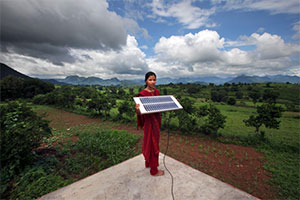 Bringing clean energy to rural India. Credit: Abbie Trayler-Smith / Panos Pictures / Department for International Development
Large reserves of oil, gas and minerals in developing countries generate opulent revenues. They could be used to stimulate economic growth and reduce poverty, but often result in environmental destruction and conflict, benefiting large companies and corrupt governments. Furthermore, competition over natural resources often manifests through geopolitical conflict. For example, before the US-Iraq war, Iraq’s domestic oil industry was nationalized. With US aggression came weakened Iraqi institutions and foreign intervention, thus eventually leading to the privatization of Iraqi oil, leaving the industry now largely dominated by Western companies. As another example, China’s rising investments within the lithium sector in South America are increasing the US-China rivalry across the Western Hemisphere. Notably, Bolivia has the largest reserves of lithium in the world, and the nation’s state-owned lithium extraction firm recently signed a contract with China’s CBC Consortium, while rejecting the entry of Western firms into the nation. In Bolivia’s case, rising Chinese investment in the nation’s lithium sector also raises concerns about environmental sustainability and the sociopolitical rights of Indigenous communities. More broadly, Sub-Saharan Africa holds nearly 30% of global reserves of critical minerals required for low-carbon technologies. Despite this, the region attracts less than 10% of global exploration investment, depicting a critical barrier to both the clean energy transitions and Sub-Saharan Africa’s economic development. Furthermore, resource wealth continues to fuel conflict like Sudan’s civil war, which has led to 9.1 million internally displaced people and is intensely connected to competition over gold, water, and agricultural land. IPS covers news about major oil, gas, and mining projects, their effects on the environment and local communities, and the ideas and actions of the interest groups involved.

The Week with IPS

NEXT STOP - SDGs
Tracking global progress towards a sustainable world
Tracking global progress towards a sustainable world
