Languages
Sunday, November 15, 2026



News and Views from the Global South
Natural Resources

Small Miners – from Digging in Danger to Becoming Legal
Congolese small-scale miner Elizabeth Tshimanga has made a successful living from prospecting. But like many artisanal miners in Africa, hers has been a long and tough journey marred by harassment and disputes over her legal status as a miner.
Group Warns of “Natural Resources Giveaway” in Latin America
Researchers have unveiled new data warning that governments in Latin America are infringing on the rights of their indigenous populations in a bid to fuel development through the extraction of natural resources.
Tug-of-War Over Nuclear Future
Pushed and pulled in opposite directions, the future of Japan’s energy plans in the wake of the accident at the Fukushima Daiichi nuclear power plant two years ago is emerging as a fight between national economic advancement and what anti-nuke activists call “the lives of the people”.
Net Tightens Around Fishing in Egypt
For Egypt’s commercial marine fishermen, making a living has never been more dangerous. Egyptian crews driven further afield in search of fish have faced pirate attacks, spent months in dingy foreign prisons, and come under fire from coast guard vessels. Dozens of fishermen have been held for ransom, abused by authorities, or shot and killed.Civil Society Seeks to Influence Mexican Mining Law Reform
Two separate bills to reform Mexico’s mining laws, one from the government and the other from academics and NGOs, agree on the urgent need for major changes in the rules governing the industry.
Water Crisis Hitting Food, Energy – And Everything Else
How much water does it take to turn on a light? It took 10,000 litres to make your jeans. Another three big bathtubs of water was needed for your two-eggs-toast-coffee breakfast this morning.China Muscles into Kyrgyzstan’s Energy Market, Fueling Suspicion
China is financing the construction of Kyrgyzstan’s first major oil refinery, and excitement is building in Bishkek that the facility could enable the Central Asian nation to break Russia’s fuel-supply monopoly.
Q&A: Master Reforestation Plan to Save Haiti
Droughts and floods, devastating hurricanes and soil erosion with a drastic impact on food security make Haiti extremely vulnerable to climate change and in need of enormous adaptation efforts.
Iraq Once More on the Brink of War
Driving into the city of Kirkuk, one is greeted by the view of a huge sea of grey concrete houses from which laundry has been hung out to dry in the wind and be blackened by smoke rising from the surrounding oil wells.U.S. Urged to Reject New World Bank Focus on Large Infrastructure
A group of environmentalists, gender activists and international finance watchdogs are calling on the U.S. government to support calls for the World Bank to step back from a new programmatic focus on large-scale infrastructure, which critics say does little to help alleviate poverty.
Water and Sanitation Seek Rightful Place in Post-2015 Agenda
When the General Assembly unanimously adopted the Millennium Development Goals (MDGs) back in 2000, water and sanitation were reduced to a subtext - never a stand-alone goal compared with poverty and hunger alleviation.
HONDURAS: Activists Protest Lack of Transparency in Extractive Industry
The Honduran government’s announcement of its plans to join the Extractive Industries Transparency Initiative (EITI) has raised expectations as well as doubts, particularly due to the speed with which it aims to complete a process that has taken several years in other countries of the region.
Visions of a Sustainable, Pollution-Free New York by 2030
As usual, midtown Manhattan is packed with whisper-quiet cars and trams while thousands walk the streets listening to the birds of spring sing amongst the gleaming, grime-free skyscrapers in the crystal-clear morning air.
How to Break the Stalemate on Global Sustainability
The current growth model is not sustainable. Neither the green economy nor alternative sources of energy can prevent global warming. Solutions will come from concerted actions at the local and national levels, from the adoption of instruments and practices borrowed from other disciplines like peacebuilding, and from the move to a “no-waste economy”, according to experts here.
Dairy Farming Needs a Shot of Modernity
Mohammad Ali's routine has not changed in over three decades. A small dairy farmer in the village of Aliabad, in the Narowal district of Pakistan’s eastern Punjab province, he wakes at sunrise and walks to the barn to milk his three cows manually, stopping only for a breakfast of unleavened bread and tea heavily laced with milk before getting back to work.
Obama Proposes Major New Renewables Research
President Barack Obama on Friday unveiled a broad new proposal to step up U.S. research into renewable energy technologies, particularly in transportation, which is responsible for around 70 percent of the United States’ oil use.
Green Taxes Seek a Spot in Mexico’s Reform Bill
As the Mexican government prepares a broad tax reform bill, experts and activists see it as an opportunity to include new “green taxes” aimed at raising funds for curbing pollution.
Latin America and Caribbean Won’t Lose Oil Aid from Venezuela
Venezuela will keep in place the regional energy integration policies promoted by the late president Hugo Chávez if he is succeeded by acting president Nicolás Maduro, experts on regional relations told IPS.
Q&A: Water Disputes Get Resolved While Other Conflicts Rage
What has education, science and culture to do with one of the world's most scarce and finite resources? Plenty, says the United Nations, which has designated the U.N. Educational, Scientific and Cultural Organisation (UNESCO) as the lead agency to promote the 2013International Year of Water Cooperation (IYWC).
Civil Society Wants Bigger Role in Green Climate Fund Planning
As the new board of the United Nations Green Climate Fund meets in Berlin this week, activist and watchdog groups here and around the world are expressing frustration over proposed rules they say are already significantly limiting civil society participation in the new initiative.
Brazilian-Made Plastic Solar Panels, a Clean Energy Breakthrough
As part of the country’s growing emphasis on green tech research, Brazilian scientists have developed plastic solar panels that could revolutionise power generation from this clean, renewable energy source.« Previous Page — Next Page »


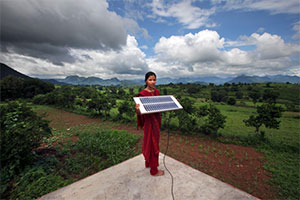 Bringing clean energy to rural India. Credit: Abbie Trayler-Smith / Panos Pictures / Department for International Development
Large reserves of oil, gas and minerals in developing countries generate opulent revenues. They could be used to stimulate economic growth and reduce poverty, but often result in environmental destruction and conflict, benefiting large companies and corrupt governments. Furthermore, competition over natural resources often manifests through geopolitical conflict. For example, before the US-Iraq war, Iraq’s domestic oil industry was nationalized. With US aggression came weakened Iraqi institutions and foreign intervention, thus eventually leading to the privatization of Iraqi oil, leaving the industry now largely dominated by Western companies. As another example, China’s rising investments within the lithium sector in South America are increasing the US-China rivalry across the Western Hemisphere. Notably, Bolivia has the largest reserves of lithium in the world, and the nation’s state-owned lithium extraction firm recently signed a contract with China’s CBC Consortium, while rejecting the entry of Western firms into the nation. In Bolivia’s case, rising Chinese investment in the nation’s lithium sector also raises concerns about environmental sustainability and the sociopolitical rights of Indigenous communities. More broadly, Sub-Saharan Africa holds nearly 30% of global reserves of critical minerals required for low-carbon technologies. Despite this, the region attracts less than 10% of global exploration investment, depicting a critical barrier to both the clean energy transitions and Sub-Saharan Africa’s economic development. Furthermore, resource wealth continues to fuel conflict like Sudan’s civil war, which has led to 9.1 million internally displaced people and is intensely connected to competition over gold, water, and agricultural land. IPS covers news about major oil, gas, and mining projects, their effects on the environment and local communities, and the ideas and actions of the interest groups involved.

The Week with IPS

NEXT STOP - SDGs
Tracking global progress towards a sustainable world
Tracking global progress towards a sustainable world
