Languages
Sunday, November 15, 2026



News and Views from the Global South
Natural Resources

India Strives to Become ‘Drought Proof’
In a country of 1.2 billion people, the threat of drought takes on epic proportions. Over a period of two centuries (between 1801 and 2002), India experienced 42 severe droughts, according to the Indian Space Research Organisation. One of these, in 1979, cut food grain production by 20 percent; another, in 1987, damaged 58.6 million hectares of cultivated land, affecting 285 million people.
Honesty to Contest Pakistan Elections
A new politics of honesty – and of campaigning for honesty – is surfacing in Pakistan. Its two prominent fronts are both Pakistanis who carry also a strong foreign stamp. What many within the country find more encouraging is the strong support people are giving them.
Across U.S., Health Concerns Vie with Fracking Profits
Peter “Pete” Seeger is a 93-year old U.S. folk legend who resides near Wappingers Falls in southern New York. He can be spotted occasionally on the traffic-heavy Route 9, flanked by world peace signs and armed with a banjo.
U.S. Abstains on Controversial World Bank Mongolia Mine Project
The United States has refused to vote for involvement by the World Bank Group in a massive but controversial mining project in Mongolia.Fishing Labour Out of the Dark Ages
When Ko Mynt fled poverty in Myanmar for a job in neighbouring Thailand, the thought of labouring long hours in a shrimp peeling shed was far from his mind. So was this seaside town south of Bangkok. The 29-year-old had set his sights on employment in a garments factory.
At the Bottom of Lake Nyasa is ‘Rare Earth’
The local Tanzanian community bordering Lake Nyasa is no nearer to understanding what the conflict between their country and Malawi is about, nor why so much is at stake, as mediation efforts between Malawi and Tanzania are expected to begin soon.For Iran and Pakistan, Energy Trumps Enmity
Iran appears to be putting its immediate economic and strategic needs ahead of religious solidarity as it seeks to promote ties with neighbouring Pakistan.
Putting Local Climate Know-How on the Map
A new weapon in the arsenal against climate change is tapping local knowledge to bridge the policy gap and let communities make their own informed decisions about how to manage livelihoods, natural resources, culture and heritage.
Indigenous Community Takes Forest Law into Own Hands
An indigenous community in Brazil has decided to single-handedly take action against illegal loggers who are moving into their territory in search of highly valued timber.
Two Million People Hold their Breath Over Lake Malawi Mediation
Over two million families who solely depend on Lake Malawi for their livelihoods are anxiously putting their hopes into an upcoming mediation between Malawi and Tanzania intended to put an end to a longstanding ownership dispute.
Draft Assessment of Tar Sands Pipeline “Devastatingly Cynical”
The U.S. State Department late Friday released a draft environmental impact assessment of a contentious pipeline project that simultaneously acknowledged the dangers posed by climate change while also noting the project would “not likely result in significant adverse environmental effects”.China Maps Out Venezuela’s Valuable Mining Resources
An agreement signed by the government of Venezuela and the Chinese state-owned company Citic Group for prospecting and mapping the country's mining reserves is being challenged by both the opposition and experts who argue that it will leave valuable natural resources dangerously exposed.
Lake Malawi Dispute Instils Fear in Fisherfolk
Since he was nine years old, Martin Mhango from Karonga village in northern Malawi has known no other livelihood than fishing. And for the last 33 years he has been fishing freely on Lake Malawi – that is, until last October when he was detained and beaten by Tanzanian security forces.
Profits Before Safety in Pakistan’s Factories
Twenty-seven-year-old Muhammad Arif works at a steel re-rolling mill in Lahore, capital of Pakistan’s northeastern Punjab province, producing steel ingots from scrap.
Peace and Dead Sea at a New Low
Two of the three main objectives of the Red Sea-Dead Sea canal project grapple with how to “save the Dead Sea” and “build a symbol of peace in the region.” With Israeli-Palestinians relations and the Dead Sea at an all time low, questions arise whether the ‘Red-Dead Canal’ (as it is known in environmental jargon) could save not only the hyper-saline desert lake but peace itself.
More Dead Than Red
The World Bank has declared the Red Sea-Dead Sea canal project feasible. Designed to “save the Dead Sea”, “desalinate water and/or generate hydroelectricity at affordable prices in Jordan, Israel and the Palestinian Authority”, and “build a symbol of peace in the Middle East”, the scheme, green groups warn, is fraught with environmental hazards.
Haitian Senate Calls for Halt to Mining Activities
Outraged that they have not been consulted, this week Haitian senators called for a moratorium on all activities connected with recently granted gold and copper mining permits.
Open Pit Miners Strike in Colombia
Two weeks into an indefinite strike called by workers at Cerrejón, one of the largest open-pit coal mines in the world, the company has agreed to sit down again and negotiate with Colombia's National Union of Coal Industry Workers (Sintracarbón).Israeli Licence to Cheney-Linked Energy Firm on Golan Heights Raises Eyebrows
In a potential new source of contention between President Barack Obama and Israeli Prime Minister Benjamin Netanyahu, Israel has reportedly granted a U.S. energy firm with heavyweight political connections to explore for oil and gas in the occupied Golan Heights.
Biofuels Converting U.S. Prairielands at Dust Bowl Rates
The rush for biofuels in the United States has seen farmers converting the United States' prairie lands to farms at rates comparable with deforestation levels in Brazil, Malaysia and Indonesia – rates not seen here since the Dust Bowl of the 1930s.
India Undercuts Tribal Rights
Over a decade ago, the Dongria Kondh tribe – tucked away in the Niyamgiri hills, a mountain range in the eastern Indian state of Orissa – found itself under attack.« Previous Page — Next Page »


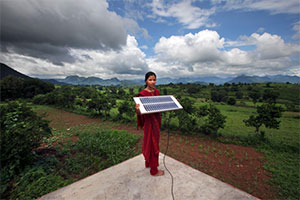 Bringing clean energy to rural India. Credit: Abbie Trayler-Smith / Panos Pictures / Department for International Development
Large reserves of oil, gas and minerals in developing countries generate opulent revenues. They could be used to stimulate economic growth and reduce poverty, but often result in environmental destruction and conflict, benefiting large companies and corrupt governments. Furthermore, competition over natural resources often manifests through geopolitical conflict. For example, before the US-Iraq war, Iraq’s domestic oil industry was nationalized. With US aggression came weakened Iraqi institutions and foreign intervention, thus eventually leading to the privatization of Iraqi oil, leaving the industry now largely dominated by Western companies. As another example, China’s rising investments within the lithium sector in South America are increasing the US-China rivalry across the Western Hemisphere. Notably, Bolivia has the largest reserves of lithium in the world, and the nation’s state-owned lithium extraction firm recently signed a contract with China’s CBC Consortium, while rejecting the entry of Western firms into the nation. In Bolivia’s case, rising Chinese investment in the nation’s lithium sector also raises concerns about environmental sustainability and the sociopolitical rights of Indigenous communities. More broadly, Sub-Saharan Africa holds nearly 30% of global reserves of critical minerals required for low-carbon technologies. Despite this, the region attracts less than 10% of global exploration investment, depicting a critical barrier to both the clean energy transitions and Sub-Saharan Africa’s economic development. Furthermore, resource wealth continues to fuel conflict like Sudan’s civil war, which has led to 9.1 million internally displaced people and is intensely connected to competition over gold, water, and agricultural land. IPS covers news about major oil, gas, and mining projects, their effects on the environment and local communities, and the ideas and actions of the interest groups involved.

The Week with IPS

NEXT STOP - SDGs
Tracking global progress towards a sustainable world
Tracking global progress towards a sustainable world
