Languages
Sunday, November 15, 2026



News and Views from the Global South
Natural Resources

Rich Countries Drag Feet at Climate Talks
Another week of international climate negotiations ended in Bonn, Germany last Friday, but there was little mid-level bureaucrats could do when world leaders remain in thrall to the fossil fuel industry, say environmentalists.
From Herders to Cultivators
 When the food-strapped Democratic People’s Republic of Korea (DPRK) appealed to the Mongolian government for food last month, it signaled a major turning point in the public image of this Central Asian country, which has long struggled to feed its own population of three million.

Imminent Outbreak of Violence on Brazilian Amazon Estate
A fresh outbreak of violence between large landowners and landless peasants is looming in the Amazonian state of Pará, in northern Brazil.
Ecuador’s Indigenous People Still Waiting to Be Consulted
The Constitution of Ecuador adopted in 2008 establishes a broad range of rights for indigenous peoples and nationalities, including the right to prior consultation, which gives them the opportunity to influence decisions that affect their lives.
Aiming to Conserve Energy, Antigua Turns to Its Residents
In drought-plagued Antigua, where water and energy top the list of most precious resources, one campaign is encouraging islanders to conserve both of these commodities.
Opinions Deeply Divided Over Fracking in Argentina
The enthusiasm of the government and oil and gas companies over Argentina’s unconventional fuel potential has come up against fierce opposition from communities living near the country’s shale gas reserves and environmental organisations.
Bolivian Entrepreneur Helps Quinoa Shine in U.S.
Ana Chipana, from Bolivia, did not like eating quinoa when she was a girl. But this grain-like crop native to the Andes was her ticket to becoming a successful entrepreneur who has visited NASA and the United Nations.
U.N. Recognises Wildlife Trafficking as “Serious Crime”
Environment groups are applauding a new United Nations decision to officially characterise international wildlife and timber trafficking as a serious organised crime, in a move that advocates say will finally give international law enforcement officials the tools necessary to counter spiking rates of poaching.
Leave It in the Ground, Climate Activists Demand
Nearly 70 percent of known reserves of oil, gas and coal must remain in the ground to avoid dangerous climate change. So why did the energy industry spend 674 billion dollars in 2012 looking for more?
Greeks Fight Canadian Gold-Diggers
Any sense of tranquility that hangs around the mountain of Skouries in northern Greece, 80 km east of Greece’s second largest city Thessaloniki, is a façade. Home to some of the oldest forests in Greece, the pristine region is now a battleground, as the local population takes on the Canadian mining giant Eldorado Gold Corporation and its local subsidiary, Hellas Gold.
Carbon Credits Could Finance Improved Cookstoves in Mexico
Environmental organisations in Mexico are hoping to finance the promotion of fuel-efficient wood-fired cookstoves, which reduce harmful greenhouse gas emissions, through the sale of carbon credits on the voluntary market.
Come Grab Our Land
Bordered by a rubber plantation in the west, a forestry plantation in the east and a palm oil farm in the south, the 18 local communities that live in Ocean Division, southern Cameroon, have had an uphill struggle for the rights to their land.
Krill Super-Trawlers Pushing Penguins Toward Extinction
Everyone loves penguins, but few will know that Thursday is World Penguin Day. Fewer still are those who know penguins are threatened with extinction by climate change and giant fishing trawlers from Europe and Asia stalking the oceans around Antarctica.
Caribbean Tourism Stakes Salvation on Greener Policies
Tourism, widely regarded as the mainstay of Caribbean economies, is being challenged to remain sustainable in an era of climate change and its impact on beaches, rivers and other attractions.
U.S., Others Wrangle over Future Arctic Governance
With climate change rapidly opening up new opportunities for shipping and resource extraction across the once permanently frozen Arctic, the United States and other northern countries are being compelled to re-examine their policies, both national and collective, towards this region of growing geostrategic importance.
U.S. Regulator Lodges “Environmental Objections” to Keystone Plan
Advocacy groups here are applauding the publication of new government concerns, formally expressed Monday by the U.S. Environmental Protection Agency (EPA), over a recent assessment of the environmental impact of a major oil pipeline that would run between Canada and the U.S. Gulf Coast.Mining and Logging Companies “Leaving Chile without Water”
More than 100 environmental, social and indigenous organisations protested Monday in the Chilean capital to demand that the state regain control over the management of water, which was privatised by the dictatorship in 1981.
Activist Shareholders Slam Brazilian Mining Giant
Representatives of social movements and communities affected by Brazilian mining company Vale's operations have bought shares in the company, to make their voices heard.
Mexico Lacks Water to Frack for Shale Gas
Mexico plans to expand shale gas exploration this year, but it could run into a shortage of water, which is essential to hydraulic fracturing or fracking, the method used to capture natural gas from shale rocks.U.S. Kiobel Decision Bucks 30 Years of Precedent
The U.S. Supreme Court has dismissed a lawsuit against the Royal Dutch Shell Petroleum Company brought by alleged human rights victims.
Time to Decolonise the World Social Forum
When participants at the 2011 World Social Forum in Dakar, Senegal, received word that former Egyptian President Hosni Mubarak had stepped down, swept away by a wave of popular resistance that brought millions of Egyptians into the streets, few could contain their joy.« Previous Page — Next Page »


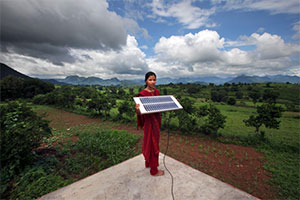 Bringing clean energy to rural India. Credit: Abbie Trayler-Smith / Panos Pictures / Department for International Development
Large reserves of oil, gas and minerals in developing countries generate opulent revenues. They could be used to stimulate economic growth and reduce poverty, but often result in environmental destruction and conflict, benefiting large companies and corrupt governments. Furthermore, competition over natural resources often manifests through geopolitical conflict. For example, before the US-Iraq war, Iraq’s domestic oil industry was nationalized. With US aggression came weakened Iraqi institutions and foreign intervention, thus eventually leading to the privatization of Iraqi oil, leaving the industry now largely dominated by Western companies. As another example, China’s rising investments within the lithium sector in South America are increasing the US-China rivalry across the Western Hemisphere. Notably, Bolivia has the largest reserves of lithium in the world, and the nation’s state-owned lithium extraction firm recently signed a contract with China’s CBC Consortium, while rejecting the entry of Western firms into the nation. In Bolivia’s case, rising Chinese investment in the nation’s lithium sector also raises concerns about environmental sustainability and the sociopolitical rights of Indigenous communities. More broadly, Sub-Saharan Africa holds nearly 30% of global reserves of critical minerals required for low-carbon technologies. Despite this, the region attracts less than 10% of global exploration investment, depicting a critical barrier to both the clean energy transitions and Sub-Saharan Africa’s economic development. Furthermore, resource wealth continues to fuel conflict like Sudan’s civil war, which has led to 9.1 million internally displaced people and is intensely connected to competition over gold, water, and agricultural land. IPS covers news about major oil, gas, and mining projects, their effects on the environment and local communities, and the ideas and actions of the interest groups involved.

The Week with IPS

NEXT STOP - SDGs
Tracking global progress towards a sustainable world
Tracking global progress towards a sustainable world
