Languages
Tuesday, September 29, 2026



News and Views from the Global South
South-South

Brazilian Innovation for Under-financed Mozambican Agriculture
Some of the technological excellence that revolutionised Brazil’s tropical agriculture is reaching small producers in Mozambique. But it is not enough to compensate for the underfinancing of the sector.
Bachelet to Recalibrate Chile’s Foreign Policy
For the past four years, the foreign policy of Chile, South America’s “miracle”, has focused more on economic than political issues.
G20 Urges U.S. Action on IMF Reforms by April
The Group of 20 (G20) industrialised and emerging economies on Sunday formally expressed frustration with the ongoing inability of the United States to approve a major reform package that would see governance at the International Monetary Fund (IMF) shift more towards developing countries.
South-South Cooperation Takes Off in Arab World
As the concept of South-South cooperation (SSC) continues to strengthen worldwide, some of the richest countries in the Arab world have been reaching out to the poor and the needy in the developing world.
CELAC Summit Targets Inequality
Heads of state and government at the Second Summit of the Community of Latin American and Caribbean States (CELAC) made a joint commitment to reduce poverty, hunger and inequality, and declared their region a “zone of peace”.
Digital Age Demands Educational Transformation, World Forum Says
The challenges of the digital age call for schools to develop an alternative model of education, with teachers who incorporate new technology and employ a more critical pedagogy, participants said at the Fórum Mundial de Educaçao (World Education Forum) in this southern Brazilian city.
Bike Paths, BRT Going Strong in Latin American Cities
Sustainable transport grew in the Latin American cities of Buenos Aires, Mexico City and Rio de Janeiro in 2013.
Women Farmers in Chile to Teach the Region Agroecology
An organisation that brings together some 10,000 peasant and indigenous women from Chile is launching an agroecology institute for women campesinos, or small farmers, in South America.
More Vehicles in Latin America – More Deaths
The family of Susana Suárez, a 35-year-old Venezuelan dentist, are still in shock over her death in a traffic accident in May. She and a friend were killed on their way back from the beach, and became just two more of the 130,000 victims who died on Latin America’s roads in 2013.
Keeping the Grass Greener for African Plant Breeders
For the few plant breeders in Africa like Vivian Oduro, working for an international research institution is an obvious choice, with prestige and benefits any agricultural scientist would find hard to decline.
Tallying Losses, St. Vincent Begins Repairs After Deadly Flood
Ralph Gonsalves fought to hold back tears as he shared how his cousin was killed the night before Christmas.
Farmers in Mozambique Fear Brazilian-Style Agriculture
Rodolfo Razão, an elderly small farmer in Mozambique, obtained an official land usage certificate for his 10 hectares in 2010, but he has only been able to use seven. The rest was occupied by a South African company that grows soy, maize and beans on some 10,000 hectares in the northeast of the country.Glaring Asymmetries in Bali Accord
As industrialised countries celebrate the World Trade Organisation’s Bali accord, the developing and the least-developed countries are forced to carry their battle to another day after securing only half-baked results and grandiose promises, said several trade ministers.Illicit Capital Leaving Developing Countries Up by 14 Percent
Developing countries are likely losing more than a trillion dollars a year in "illicit financial flows" stemming from crime and corruption, according to new estimates. This fast-rising figure is already 10 times the total amount of foreign aid these countries are receiving.Turkmenistan & Uzbekistan: Cold Leaders, Warm Ties
Two of the most despotic leaders in the world sit atop the governments of Turkmenistan and Uzbekistan, according to rights groups. But in sharp contrast to the way they regard their respective peoples, Turkmenistan’s Gurbanguly Berdymukhamedov and Uzbekistan’s Islam Karimov seem to treat each other with courtesy and respect when they get together.
Where Is the Global Economy Heading?
In a passage in Charles Darwin’s The Voyage of the Beagle, he condemns an egalitarian native people at the tip of South America to remain primitive.
Food Security, Trade Facilitation Clash in Bali
The World Trade Organisation’s ninth ministerial meeting at Bali, Indonesia has morphed into a fierce battle between the countries seeking social safety nets for hundreds of millions of poor people and those insisting on having advanced import-facilitation programmes in the developing countries on par with the industrialised nations.
The Asia-Africa Link Is IT
Only 16 percent of Africa’s population of over a billion is online. But as Internet and mobile phone connectivity grows rapidly, the continent wants to join forces with Asian powerhouses to change its digital landscape.
Egypt Begs Gulf for Rescue
“Subsidies from the Arab world are large and reflect Arabs’ love towards the Egyptian people, but we cannot depend on that to build an economy that can compete with other countries,” said economist Dr Alia el Mahdi.
Global Trade Winds Leave the Poor Gasping
For years, it was the power chamber at the headquarters of the World Trade Organisation (WTO) in Geneva - the Director General’s Conference Room, more popularly known as the Green Room, where a handful of delegates would gather for important discussions and meetings.
CARICOM Chastises Dominican Republic over Deportations
Outraged at a court ruling that would potentially render stateless thousands of Dominican people of Haitian descent, the Caribbean Community on Tuesday suspended the Dominican Republic's bid to join the 15-member regional grouping.« Previous Page — Next Page »


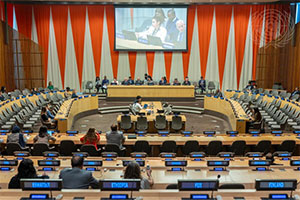 Panel Discussion on International Day for South-South Cooperation 2023. Credit: UN Photo/Cia Pak
South-South cooperation – collaboration between developing countries – is a growing and dynamic phenomenon, an important process that is vital in confronting shared challenges. Led by emerging giants, India, Brazil and South Africa (IBSA), the Global South is a tremendous source of tested solutions to development challenges, including the Millennium Development Goals (MDGs). China’s Belt and Road Initiative (BRI), launched in 2013, has further transformed South-South cooperation by enhancing infrastructure, trade, and investment linkages across Asia, Africa, and Latin America. Meanwhile, new platforms like the expansion of BRICS to include other countries such as Thailand, Nigeria, and Cuba are reshaping global economic governance and offering alternatives to traditional Western-led institutions. The Nairobi Outcome of the 2009 High-Level United Nations Conference on South-South Cooperation in Nairobi, Kenya highlights growing political and economic ties within the developing world, as countries from the Global South assume leading roles in decision-making on hot global issues ranging from economic recovery to food security, energy transitions, debt relief, and climate change. Today, the African Continental Free Trade Area and India’s “Voice of the Global South” summits have advanced frameworks for regional self-reliance, while G77 has reaffirmed commitments to resilient and inclusive economies ahead of the 16th UN Conference on Trade and Development.
Updated by Yilan Batista and Shuli Wong August 2026

The Week with IPS

NEXT STOP - SDGs
Tracking global progress towards a sustainable world
Tracking global progress towards a sustainable world
