Languages
Friday, October 9, 2026



News and Views from the Global South
North America

Harper Playing Defence in Canada’s Pipeline Politics
Canada’s tar sands oil boom may be in jeopardy and it appears the ruling Conservative government of Prime Minister Stephen Harper does not have any plan B in its ambition to remake this resource-rich country into “an energy superpower.”U.S. to Create National Plan on Responsible Business Practices
The United States will begin developing a national action plan on responsible business practices, following on several years of related advocacy from civil society.
Championing Ocean Conservation Or Paying Lip Service to the Seas?
President Barack Obama this week extended the no-fishing areas around three remote pacific islands, eliciting praise from some, and disappointment from those who fear the move did not go far enough towards helping depleted species of fish recover.
Obama Mandates Climate Resilience in All U.S. Development Projects
All international development assistance and investments from the United States will now be required to take into account the potential impacts of climate change, according to a new rule signed Tuesday by President Barack Obama.
“No Planet B”: Marchers Demand Swift Action on Climate Change
 On Sunday, Sep. 21, at least 300,000 people filled the streets of New York City ahead of the U.N. General Assembly and special one-day Climate Summit Sep. 23 to protest the ongoing lack of political will to cut global CO2 emissions and kick-start a greener economy. They came by bus and bike and train. They came with their kids -- some in strollers, others old enough to proudly carry signs. By afternoon, it had become clear that the march in New York was the biggest climate-change gathering in history. Protesters also turned out in more than 150 other cities around the world.

Surprisingly Equal, Surprisingly Unequal
Thomas Piketty, a French economist who works on wealth and income inequality, has triggered a debate on the distribution of income and wealth in many countries. This is no small issue because views on income inequality and concomitant redistributive preferences are crucial to the design of tax and transfer systems.
Declining Majority Still Supports “Active” U.S. Role in World Affairs
Despite elite concerns about growing “isolationism” in the U.S. electorate, nearly six in 10 citizens believe Washington should “take an active part in world affairs,” according to the latest in a biennial series of major surveys of U.S. foreign-policy attitudes.
ISIS Carrying Out Ethnic Cleansing on “Historic Scale”
While the administration of U.S. President Barack Obama ponders broader actions against the Islamic State of Iraq and Syria (ISIS), Amnesty International Tuesday accused the group of carrying out ethnic cleansing in Iraq on a “historic scale.”
Criminalisation of Homelessness in U.S. Criticised by United Nations
A United Nations panel reviewing the U.S. record on racial discrimination has expressed unusually pointed concern over a new pattern of laws it warns is criminalising homelessness.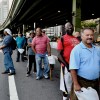
New York’s Homeless Pushed Deeper into the Shadows
Joe sits on newspapers spread on the sidewalk by the entrance to midtown's Grand Central Station. His head rests in his hands, only looking up when coins from passersby clink into his paper cup.
Despite Current Debate, Police Militarisation Goes Beyond U.S. Borders
The shooting of an unarmed black teenager by a white police officer in the southern United States earlier this month has led to widespread public outrage around issues of race, class and police brutality.
Protecting America’s Underwater Serengeti
U.S. President Barack Obama has proposed to more than double the world’s no-fishing areas to protect what some call America’s underwater Serengeti, a series of California-sized swaths of Pacific Ocean where 1,000-pound marlin cruise by 30-foot-wide manta rays around underwater mountains filled with rare or unique species.
Minimum Wage, Minimum Cost
In 1958, when New York State was considering raising its minimum wage, merchants complained that their profit margins were so small that they would have to cut their work forces or go out of business. In 2014 in Seattle at hearings on a proposed minimum wage increase, some businesses voiced the same fears.
More U.S. Diplomas Come with Crushing Debts
Leah Hughes has big dreams of becoming a community organiser in Appalachia. A rising senior at the California-based Scripps College, Hughes is pursuing a dual degree in International Relations and Studio Art, and is incredibly thankful for her higher education experience thus far.
The ‘Global’ Land Rush
The first years of the twenty-first century will be remembered for a global land rush of nearly unprecedented scale.
Under Water: The EPA’s Struggle to Combat Pollution
For years, the U.S. Environmental Protection Agency (EPA) has been frustrated in its efforts to pursue hundreds of cases of water pollution — repeatedly tied up in legal fights about exactly what bodies of water it has the authority to monitor and protect.
Thousands of New Yorkers Protest Gaza Killings
Thousands of New Yorkers took to the streets in multiple protests this past week against the Israeli offensive in Gaza, which has left at least 1,049 Palestinians dead and over 6,000 injured since Jul. 8.
Child Migrants – A “Torn Artery” in Central America
The migration crisis involving thousands of Central American children detained in the United States represents the loss of a generation of young people fleeing poverty, violence and insecurity in Honduras, Guatemala and El Salvador, the countries of the Northern Triangle of Central America where violence is rife.U.S., Obama’s Image Remains Positive Worldwide
While Republicans and other right-wingers claim that President Barack Obama has inflicted unprecedented damage on Washington’s global reputation, a major new global survey suggests that the image of the U.S. remains generally positive.
Major Companies Push for More, Easier Renewable Energy
Some of the largest companies in the United States have banded together to call for a substantial increase in the production of renewable electricity, as well as for more simplicity in purchasing large blocs of green energy.
Europe and the United States, Allies in Crisis
A few decades ago, even before the end of the Cold War and before and after Ronald Reagan’s election to the White House, analyses regularly referred to U.S. decadence. At other times, it was Europe’s turn for pessimistic descriptions, especially when it could not overcome its ambivalence over deepening integration, and above all because of the failure of its constitutional project.« Previous Page — Next Page »





The Week with IPS

NEXT STOP - SDGs
Tracking global progress towards a sustainable world
Tracking global progress towards a sustainable world
