Languages
Monday, August 10, 2026



News and Views from the Global South

Women of Haitian Descent Bear the Brunt of Dominican Migration Policy
A middle-aged woman arranges bouquets of yellow roses in a street market in Little Haiti, a slum neighbourhood in the capital of the Dominican Republic. “I don’t want to talk, don’t take photos,” she tells IPS, standing next to a little girl who appears to be her daughter.
Over $10 Billion in Aid Pledges at Syria Donor Conference
More than $10 billion were pledged as humanitarian aid for war-ravaged Syria at the fourth international donor conference in London.After 20 Years, Nuclear Test Ban Treaty Still in Political Limbo
After nine years in office, UN Secretary-General Ban Ki-moon will step down in December perhaps without achieving one of his more ambitious and elusive political goals: ensuring the entry into force of the Comprehensive Nuclear-Test-Ban Treaty (CTBT).
“A Fair Day’s Wage for a Fair Day’s Work?”
“During the first months in Italy, I always prayed for rain. I spent hours checking the weather forecast” said Roni, a 26 year old graduate from a middle-income family in Bangladesh. His father, a public servant and his mother a home maker, Roni had to sell umbrellas on the streets of Rome for more than a year before finding a summer job by the sea at a coffee shop, popularly known as a ‘bar’ in Italy.
Europe is disintegrating while its citizens watch indifferent
We are witnessing the slow agony of the dream of European integration, disintegrating without a single demonstration occuring anywhere, among its 500 millions of citizens. It is clear that European institutions are in an existential crisis but the debate is only at intergovernmental level.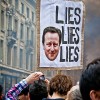
Cameron at large: Want Not to Become a Terrorist? Speak Fluent English!
“Do you speak English fluently? No? Then you risk to become a terrorist!.” IPS posed this dilemma to some young Muslim women living in Cairo, while explaining that this appears to be UK prime minister David Cameron's formula to judge the level of Muslim women's risk to fall, passively, into the horrific trap of extremism.
Turkey descends into civil war as conflict in southeast escalates
The latest footage to come out of Sur, the historical district in Diyarbakir that has been under total lock down by Turkish armed forces for the past sixty days, shows a level of devastation one would sooner expect in Syria. In more ways than one – empty streets lined with debris, bombed-out buildings, tanks and soldiers shooting at invisible assailants – the situation in Turkey's predominantly Kurdish southeastern regions resembles a war zone.
2 Billion Couples and 10 Relationship Challenges
The relationship challenges that the world’s 2 billion couples confront vary considerably by circumstances, including age, sex, education, income, marital status, family size, length of relationship, urban-rural residence, customs, religion and region of the world. Nevertheless, 10 major challenges among married and cohabiting couples may be identified across countries.
Small-scale Fishing Is About Much More than Just Subsistence in Chile
“Fishing isn’t just for making a living, it’s also enjoyable,” said Pedro Pascual, a 70-year-old fisherman who has been taking his small boat out to sea off Chile’s Pacific coast in the early hours of the morning almost every day for the past 50 years, to support his family.
Women’s Empowerment Will Accelerate Kenya’s Economic Prosperity
When President Barack Obama made his first visit to Kenya as US President in July 2015, one of the poignant messages he left was an exhortation for communities to shun cultures that degrade women and girls.
Media Come Together to Discuss Safety of Journalists, Fight Against Impunity
Amid continuing attacks on journalists, media representatives from around the world will meet in the French capital this week to discuss how to reinforce the safety of those working in the sector. Organized and hosted by the United Nations cultural agency, UNESCO, this “unprecedented” meeting between media executives and the agency’s members states on Feb. 5 is an attempt to “improve the safety of journalists and tackle impunity for crimes against media professionals”, UNESCO said.
UN Hails Myanmar’s Historic New Parliament
When U.Thant of Burma (now Myanmar) was elected UN Secretary-General back in November 1962, he was the first Asian to hold that post after Trygve Lie of Norway and Dag Hammarskjold of Sweden. The appointment was also a historic moment for Asia, which waited for 45 long years for the second Asian to hold that position: Ban Ki-moon of South Korea, the current UN Secretary-General, who was elected in January 2007.
Rabbit Farming Now a Big Hit in Zimbabwe
Tichaona Muzariri, 44, a villager based at Range in Chivhu, a town 143 kilometers south of Harare, the Zimbabwean capital, quit his job as a teacher in 2009 to start a rabbit farm on a small scale with three does (female rabbits) and one buck (male). With around US$30 as capital, Muzariri waded into rabbit farming back then. Today, his rabbit farm breeds nearly 3,000 rabbits every year and slaughters up to 120 every week for sale to grocery stores, restaurants and hotels.

Brazil Wages War against Zika Virus on Several Fronts
Brazil is deploying 220,000 troops to wage war against the Zika virus, in response to the alarm caused by the birth of thousands of children with abnormally small heads. But eradicating the Aedes aegypti mosquito requires battles on many fronts, including science and the pharmaceutical industry.
TPP: Lessons from New Zealand
A new paper* on the implications of the Trans-Pacific Partnership (TPP) Agreement for New Zealand examines key economic issues likely to be impacted by this trade agreement. It is remarkable how little TPP brings to the table. NZ’s gross domestic product will grow by 47 per cent by 2030 without the TPP, or by 47.9 per cent with the TPP. Even that small benefit is an exaggeration, as the modelling makes dubious assumptions, and the real benefits will be even smaller. If the full costs are included, net economic benefits to the NZ economy are doubtful. The gains from tariff reductions are less than a quarter of the projected benefits according to official NZ government modelling. Although most of the projected benefits result from reducing non-tariff barriers (NTBs), the projections rely on inadequate and dubious information that does not even identify the NTBs that would be reduced by the TPP!
Tackling Climate Change in the Caribbean: Natural Solutions to a Human Induced Problem
The world is still celebrating the Paris Agreement on Climate Change, the main outcome of the 21st Conference of the Parties of the United Nations Framework Convention on Climate Change. Its ambitions are unprecedented: not only has the world committed to limit the increase of temperature to “well below 2°C above pre-industrial levels,” it has also agreed to pursue efforts to “limit the temperature increase to 1.5 °C.”Ebola Recovery Funds Impossible to Track, Says New Study
When the Ebola epidemic devastated three West African countries – Liberia, Sierra Leone and Guinea two years ago – the international community responded with pledges of over $5.8 billion in funds to fight the disease which has killed over 11,300 people.
United Arab Emirates Strengthens Ties with Argentina’s New Government
The new government of Argentina and the United Arab Emirates (UAE) are strengthening the relationship established by the previous administration, at a time when this South American country is seeking to bring in foreign exchange, build up its international reserves and draw investment, in what the authorities describe as a new era of openness to the world.
Women’s Rights First — African Summit
Despite the enormous challenges facing Africa now, the leaders of its 1.2 billion plus inhabitants have decided to spotlight the issue of Human Rights With a Particular Focus on the Rights of Women in their 26th summit held in Addis Ababa on 21-31 January this year. Why?
Combating HIV among Teens
Keziah Juma is coming to terms with her shattered life at the shanty she shares with her family in Kenya’s sprawling Kibera slum where friends and relatives are gathered for her son’s funeral arrangements. While attending an antenatal clinic, Juma who is only 16 years discovered that she had been infected with HIV. “I went into shock and stopped going to the clinic, that is why they could not save my baby and I have been bed-ridden since giving birth two months ago,” she told IPS.Core Principals of Climate Finance to Realize the Paris Agreement
The Paris climate change conference brought together 197 countries and over 150 Heads of State – the largest convening of world leaders in history – to agree on measures and work together to limit the global average temperature rise.« Previous Page — Next Page »


The Week with IPS

NEXT STOP - SDGs
Tracking global progress towards a sustainable world
Tracking global progress towards a sustainable world
