Languages
Sunday, November 8, 2026



News and Views from the Global South
Active Citizens
In the Land of the Gods, Disaster Response Falls Short of Divine
Over 580 bodies have so far been found. Hundreds more will likely never turn up. Survivors say they are suspended in a kind of nightmare, either haunted by memories of their brush with death or desperate for news of loved ones. At least 3,000 are reported to be missing.
San Francisco Pride Draws Huge Crowd, Critics
Sporting wedding gowns, tuxedos, leather, beads, bangles, union t-shirts and Free Bradley Manning buttons – and some wearing just about nothing at all – some 1.5 million people poured into downtown San Francisco Sunday to celebrate lesbian-gay-bisexual-transgender pride.Snowden Defies White House, Still Caught in Limbo
Late on Monday night, Sarah Harrison, a Wikileaks activist, hand-delivered 21 letters to Kim Shevchenko, the duty officer at the Russian consulate office in Moscow's Sheremetyevo airport, on behalf of Edward Snowden, the U.S. National Security Agency (NSA) whistleblower.Donations Sound the New Note
The global economic crisis has not hit Serbia for the first time, but this year it has bitten into Serbian culture. State subsidies for theatres, festivals, films and exhibitions have almost hit the bottom. State support for films is down to zero.
Faster Development Needed to Sustain Decade of Gains in Brazil
After 10 years of social and economic gains thanks to successful employment and public investment policies and anti-poverty programmes, Brazil is facing the challenge of broadening and accelerating a model of development that includes, for instance, the young people protesting on the country’s streets.
Obama Calls for Compromise in Egyptian Crisis
U.S. President Barack Obama Monday called for both the Muslim Brotherhood-dominated government of Egyptian President Mohamed Morsi and opposition forces to compromise in the fast-developing political crisis.
Media Scholars Decry Financial Crisis, Call for Action
Communications scholars from around the world deplored the global financial crisis and called on their peers to take more active roles in the search for solutions at a recent four-day conference in Dublin, Ireland.
The New Fascism
The atrocious Second World War left behind lasting damage by lowering our standards for what is marginally acceptable.
Tunisia Tiring of Transition
In the third year after the revolution that toppled former dictator Ben Ali, true democracy is still work in progress in Tunisia.
Spring Brings Differing Fruits for Tunisian Women
The revolution that ousted dictator Ben Ali in January 2011 brought new, hard-won freedom to the Tunisian people. However as the country discovers whether secularism and growing political Islam can co-exist, some women are enjoying greater liberty to practise their religion while others are concerned that their rights may be eroded.
A President Fights His People
Egyptian President Mohammed Morsi faces massive demonstrations, but he faces also his own government on many fronts.
Tunisia Now Searches an Economic Spring
Nearly two-and-a-half years since the toppling of the autocratic regime of Zine el-Abidine Ben Ali in the first regime change of the now famous Arab Spring, the high expectations of change to come with the revolution have hardly been met.Abandoned Egypt Suffers
As supporters and opponents of Egyptian President Mohammed Morsi prepare for a face-off on Sunday, a mushrooming problem for Egypt arises from the people not there – the tourists.
Grapes of Wrath Sour Wine Market
So much about wine is a boast over its land of origin. The label reads, ‘Product of Israel’, but don’t let that deceive you. This particular Cabernet Sauvignon is produced in Israeli-occupied territory.
To Find Peace, And Then Sell It
As the month of Ramadan nears, shop owners in Sanaa’s old city souk stock up on goods. For men like Ali Al-Fakri, who sells jambiyahs, Yemen’s traditional daggers held in place with richly embroidered belts, the gift-giving holiday marking Ramadan’s end is the busiest time of the year.Native People’s Land Demands Gain Visibility in Argentina
The native people of Argentina are achieving unprecedented visibility for their demands. However, they are still faced with hurdles to more rapid progress towards their claims.
Acid Survivors Say Theirs Is a Fate Worse Than Death
Women in Pakistan are no strangers to horror. In this country of 176 million, about 90 percent of women have experienced domestic violence; every year, over 1,000 women are murdered in so-called ‘honour killings’. Two years ago, the Thomson Reuters Foundation named Pakistan the most dangerous country in the world for women and girls.Confrontation Builds Up in Cairo
Islamist President Mohamed Morsi's first turbulent year in office will end with two massive rallies in Cairo, both expected to draw hundreds of thousands: one by his mostly Islamist supporters and another by secular opposition forces who demand he step down.Polio Fear at Europe’s Door
The Ukraine is facing a “real threat” of a return of polio as well as outbreaks of other serious diseases such as mumps, rubella and measles because of a combination of state inefficiency and public mistrust of vaccinations, health experts have said.
Egypt Split ‘Between Egyptians and Islamists’
The Muslim Brotherhood realised a long cherished dream when it came to power last year. The Muslim Brotherhood had faced continuing discrimination since former president Gamal Abdel Nasser came to power in 1956 until the end of Hosni Mubarak’s days.
Cultural Engagement Key to Improving U.S.-Iran Relations – Report
Increasing U.S.-Iran cultural exchanges could lay the groundwork for better relations between the two countries, believes a prominent think tank here, despite the prevalence of stereotypical memes of the United States as the "Great Satan" and Iran as part of the "Axis of Evil".« Previous Page — Next Page »





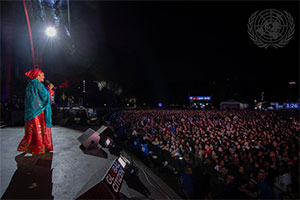 Global Citizen Festival in New York. Credit: UN Photo/Eskinder Debebe
Active citizens are committed to social change because they know that it is achievable. However, major political challenges face active citizens across the world. For example, in authoritarian regimes in Latin America where the hegemonic party has been in power for decades on end, protestors and human rights activists face enormous repression and struggle to materialize their advocacy into concrete results. The same can be said for Africans, where a shift towards elected government in recent decades has yet to translate into an effective voice in decision-making. Now, the Strengthening Citizen Demand for Good Governance, which uses evidence-based approaches – funded by DFID's Governance and Transparency Fund – seeks to raise their voices.
In 2025, the CIVICUS Monitor’s People Power Under Attack report revealed that civic freedoms are severely limited in 122 of 198 countries and territories, and only 7.2% of the global population now lives in countries where civic space is open. Through partnership with the Overseas Development Institute (ODI) and CIVICUS, IPS reporters across the continent will seek to define the extent and limits of state capability, government accountability and the responsiveness of leaders to the needs of citizens.

The Week with IPS

NEXT STOP - SDGs
Tracking global progress towards a sustainable world
Tracking global progress towards a sustainable world
