Languages
Wednesday, November 11, 2026



News and Views from the Global South
Active Citizens
Paraguay Opens Doors to Unregulated Foreign Investment
In his first month as president of Paraguay, Federico Franco has thrown open the doors of his country to foreign investments that have raised questions about environmental safety.
Military Service Leaves Culture of War Behind in Guatemala
“I feel proud to be a part of this change. Malnutrition cannot be wiped out in just two or three years, but this is the beginning and I want to be a part of it,” says Isabela Tzoc, a civic service volunteer involved in a youth programme aimed at fighting extreme poverty in Guatemala.
Orange Shadow Over Olympics
Agent Orange (AO), often called the ‘last legacy’ of the United States war in Vietnam (1955-1975), has popped up again thanks to its manufacturer Dow Chemical’s controversial sponsorship of the Olympic Games.Banksters Hijack Microfinance
For several decades, microcredit presented itself as a magical and benign financial tool for the poorest people in the world, who were otherwise completely excluded from conventional commercial banking services, to secure easy access to loans in order to set up their own businesses and live a dignified life.
Arms Trade Treaty Called a “Leaky Bucket”
As heated negotiations on a global Arms Trade Treaty near their close Friday at United Nations headquarters in New York, members of civil society as well as some U.N. member states are highly disappointed by what they call the draft text's numerous loopholes.
Silenced by U.S., Sex Workers Speak from Kolkata
Bare-chested and beaming in the company of many like him, London-based male sex worker Thierry Schaffauser wipes the beads of sweat trickling down his face on a humid Kolkata evening, and slams U.S. President Barack Obama.
Protesters: Free Trade Deals, Drug Patents Derail AIDS Fight
As the nineteenth International AIDS Conference continued in Washington Tuesday, thousands of protesters marched on the White House with a set of demands to end the epidemic.
Cultivating Toxic Crops
At a time when spiraling input costs and perennial shortages of irrigation water are breaking countless farmers’ backs, a small village community on the outskirts of Lahore appears to have been spared.Bankers or ‘Banksters’?
European media, political leaders, and the citizenry are bashing bankers again, overtly calling them at best accomplices of numerous illegal activities, at worst downright criminals.Assault on Colombian Trade Unions Continues Unabated
Two months after a free-trade agreement between the United States and Colombia went into effect, workers and activists are warning that U.S.-stipulated labour reforms have not been fully implemented and have yet to result in promised improvements in the lives of workers.Poets Caught in Political Web
As two young Azeri poets enter their 11th week in detention in Iran, efforts to secure their release are not losing steam, nor are political tensions between the two countries.
Balkans Bristles Under Turkey’s Gaze
In the decade following the break-up of Yugoslavia, it was rare for a statement made by a foreign politician to stir heated debate in the Eastern European bloc.
What Do Egyptians Know
During the uprising that ended Hosni Mubarak’s 29-year rule, Egyptian protesters stormed state security headquarters in Cairo. Inside they discovered a trove of documents – including surveillance reports on activists, transcripts of telephone conversations, and intercepted emails – that revealed the meticulous records the state kept on the activities of its citizens.
Celebrating the Olympic Ideal with a Big Mac
As the 2012 London Olympics gears up to open on Jul. 27, criticism of the longstanding partnership between the Games and sponsor McDonald’s has stolen a small portion of the limelight.
Athletes Wither Under Government Apathy
He dreamed of one day running on international athletic tracks and worked hard for seven long years to make this a reality.
Women Rights Defenders Targeted in Mexico
There has been an alarming increase over the past two years in violence against women human rights defenders and journalists in Mexico, according to women’s human rights organisations.
Impure Flows the Ganga
Every year Yogesh Mudgal treks miles through the mountainous roads of the Indian Himalayas during the holy Hindu month of Shravan, in July.
67 Minutes of Shame on African Icon Nelson Mandela’s Birthday
Wendy Hlophe* is still visibly grieving for her long-term friend, 28-year-old Sanna Supa, who was shot and killed outside her home in Braamficherville, a South African township, two weeks ago.Investigation Exposes Arms Trafficking Network in Mauritius
An investigation by the Conflict Awareness Project has exposed an active arms trading network of associates of former trafficker Viktor Bout that involves companies from the United States, South Africa and the United Kingdom, among other countries.
Family Planning Essential for Development
Improving family planning to avoid unwanted pregnancies in developing countries, as well as assuring girls’ access to education, and women’s participation in the economy, are essential components of a sound development policy, according to Western experts and African activists.Will Austerity Prompt Nuclear Disarmament?
The changing international political order and a dramatic budgetary situation at home are forcing France to consider giving up the extremely expensive nuclear arsenal the country has maintained since the late 1950s.« Previous Page — Next Page »





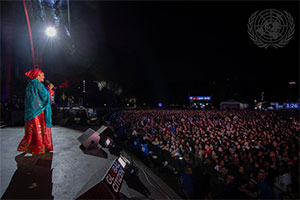 Global Citizen Festival in New York. Credit: UN Photo/Eskinder Debebe
Active citizens are committed to social change because they know that it is achievable. However, major political challenges face active citizens across the world. For example, in authoritarian regimes in Latin America where the hegemonic party has been in power for decades on end, protestors and human rights activists face enormous repression and struggle to materialize their advocacy into concrete results. The same can be said for Africans, where a shift towards elected government in recent decades has yet to translate into an effective voice in decision-making. Now, the Strengthening Citizen Demand for Good Governance, which uses evidence-based approaches – funded by DFID's Governance and Transparency Fund – seeks to raise their voices.
In 2025, the CIVICUS Monitor’s People Power Under Attack report revealed that civic freedoms are severely limited in 122 of 198 countries and territories, and only 7.2% of the global population now lives in countries where civic space is open. Through partnership with the Overseas Development Institute (ODI) and CIVICUS, IPS reporters across the continent will seek to define the extent and limits of state capability, government accountability and the responsiveness of leaders to the needs of citizens.

The Week with IPS

NEXT STOP - SDGs
Tracking global progress towards a sustainable world
Tracking global progress towards a sustainable world
