Languages
Tuesday, September 29, 2026



News and Views from the Global South
Active Citizens
Chaos Grows in Burundi as President Defies Advice to Step Down
Burundian President Pierre Nkurunziza, overriding objections to an ill-advised third term, now faces a growing popular movement to oust him after his term ends this coming June.
Moving Indigenous Land Rights from Paper to Reality
Frustrated with decades of marginalisation, and of seeing their rights respected only on paper, Indigenous peoples are calling for major recognition from the international community.
As Nuke Talks Begin, U.N. Chief Warns of Dangerous Return to Cold War Mentalities
Against the backdrop of a new Cold War between the United States and Russia, two of the world’s major nuclear powers, the United Nations is once again playing host to a four-week-long international review conference on the Nuclear Non-Proliferation Treaty (NPT).
Opinion: Progress of the World’s Women 2015-2016: Transforming Economies, Realising Rights
Our world is out of balance. It is both wealthier and more unequal today than at any time since the Second World War.
Want to Help Nepal Recover from the Quake? Cancel its Debt, Says Rights Group
The death toll has now passed 3,300, and there is no telling how much farther it will climb. Search and rescue operations in Nepal entered their third day Monday, as the government and international aid agencies scramble to cope with the aftermath of a 7.8-magnitude earthquake that struck this South Asian nation on Apr. 25.
The U.N. at 70: A Time for Compliance
At key anniversaries of the U.N., there have been calls for compliance with international instruments.
Peace Is Not a Boy’s Club
Governments have long pledged to bring more women to the peace table, but for many (if not most), it has been little more than lip service.Push to Privatise Education in Global South Challenged
The multinational education and publishing company Pearson PLC was challenged during its annual general meeting on Apr. 24 by representatives of civil society and trade union groups over various profit-driven programmes aimed at expanding private education in numerous countries in the global South.
U.N. Committee Gets ‘Unhindered Access’ to Azerbaijan’s Detention Centres – But Is it Enough?
Months after being denied access to Azerbaijan’s places of detention, the head of the United Nation’s Subcommittee on Prevention of Torture (SPT) announced Friday that her four-member delegation had successfully conducted investigations of Azerbaijani prisons, police stations and investigative isolation units.
Media Watchdog Unveils Top Ten Worst Censors
While technology has given millions greater freedom to express themselves, in the world's 10 most censored countries, this basic right exists only on paper, if at all.
Planned Mega-Port in Brazil Threatens Rich Ecological Region
Activists and local residents have brought legal action aimed at blocking the construction of a nearly 50 sq km port terminal in the Northeast Brazilian state of Bahia because of the huge environmental and social impacts it will have.
Opinion: To Solve Hunger, Start with Soil
Peter looked confused as he recounted how he’d painstakingly planted potatoes to sell and to feed his family of eight, only to find that when harvest time rolled around he had been greeted with tiny tubers not much bigger than golf balls.
Opinion: The World Has Reached Peak Plutocracy
Parents in despair because they can’t pay the fees at the privatised neighbourhood school…
Opinion: Challenging the Nuclear Powers’ Extremism
On the eve of the Nuclear Non-Proliferation Treaty (NPT) Review Conference five years ago, U.N. Secretary-General Ban Ki-moon warned that governments alone will not rid the world of the specter of nuclear annihilation.
Rights Abuses Still Rampant in Bangladesh’s Garment Sector
Some say they were beaten with iron bars. Others confess their families have been threatened with death. One pregnant woman was assaulted with metal curtain rods.
East African Environmental Activist Wins Major Prize
On Earth Day, Apr. 22, Kenyan activist Phyllis Omido takes the stage in Washington DC to receive the Goldman Environmental Prize for her efforts to defend her community from lead poisoning and force the closure of a lead smelting plant that was emitting fumes and spewing untreated acid wastewater into streams, poisoning the neighbourhood – including her own baby.
Water Politics Polarised in Mexico
Laura Romero has piped water in her home for only a few hours a day, and at least once a week she is cut off completely. Like the rest of the residents in her neighbourhood in the north of the Mexican capital, she has to store water in containers like drums or jerrycans.
U.N. Helpless as Crises Rage in 10 Critical Hot Spots
The United Nations is fighting a losing battle against a rash of political and humanitarian crises in 10 of the world’s critical “hot spots.”
Tailings Ponds Pose a Threat to Chilean Communities
Chile lives under the constant threat of spillage from tailings ponds, which became even more marked in late March after heavy rains fell in the desert region of Atacama leaving over two dozen people dead and missing and thousands without a home.
To Defend the Environment, Support Social Movements Like Berta Cáceres and COPINH
The 2015 Goldman Environmental Prize for Central and South America has been awarded to Berta Cáceres, an indigenous Honduran woman who co-founded the Council of Popular and Indigenous Organizations of Honduras, known as COPINH.
Opinion: Realising Unfinished Business of MDGs : A Call for Greater Action and Investment for Malaria
Later this week, communities around the world will commemorate World Malaria Day for the last time in the context of the global development priorities set in 2000.« Previous Page — Next Page »


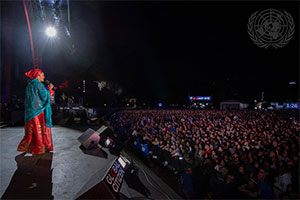 Global Citizen Festival in New York. Credit: UN Photo/Eskinder Debebe
Active citizens are committed to social change because they know that it is achievable. However, major political challenges face active citizens across the world. For example, in authoritarian regimes in Latin America where the hegemonic party has been in power for decades on end, protestors and human rights activists face enormous repression and struggle to materialize their advocacy into concrete results. The same can be said for Africans, where a shift towards elected government in recent decades has yet to translate into an effective voice in decision-making. Now, the Strengthening Citizen Demand for Good Governance, which uses evidence-based approaches – funded by DFID's Governance and Transparency Fund – seeks to raise their voices.
In 2025, the CIVICUS Monitor’s People Power Under Attack report revealed that civic freedoms are severely limited in 122 of 198 countries and territories, and only 7.2% of the global population now lives in countries where civic space is open. Through partnership with the Overseas Development Institute (ODI) and CIVICUS, IPS reporters across the continent will seek to define the extent and limits of state capability, government accountability and the responsiveness of leaders to the needs of citizens.

The Week with IPS

NEXT STOP - SDGs
Tracking global progress towards a sustainable world
Tracking global progress towards a sustainable world
