Languages
Wednesday, September 30, 2026



News and Views from the Global South
Active Citizens

Instead of Scaling up Funding for Education, Major Donors Are Cutting Back
Despite commitments by the international community to achieve universal primary education by 2015, funds for education have been decreasing over the past ten years, according to a report released Friday by the global advocacy campaign ‘A World at School’.
Clean Cookstoves Could Change the Lives of Millions in Nepal
 When 26-year-old Laxmi married into the Archaya household in Chhaimale village, Pharping, south of Nepal’s capital Kathmandu, she didn’t think she would be spending half the day in the kitchen inhaling smoke from the stove.

Women Farmers Rewrite Their History in Chile’s Patagonia Region
More than 100 women small farmers from Chile’s southern Patagonia region have joined together in a new association aimed at achieving economic autonomy and empowerment, in an area where machismo and gender inequality are the norm.
Rural Women in Latin America Define Their Own Kind of Feminism
Rural organisations in Latin America are working on defining their own concept of feminism, one that takes into account alternative economic models as well as their own concerns and viewpoints, which are not always in line with those of women in urban areas.

Investigation Tears Veil Off World Bank’s “Promise” to Eradicate Poverty
An expose published Thursday by the International Consortium of Investigative Journalists (ICIJ) and its media partners has revealed that in the course of a single decade, 3.4 million people were evicted from their homes, torn away from their lands or otherwise displaced by projects funded by the World Bank.
Acid Attacks Still a Burning Issue in India
Vinita Panikker, 26, considers herself "the world's most unfortunate woman".Spiritual Leaders Urge Action On Nuclear Disarmament
Religious leaders addressed the United Nations in New York last week, pleading on moral grounds for global nuclear disarmament.
U.N. Warns of Growing Divide Between Nuclear Haves and Have-Nots
As she prepared to leave office after more than three years, High Representative for Disarmament Affairs Angela Kane painted a dismal picture of a conflicted world: it is “not the best of times for disarmament.”
Economic Slowdown Threatens Progress Towards Equality in Latin America
Predictions of a sharp slowdown in Latin America’s economic growth this year make it even more necessary for the region’s leaders to make commitments to boost prosperity with equality during the Seventh Summit of the Americas, currently taking place in the Panamanian capital.
Nepal: A Trailblazer in Biodiversity Conservation
At dusk, when the early evening sun casts its rays over the lush landscape, the Chitwan National Park, a UNESCO World Heritage Site about 200 km south of Nepal’s capital, Kathmandu, is a place of the utmost tranquility.Mexican Human Rights Fight Illustrated in New Graphic Novel Series
A Dublin-based human rights group has launched a series of graphic novels highlighting the stories of activist groups and rights struggles around the world.
In Belize, Climate Change Drives Coastal Management
A five-year project launched here in Belize City in March seeks to cement a shift in view of climate change and its impact on Belize’s national development.U.N. Rapporteur Calls for Action on Discrimination of Roma
The United Nations rapporteur for minorities has anti-Roma and anti-'Gypsy' bias in her sights.
In Bangladesh, Gender Equality Comes on the Airwaves
Judging by how often they make headlines, one might be tempted to believe that women in Bangladesh don’t play a major role in this country’s affairs.
‘Cli-fi’ to Heat Up Literature Course in India
University lecture halls in North America are no strangers to the ''cli-fi" genre of climate-themed novels and movies, but now India is getting into the act as well, thanks to the pioneering work of Professor T. Ravichandran of the Indian Institute of Technology Kanpur (IITK) in Uttar Pradesh.
Women Still Struggling to Gain Equal Foothold in Nepal
Kali Sunar, 25, a resident of the Dumpada village in the remote Humla District in Far-West Nepal, lives a life that mirrors millions of her contemporaries.
Child Labour on U.S. Tobacco Farms: A Stubborn Problem in a Billion-Dollar Industry
For many young people, the summer is synonymous with free time, relaxation, or family vacations. For less fortunate kids the summer means labour, with scores of youths taking on part-time work to support their families.
Civil Society and Politics March for Negev Bedouin Recognition
There was a symbolic dimension to a recent four-day march from the periphery of Israel to the corridors of power in Jerusalem to seek recognition for Bedouin villages.
Effective War Crimes Inquiry Could Heal Sri Lanka’s Old Wounds
Jessi Joygeswaran seems like your typical 23-year-old young woman. She has an infectious smile and laughs a lot when she talks. Like many other young women anywhere in the world, her life is full of dreams.Opinion: Challenging the Power of the One Percent
When you are faced with the task of moving an object but find it is too heavy to lift, what is your immediate and most natural response? You ask someone to help you lift it. And it makes all the difference.
Global Civil Society to the Rescue of the Amazon
A global civil society petition to save the Amazon is circulating on the internet and its promoters say that once one million signatures have been collected indigenous leaders will deliver it directly to the governments of Brazil, Colombia and Venezuela.« Previous Page — Next Page »


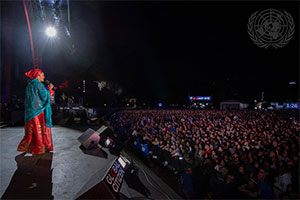 Global Citizen Festival in New York. Credit: UN Photo/Eskinder Debebe
Active citizens are committed to social change because they know that it is achievable. However, major political challenges face active citizens across the world. For example, in authoritarian regimes in Latin America where the hegemonic party has been in power for decades on end, protestors and human rights activists face enormous repression and struggle to materialize their advocacy into concrete results. The same can be said for Africans, where a shift towards elected government in recent decades has yet to translate into an effective voice in decision-making. Now, the Strengthening Citizen Demand for Good Governance, which uses evidence-based approaches – funded by DFID's Governance and Transparency Fund – seeks to raise their voices.
In 2025, the CIVICUS Monitor’s People Power Under Attack report revealed that civic freedoms are severely limited in 122 of 198 countries and territories, and only 7.2% of the global population now lives in countries where civic space is open. Through partnership with the Overseas Development Institute (ODI) and CIVICUS, IPS reporters across the continent will seek to define the extent and limits of state capability, government accountability and the responsiveness of leaders to the needs of citizens.

The Week with IPS

NEXT STOP - SDGs
Tracking global progress towards a sustainable world
Tracking global progress towards a sustainable world
