Languages
Friday, October 9, 2026



News and Views from the Global South
Active Citizens

Press Freedom Groups Denounce NSA Spying on AJ Bureau Chief
Ahmad Muaffaq Zaidan doesn’t deny that he’s had contact with terrorist groups. In fact, it would have been rather difficult to do his job otherwise.
The Definition of ‘Rape’ Cannot Change with a Marriage Certificate
"I was brutally raped thrice by my husband. He kept me under surveillance in his Dubai house while I suffered from severe malnutrition and depression. When I tried to flee from this hellhole, he confiscated my passport, deprived me of money and beat me up," recalls Anna Marie Lopes, 28, a rape survivor who after six years of torture, finally managed to board a flight to New Delhi from the United Arab Emirates in 2012.
NGOs Urge Commission of Inquiry to Probe Sexual Abuse in U.N. Peacekeeping
A rising tide of sexual abuse in U.N. peacekeeping operations has triggered the launch of a high-level campaign to end the continued attacks on women and children and an urgent call for the creation of an independent commission of inquiry.
IACHR Tackles Violence Against Native Peoples in Costa Rica
After years of violence against two indigenous groups in Costa Rica, the Inter-American Commission on Human Rights (IACHR) demanded that the government adopt measures by May 15 to protect the life and physical integrity of the members of the two communities.
Q&A: Nuclear Disarmament a Non-Starter, “But I Would Love to Be Proven Wrong”
Albert Einstein, the internationally-renowned physicist who developed the theory of relativity, once famously remarked: “I know not with what weapons World War III will be fought, but World War IV will be fought with sticks and stones.”
Opinion: Don’t Leave Indigenous Peoples Behind in SDGs
U.N. member states are meeting throughout the year to finalize the Sustainable Development Goals (SDGs), which will set the global development agenda for the next 15 years. The goals are supposed to be universal and aspire to “leave no one behind.”
Farmers Fight Real Estate Developers for Kenya’s Most Prized Asset: Land
 Vegetables grown in the lush soil of this quiet agricultural community in central Kenya’s fertile wetlands not only feed the farmers who tend the crops, but also make their way into the marketplaces of Nairobi, the country’s capital, some 150 km south.

Latin America’s Social Policies Have Given Women a Boost
Although they do not specifically target women, social policies like family allowances and pensions have improved the lives of women in Latin America, the region that has made the biggest strides so far this century in terms of gender equality, although there is still a long way to go.
The Biggest Lessons Nepal Will Take Away From This Tragedy
There has never been any doubt that Nepal is sitting on one of the most seismically active areas in South Asia. The fact that, when the big one struck, damages and deaths would be catastrophic has been known for years.
Faith-Based Organisations Warn of Impending Nuclear Disaster
As the month-long review conference on the Nuclear Non-Proliferation Treaty (NPT) continued into its second week, a coalition of some 50 faith-based organisations (FBOs), anti-nuclear peace activists and civil society organisations (CSOs) was assigned an unenviable task: a brief three-minute presentation warning the world of the disastrous humanitarian consequences of a nuclear attack.
Police Killings Challenge U.S. “Exceptionalism”
Since being roundly chastised last fall by the U.N. Committee Against Torture for excessive use of force by its law enforcement agencies, the United States hasn't exactly managed to repair its international reputation.
Falling Oil Prices Trigger Initial Economic Gains for Pacific Islanders
The recent dramatic fall in world oil prices, with Brent crude plummeting from a high of 115 dollars per barrel in June last year to around 47 dollars in January 2015, is beginning to benefit Pacific Islanders who are seeing lower prices for fuel and energy.
Urban Slums a Death Trap for Poor Children
It’s called the urban survival gap – fuelled by the growing inequality between rich and poor in both developing and developed countries – and it literally determines whether millions of infants will live or die before their fifth birthday.
Families in Quake-Hit Nepal Desperate to Get on With Their Lives
Just over a week after a dreadful 7.8 magnitude earthquake rocked Nepal, displaced families are gradually – but cautiously – resuming their normal lives, though most are still badly shaken by the disaster and the proceeding aftershocks that devastated the country.Popular Nigerian Writer Headlines at Blockbuster World Voices Fest
Prize-winning writer Chimamanda Ngozi Adichie is hoping to break down some stereotypes at the upcoming World Voices Festival sponsored by the PEN America free expression group.
In India, a Broken System Leaves a ‘Broken’ People Powerless
As India paid glowing tributes to Bhimrao Ramji Ambedkar, the architect of its constitution and a champion of the downtrodden, on his 124nd birth anniversary last month, public attention also swivelled to the glaring social and economic discrimination that plagues the lives of lower-caste or ‘casteless’ communities – who comprise over 16 percent of the country's 1.2 billion people.
In India, a Broken Systems Leaves a Broken People Powerless
As India paid glowing tributes to Bhimrao Ramji Ambedkar, the architect of its constitution and a champion of the downtrodden, on his 124nd birth anniversary last month, public attention also swivelled to the glaring social and economic discrimination that plagues the lives of lower-caste or ‘casteless’ communities – who comprise over 16 percent of the country’s 1.2 billion people.

Q&A: “People Need to Be at the Centre of Development”
In a populous archipelago nation like Indonesia, where 250 million live spread across some 17,500 islands, speaking over 300 languages, the question of development is a tricky one.
Draconian Ban on Abortion in El Salvador Targeted by Global Campaign
International and local human rights groups are carrying out an intense global campaign to get El Salvador to modify its draconian law that criminalises abortion and provides for prison terms for women.
In Nicaragua Marriage Is Only for ‘Him’ and ‘Her’
A new Family Code that went into effect in Nicaragua this month represents an overall improvement in terms of the rights of Nicaraguans. However, it has one major gap: it fails to recognise same-sex marriage, and as a result it closes the doors to adoption by gay couples.
Deadline Looms for NGOs to Apply for ECOSOC Status
The NGO Branch of the Department of Economic and Social Affairs at the United Nations is calling on non-governmental organisations to apply for Economic and Social Council (ECOSOC) consultative status in order to be considered by the 2016 NGO Committee.« Previous Page — Next Page »





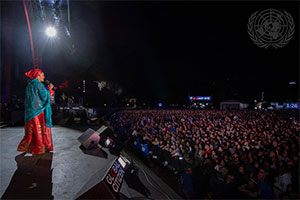 Global Citizen Festival in New York. Credit: UN Photo/Eskinder Debebe
Active citizens are committed to social change because they know that it is achievable. However, major political challenges face active citizens across the world. For example, in authoritarian regimes in Latin America where the hegemonic party has been in power for decades on end, protestors and human rights activists face enormous repression and struggle to materialize their advocacy into concrete results. The same can be said for Africans, where a shift towards elected government in recent decades has yet to translate into an effective voice in decision-making. Now, the Strengthening Citizen Demand for Good Governance, which uses evidence-based approaches – funded by DFID's Governance and Transparency Fund – seeks to raise their voices.
In 2025, the CIVICUS Monitor’s People Power Under Attack report revealed that civic freedoms are severely limited in 122 of 198 countries and territories, and only 7.2% of the global population now lives in countries where civic space is open. Through partnership with the Overseas Development Institute (ODI) and CIVICUS, IPS reporters across the continent will seek to define the extent and limits of state capability, government accountability and the responsiveness of leaders to the needs of citizens.

The Week with IPS

NEXT STOP - SDGs
Tracking global progress towards a sustainable world
Tracking global progress towards a sustainable world
