Languages
Thursday, September 17, 2026



News and Views from the Global South
Active Citizens

High-Tech, High Yields: Caribbean Farmers Reap Benefits of ICT
Farmers in the Caribbean are being encouraged to make more use of farm apps and other forms of ICT in an effort to increase the knowledge available for making sound, profitable farming decisions.
Civil Society in Cuba Finds More Space Under the Reforms
Cafés, real estate agencies, taxis and other small privately-owned businesses and cooperatives in Cuba have brought new life to the depressed local economy and have given rise to pockets of prosperity in the country’s towns and cities.
Ahead of Myanmar Trip, Obama Urged to Demand Extractives Transparency
Lawmakers here are urging President Barack Obama to put transparency in the extractives sector at the centre of an upcoming trip to Myanmar.
Biodiversity, Climate Change Solutions Inextricably Linked
The remarkable biodiversity of the countries of the Caribbean, already under stress from human impacts like land use, pollution, invasive species, and over-harvesting of commercially valuable species, now faces an additional threat from climate change.
Vanuatu Puts Indigenous Rights First in Land Reform
Stemming widespread corruption in the leasing of customary land to investors is the aim of bold land reform, introduced this year in the Southwest Pacific Island state of Vanuatu, which puts the rights of traditional landowners above the discretionary powers of politicians.
Reducing Hunger: More Than Just Access to Food
“We want healthy food, we want to produce according to our traditions,” farmers and activists demanded during an international forum of experts on agriculture and the environment in this southern Italian city.
In Pakistan’s Tribal Areas, a Nobel Prize Is a ‘Ray of Hope’
For girls living in northern Pakistan’s sprawling tribal regions, the struggle for education began long before that fateful day when members of the Taliban shot a 15-year-old schoolgirl in the head, and will undoubtedly continue for many years to come.
World Bank Pushes Private Sector for Major Investments in Infrastructure
The World Bank has initiated a major call to action for private sector investors around infrastructure projects in developing countries.
2015 a Make-or-Break Year for Nuclear Disarmament
U.N. Secretary-General Ban Ki-moon last month singled out what he described as "one of the greatest ironies of modern science": while humans are searching for life on other planets, the world's nuclear powers are retaining and modernising their weapons to destroy life on planet earth.
Displacement Spells Danger for Pregnant Women in Pakistan
Imagine traveling for almost an entire day in the blistering sun, carrying all your possessions with you. Imagine fleeing in the middle of the night as airstrikes reduce your village to rubble. Imagine arriving in a makeshift refugee camp where there is no running water, no bathrooms and hardly any food. Now imagine making that journey as a pregnant woman.
Synthetic Biology Could Open a Whole New Can of Worms
Haiti, the poorest country in the Western Hemisphere, is the world’s leading producer of vetiver. In the southwest of the country, vetiver production is hard to ignore.
OPINION: Put People Power Back at Centre of Citizen Action
A few weeks ago, I co-signed perhaps the most important open letter of my career. It was an open provocation to my fellow activists and colleagues, to the members of our organisation, and to all those who, like me, earn their living in the civil society sector.
U.S. Investigation into Illegal Timber Imports a “Sea Change”
A year after a U.S. company was accused of engaging in the systematic importing of flooring made from illegally harvested timber, pressure is mounting on federal agencies currently investigating the allegations.
OPINION: Planet Racing Towards Catastrophe and Politics Just Looking On
If ever there was a need to prove that we are faced with a total lack of global governance, the U.N. Climate Summit, extraordinarily called by U.N. Secretary-General Ban Ki-moon on Sep. 23, makes a very good case.
Harper Playing Defence in Canada’s Pipeline Politics
Canada’s tar sands oil boom may be in jeopardy and it appears the ruling Conservative government of Prime Minister Stephen Harper does not have any plan B in its ambition to remake this resource-rich country into “an energy superpower.”
Antigua Faces Climate Risks with Ambitious Renewables Target
Ruth Spencer is a pioneer in the field of solar energy. She promotes renewable technologies to communities throughout her homeland of Antigua and Barbuda, playing a small but important part in helping the country achieve its goal of a 20-percent reduction in the use of fossil fuels by 2020.
Humanity Failing the Earth’s Ecosystems
In pure numbers, the past few decades have been marked by destruction: over the last 40 years, Earth has lost 52 percent of its wild animals; nearly 17 percent of the world’s forests have been felled in the last half-century; freshwater ecosystems have witnessed a 75-percent decline in animal populations since 1970; and nearly 95 percent of coral reefs are today threatened by pollution, coastal development and overfishing.
New Global Declaration “Insufficient” to Tackle Deforestation
Heads of state, civil society groups and the leaders of some of the world’s largest companies this week urged their peers to sign on to a landmark new global agreement aimed at halting deforestation by 2030, even as others are warning the accord is too lax.
Puerto Rico’s Green Crusaders Still Going Strong
The heart of Puerto Rico’s central mountain range is the site of an extraordinary story of struggle and triumph.U.S. to Create National Plan on Responsible Business Practices
The United States will begin developing a national action plan on responsible business practices, following on several years of related advocacy from civil society.
Outgunned by Rich Polluters, Africa to Bring United Front to Climate Talks
As climate change interest groups raise their voices across Africa to call for action at the COP20 climate meeting in December and the crucial COP21 in Paris in 2015, many worry that the continent may never have fair representation at the talks.« Previous Page — Next Page »


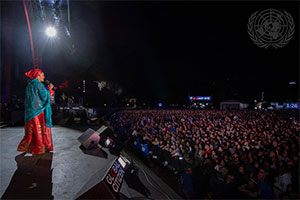 Global Citizen Festival in New York. Credit: UN Photo/Eskinder Debebe
Active citizens are committed to social change because they know that it is achievable. However, major political challenges face active citizens across the world. For example, in authoritarian regimes in Latin America where the hegemonic party has been in power for decades on end, protestors and human rights activists face enormous repression and struggle to materialize their advocacy into concrete results. The same can be said for Africans, where a shift towards elected government in recent decades has yet to translate into an effective voice in decision-making. Now, the Strengthening Citizen Demand for Good Governance, which uses evidence-based approaches – funded by DFID's Governance and Transparency Fund – seeks to raise their voices.
In 2025, the CIVICUS Monitor’s People Power Under Attack report revealed that civic freedoms are severely limited in 122 of 198 countries and territories, and only 7.2% of the global population now lives in countries where civic space is open. Through partnership with the Overseas Development Institute (ODI) and CIVICUS, IPS reporters across the continent will seek to define the extent and limits of state capability, government accountability and the responsiveness of leaders to the needs of citizens.

The Week with IPS

NEXT STOP - SDGs
Tracking global progress towards a sustainable world
Tracking global progress towards a sustainable world
