Languages
Thursday, October 8, 2026



News and Views from the Global South
Conferences

North and South Face Off Over “Right to the City”
The declaration that will be presented for approval at the Third United Nations Conference on Housing and Sustainable Urban Development (Habitat III) in October has again sparked conflict between the opposing positions taken by the industrial North and the developing South.
AIDS Meeting Was Bold but Disappointing, Organisations Say
Though the High Level Meeting on Ending AIDS ended with the adoption of bold and life saving targets, many organisations have expressed their disappointment in its outcomes.
“Them” and “Us”, a Metaphor for Urban Inequality
For the inhabitants of “Bajo Autopista” (Under the Freeway), a slum built under an expressway in the Argentine capital, “they” are the people who live in areas with everything that is denied to “us” – a simple definition of social inclusion and a metaphor for urban inequality.
When the UN Comes Under Heavy Fire
When heads of government and foreign ministers make their annual pilgrimage to the United Nations in September, it is rare to hear hard-hitting, headline-grabbing political statements from the podium.
When Emergencies Last for Decades
For the millions of people whose lives have been uprooted by conflict and natural disasters the average amount of time before they can return home is now 17 years.
Climate Change Compounds Humanitarian Crises in Global South
As the Global South works to overcome a history of weak institutions, armed conflict and poverty-driven forced exodus, key causes of its humanitarian crises, developing countries now have to also fight to keep global warming from compounding their problems.
A Latin American Humanitarian Emergency Invisible to the World
“This is a humanitarian crisis,” said Bertha Zúñiga Cáceres, referring to the generalised violence in Mexico and in Honduras and other countries of Central America, which has claimed hundreds of thousands of lives and is a product of transnational crime, but is invisible to the international community.
Industrial-Level Aid Logistics in Colombia’s Decades-Long Humanitarian Disaster
“If you’re going to talk about Colombia and the peace process, do it somewhere else,” was heard at a regional preparatory meeting for the World Humanitarian Summit, according to Ramón Rodríguez, with the Colombian government’s Unit for Attention and Integral Reparation for Victims (UARIV).
MSF Withdrawal Part of Ongoing Debate Over Humanitarian Aid
Aid organisations have differing views about the upcoming World Humanitarian Summit, after Médecins Sans Frontières (MSF) pulled out last week some still hope the Summit will help bring about much needed change.
“Together, Civil Society Has Power”
When Tamara Adrián, a Venezuelan transgender opposition legislator, spoke at a panel on inclusion during the last session of the International Civil Society Week held in Bogotá, 12 Latin American women stood up and stormed out of the room.
Why we need to stand united against governments cracking down on dissent
Last month, after receiving threats for opposing a hydroelectric project, Berta Caceres, a Honduran indigenous and environmental rights campaigner, was murdered. A former winner of the Goldman Environmental Prize for her opposition to one of Central America’s biggest hydropower projects, Berta was shot dead in her own home.
Choose Humanity: Make the Impossible Choice Possible!
We have arrived at the point of no return. At this very moment the world is witnessing the highest level of humanitarian needs since World War Two. We are experiencing a human catastrophe on a titanic scale: 125 million in dire need of assistance, over 60 million people forcibly displaced, and 218 million people affected by disasters each year for the past two decades.
Organised Civil Society Increasingly Hemmed In by Global Elites
Collusion, according to the dictionary, means “secret or illegal cooperation or conspiracy, especially in order to cheat or deceive others.” That is what the world’s political and economic elites engage in, according to Danny Sriskandarajah, secretary general of the international civil society alliance CIVICUS.
Boosting the Future of the Food Movement
Investing in new entrepreneurs who bring a holistic approach to food sustainability is one way that the food movement can overcome mounting global challenges from environmental degradation to food waste.
Latin America to Redouble Its Climate Efforts in New York
The countries of Latin America will flock to sign the Paris Agreement, in what will be a simple act of protocol with huge political implications: it is the spark that will ignite actions to curb global warming.
A World Drowning in Oil
Thanks to tensions between Saudi Arabia and Iran, major oil producers couldn’t come to an agreement in Doha to freeze their output to January levels to raise oil prices. The current low oil prices have a lot to do with the grim outlook for global economic growth while supply is growing. China, the second largest economy in the world, is slowing down. Not surprisingly, global oil demand is much lower at 94.8 million barrels a day vis-à-vis supply of 96.3 million barrels a day in the first quarter of 2016 according to the International Energy Agency.
Build Healthy, Sustainable Food Systems to Fight Malnutrition
Creating healthy and sustainable food systems is key to overcoming hunger and all forms of malnutrition (undernourishment, micronutrient deficiencies, obesity) around the world. Food production has tripled since 1945 while average food availability per person has risen by 40 per cent. Current food systems are not delivering well on ensuring healthy diets for all. We have to fix the problem. The most efficient and sustainable approach will be to reshape and strengthen food systems that support healthy diets for all.
Fat’s Heavy Burden on the World Economy
About 2.1 billion people are regarded as overweight or obese today, or almost thirty per cent of the world’s population. With over 800 million people estimated to be chronically hungry in the world, it appears that the number of overweight is more than 2.5 times the number of undernourished.
Latin America’s Indigenous Peoples Find an Ally in the Pope
“We want Pope Francis’ message to come true…We want the rights of indigenous people to be supported, respected and strengthened,” Yuam Pravia, a representative of the Misquito native people, said in this city in southern Mexico.
Dying for the News: Media Call for Help from Gov’t and Public against Attacks
“No story is worth dying for.” This comment at a landmark conference on media safety at UNESCO last Friday emphasised the bewilderment the media felt at the brutal slayings of journalists as they carry out their work.
Media Come Together to Discuss Safety of Journalists, Fight Against Impunity
Amid continuing attacks on journalists, media representatives from around the world will meet in the French capital this week to discuss how to reinforce the safety of those working in the sector. Organized and hosted by the United Nations cultural agency, UNESCO, this “unprecedented” meeting between media executives and the agency’s members states on Feb. 5 is an attempt to “improve the safety of journalists and tackle impunity for crimes against media professionals”, UNESCO said.« Previous Page — Next Page »





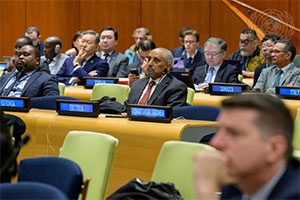 General Assembly Meets to Hear Briefing on UN80 Initiative. Credit: UN Photo/Manuel Elías
Global development conferences are continuing to produce critical frameworks for South-South cooperation and multilateral reform. In January of 2024, the 3rd Global South Nexus (GSN) International Conference was held in Odisha, India, with its theme being “Creating Responsible Professionals for Advancing SDGs: Inputs from Global North and South.” The 2025 UN SDG Report provided a midpoint assessment of the 2030 Agenda, with only 35% of targets on track and 18% having reversed. The 2025 UN Climate Change Conference (COP30) in Belém, Brazil, agreed to mobilize $1.3 trillion annually for climate action by 2035, operationalize the loss and damage fund, triple adaptation finance, and launched the Belém Mission to 1.5°C. In 2025, the Partnership for Economic Policy (PEP) convened its annual Policy Conference in Nairobi, Kenya, addressing the issue of “Financing and Inclusivity in Green Energy Transition in the Global South.” As the Global South advocates increasingly for a South-South framework alongside North-South cooperation, international conferences on sustainability aim to bridge economic and social divides between developed and developing countries in achieving the UN SDGs. Furthermore, to mark the UN’s 80th anniversary, the UN80 Initiative was launched to reshape how the UN system works so that every mandate, dollar, and decision creates greater impact for the global system.

The Week with IPS

NEXT STOP - SDGs
Tracking global progress towards a sustainable world
Tracking global progress towards a sustainable world
