Languages
Thursday, October 8, 2026



News and Views from the Global South
Conferences

The World is Losing the Battle Against Child Labour
The IV Global Conference on the Sustained Eradication of Child Labour, which drew nearly 2000 delegates from 190 countries to the Argentine capital, left many declarations of good intentions but nothing to celebrate.
A Trump Doctrine of Hypocrisy
In his first address on the global stage of the General Assembly, United States’ President Donald Trump touted an “America First” approach at the very institution that is meant to inspire collaboration between nations.
Secretary-General Talks Myanmar, Trump Ahead of General Assembly
In an environment full of major threats, countries must work together towards peace and stability, the Secretary-General said ahead of the General Assembly.
Towards a Resource Efficient and Pollution Free Asia-Pacific
Senior government officials from across Asia and the Pacific will meet in Bangkok this week for the first-ever Asia-Pacific Ministerial Summit on the Environment. The high-level meeting is co-convened by the United Nations Economic and Social Commission for Asia and the Pacific (UN ESCAP) and UN Environment and is a unique opportunity for the region’s environment leaders to discuss how they can work together towards a resource efficient and pollution-free Asia-Pacific.
How to Achieve Universal Goals, Strategically
Discussion around the 2030 Agenda for Sustainable Development, a list of 17 goals listed by the UN, was all the buzz in the conference rooms of UN headquarters this week.
Civil Society on SDG Engagement: “We Are Not Guests”
Showing up in record numbers, civil society groups are urging greater inclusion and accountability in sustainable development processes at a UN high level meeting.
Social Forum Calls for Fight Against Corruption, to Defend the Amazon
Corruption has penetrated the Amazon rainforest like an illness that infects everything, said Ruben Siqueira, coordinator of the Pastoral Land Commission (CPT), during the VIII Panamazonic Social Forum (FOSPA), which brought together in the Peruvian Amazon jungle representatives of civil society from eight Amazon basin countries.
New Recipe for School Meals Programmes in Latin America
Sunita Daniel remembers what the school lunch programmes were like in her Caribbean island nation, Saint Lucía, until a couple of years ago: meals made of processed foods and imported products, and little integration with the surrounding communities.
Mistrust Hindering Global Solutions, says Secretary General
The global lack of confidence and trust is undermining the ability to solve the world’s complex problems, said UN Secretary-General during an international conference.
Threats to Freedom of Expression in the Social Networks
Email surveillance, blocking of websites with content that is awkward for governments, or the interruption of services such as WhatsApp are symptoms of the threat to freedom of expression online, according to Latin American activists.
New Technologies in Debate in Biodiversity Conference
Synthetic biology, geoengineering and the recognition of ancestral knowledge are the issues that have generated the most heated debate in the United Nations Conference on Biodiversity, which ends in this Mexican resort city on Friday Dec. 17.
Developmentalism and Conservation Clash Out at Sea
“We don’t have access to marine areas, because most are protected areas or are in private hands. We indigenous people have been losing access to our territories, as this decision became a privilege of the state,” complained Donald Rojas, a member of the Brunka indigenous community in Costa Rica.
Latin America to Take the Temperature of Paris Agreement at Climate Summit
With the ratification and entry into effect of the Paris Agreement still fresh, the countries of Latin America are heading to the climate summit in Marrakesh in search of clear rules that will enable them to decarbonise their economies to help mitigate global warming.
Cities Address a Key Challenge: Infrastructure Needs
“We as mayors have to govern midsize cities as if they were capital cities,” said Héctor Mantilla, city councilor of Floridablanca, the third-largest city in the northern Colombian department of Santander.
Governments and Social Movements Disagree on Future of Cities
The Third United Nations Conference on Housing and Sustainable Urban Development and the alternative forums held by social organisations ended in the Ecuadorean capital with opposing visions regarding the future of cities and the fulfillment of rights in urban areas.
U.N. Urban Summit Gives Rise to a Mixture of Optimism and Criticism
Experts and activists greeted with a mixture of hope and skepticism the Third United Nations Conference on Housing and Sustainable Urban Development (Habitat III), which opened Monday Oct. 17 in the capital of Ecuador, and which seeks to produce a new urban agenda for cities and their inhabitants.
Mexico City’s Expansion Creates Tension between Residents and Authorities
People living in neighborhoods affected by the expansion of urban construction suffer a “double displacement”, with changes in their habitat and the driving up of prices in the area, in a process in which “we are not taken into account,” said Natalia Lara, a member of an assembly of local residents in the south of Mexico City.
Making African Palm Oil Production Sustainable
“In San Lorenzo they cut down the jungle to plant African oil palms. The only reason they didn’t expand more was that indigenous people managed to curb the spread,” Ecuadorean activist Santiago Levy said during the World Conservation Congress.
When It Comes to Conservation, Size Matters
When the communities living in the Tatamá y Serranía de los Paraguas Natural National Park in the west of Colombia organised in 1996 to defend their land and preserve the ecosystem, they were fighting deforestation, soil degradation and poaching.
Without Indigenous People, Conservation Is a Halfway Measure
“You don't convert your own house in a tourist site,” said Oussou Lio Appolinaire, an activist from Benin, wearing a traditional outfit in vivid yellows and greens. He was referring to opening up to tourists places that are sacred to indigenous people.
UN Spotlight for Dark Shadow over Civil Society Rights
With more and more governments narrowing space for dissent and activism, the UN has emerged as a key platform to air concerns about acute rights violations and develop protections for civil society and other vulnerable groups.« Previous Page — Next Page »





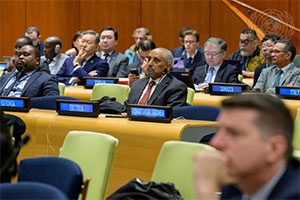 General Assembly Meets to Hear Briefing on UN80 Initiative. Credit: UN Photo/Manuel Elías
Global development conferences are continuing to produce critical frameworks for South-South cooperation and multilateral reform. In January of 2024, the 3rd Global South Nexus (GSN) International Conference was held in Odisha, India, with its theme being “Creating Responsible Professionals for Advancing SDGs: Inputs from Global North and South.” The 2025 UN SDG Report provided a midpoint assessment of the 2030 Agenda, with only 35% of targets on track and 18% having reversed. The 2025 UN Climate Change Conference (COP30) in Belém, Brazil, agreed to mobilize $1.3 trillion annually for climate action by 2035, operationalize the loss and damage fund, triple adaptation finance, and launched the Belém Mission to 1.5°C. In 2025, the Partnership for Economic Policy (PEP) convened its annual Policy Conference in Nairobi, Kenya, addressing the issue of “Financing and Inclusivity in Green Energy Transition in the Global South.” As the Global South advocates increasingly for a South-South framework alongside North-South cooperation, international conferences on sustainability aim to bridge economic and social divides between developed and developing countries in achieving the UN SDGs. Furthermore, to mark the UN’s 80th anniversary, the UN80 Initiative was launched to reshape how the UN system works so that every mandate, dollar, and decision creates greater impact for the global system.

The Week with IPS

NEXT STOP - SDGs
Tracking global progress towards a sustainable world
Tracking global progress towards a sustainable world
