Languages
Saturday, October 10, 2026



News and Views from the Global South
Conferences

Africa, Only If It Bleeds It Leads?
Africa is clearly one of the most negatively impacted regions in the world, not helped by the increasing trend of the mainstream media to focus on tragic news, following a self-imposed rule: “if it bleeds it leads”.
CoP 21: The Start of a Long Journey
The agreement reached in December, 2015 at the 21st Conference of the Parties under the United Nations Framework Convention on Climate Change (UNFCCC) is a major step forward in dealing with the challenge of climate change. The very fact that almost every country in the world signed off on this agreement is a major achievement, credit for which must go in substantial measure to the Government of France and its leadership. However, in scientific terms, while this agreement certainly brings all the Parties together in moving ahead, in itself the commitments that have been made under the Intended Nationally Determined Contributions (INDCs) are quite inadequate for limiting temperature increase to 2 degrees Celsius by the end of this century relative to pre-industrial levels.
Syria: Minding the Minds II
Baher Kamal, in … And All of a Sudden Syria!: “The “big five,” the United Nations veto powers, have just agreed United Nations Resolution 2254 of 18-12-2015, time to end the Syrian five-year long human tragedy; they waited until 300,000 innocent civilians were killed and 4.5 million humans lost as refugees and homeless at home, hundreds of field testing of state-of-the-art drones made, and daily U.S., British, French and Russian bombing carried out.” No Chinese bombing.
Cash for the Climate Please, Caribbean Leaders Lament
Funding to address the financial flows needed for adaptation and mitigation of climate change remains an issue of concern for the Caribbean.
Caribbean Journalists Prepare to Report on Climate Change
Environmentally committed journalists in the Caribbean point to a major challenge for media workers: communicating and raising awareness about the crucial climate change agreement that emerged from the 21st Conference of the Parties (COP21) in Paris.
Hail to the Cowpea: a Blue Ribbon for the Black-Eyed Pea
2016 is the International Year of Pulses, and we at the International Institute of Tropical Agriculture are proud to be organizing what promises to be the landmark event, the Joint World Cowpea and Pan-African Grain Legume Research Conference.
… And All of a Sudden Syria!
The “big five” – i.e., the most military powerful states on earth (US, UK, France, Russia and China) have just agreed that it would be about time to end the Syrian five-year long human tragedy.
Water, Water Everywhere but Too Much or Too Little
“Water is at the core of the Lima-Paris Action Agenda (LPAA), but it is true that for a long time water and oceans issues have been marginalized in climate conferences, considering that 90 per cent of natural catastrophes are linked to water and 40 per cent of global population will face water scarcity from now to 2050,” stated Marie-Ségolène Royal, French Minister of Ecology, Sustainable Development and Energy, during the press conference at the launch of the #ClimateIsWater initiative at COP21. “It is through water that it is possible to measure climate change impacts,” she said.
‘Good, But Not Perfect’, Pacific Islands Women on Climate Deal
Women leaders in the Pacific Islands have acclaimed the agreement on reducing global warming achieved at the United Nations (COP21) Climate Change conference in Paris as an unprecedented moment of world solidarity on an issue which has been marked to date by division between the developing and industrialized world. But for Pacific small island developing states, which name climate change as the single greatest threat to their survival, it will only be a success if inspirational words are followed by real action.
WTO: Giant Steps in the World Conference
World Trade Organization (WTO) members concluded the Tenth Ministerial Conference in Nairobi on 19 December by securing an historic agreement on a series of trade initiatives. The “Nairobi Package” pays fitting tribute to the Conference host, Kenya, by delivering commitments that will benefit in particular the organization’s poorest members.
Accord Calls for First Global Conference on Peace
On 21 November 2015, during ACCORD’s 2015 Africa Peace Award celebration, I made a call for the United Nations to convene the first ever UN Global Conference on Peace.COP21 Solved a Dilemma Which Delayed a Global Agreement
One of the most significant aspects of the international conference on climate change, concluded in Paris on December 12, is that food security and ending hunger feature in the global agenda of the climate change debate.Paris Agreement Leaves Climate Funding in Limbo
Secretary-General Ban Ki-moon, who described climate change as one of the “defining priorities” of his nine-year tenure as UN chief, went into raptures over the Paris agreement concluded on Saturday.
Paris Delivers Historic Climate Treaty, but Leaves Gender Untouched
After 2 weeks of intense negotiations, on Saturday evening, the 21st UN climate conference (COP21) in Paris finally delivered a historic agreement that, for the first time, promises to keep the global warming under 2 degrees Celsius. The treaty, consisting 31 pages and signed by by 196 countries, include the big five steps of climate action:
Paris Delivers the Promised Climate Deal to Resounding Cheer and Applause
The impossible was made possible. Governments from 195 countries around the world emerged here with the first universal agreement to cut greenhouse gases emissions and reduce the negative impacts of climate change.Climate Change and Women Across Three Continents
The link between women in climate change is a cross-cutting issue that deserves greater recognition at climate negotiations. It is pervasive, touching everything; from health and agriculture to sanitation and education.
Hidden Hunger, Hidden Danger
Access to generic vitamin and mineral supplements in developing countries constrained by trade rules
The latest estimates are that over two billion people in the world suffer some micronutrient deficiencies, often referred to as “hidden hunger.” The main sustainable solution is to ensure adequate public health interventions, including clean water, sanitation and hygiene as well as healthy, diverse diets for all.
Tackling Climate Change in Africa: Europe’s Solution to the Migrant Crisis?
As thousands of Africans arrive in Europe every month, often risking their lives aboard shaky boats to get to a better life, lack of access to energy could be one of the reasons for their exodus.What is at Stake in the World Trade Organization Conference in Nairobi
The Ministerial Conference of the World Trade Organization (WTO) is now just a few days away, from 15 to 18 December in Nairobi.
Honour Our Right to Exist, Say Pacific Island Leaders at COP21
On World Human Rights Day (December 10) at the UN climate conference in Paris, small island nations from the Pacific made a passionate call to the world leaders: stop climate change and honour our right to exist on the earth.
Farmers to COP 21: Don’t Bite the Hand That Feeds You!
When Dr. Evelyn Nguleka says that the world’s people shouldn’t bite the hand that feeds them, she explains that she’s not only referring to protecting farmers, but also to safeguarding the environment.« Previous Page — Next Page »





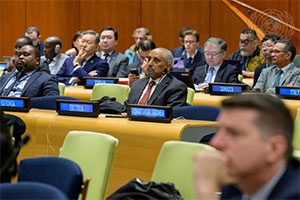 General Assembly Meets to Hear Briefing on UN80 Initiative. Credit: UN Photo/Manuel Elías
Global development conferences are continuing to produce critical frameworks for South-South cooperation and multilateral reform. In January of 2024, the 3rd Global South Nexus (GSN) International Conference was held in Odisha, India, with its theme being “Creating Responsible Professionals for Advancing SDGs: Inputs from Global North and South.” The 2025 UN SDG Report provided a midpoint assessment of the 2030 Agenda, with only 35% of targets on track and 18% having reversed. The 2025 UN Climate Change Conference (COP30) in Belém, Brazil, agreed to mobilize $1.3 trillion annually for climate action by 2035, operationalize the loss and damage fund, triple adaptation finance, and launched the Belém Mission to 1.5°C. In 2025, the Partnership for Economic Policy (PEP) convened its annual Policy Conference in Nairobi, Kenya, addressing the issue of “Financing and Inclusivity in Green Energy Transition in the Global South.” As the Global South advocates increasingly for a South-South framework alongside North-South cooperation, international conferences on sustainability aim to bridge economic and social divides between developed and developing countries in achieving the UN SDGs. Furthermore, to mark the UN’s 80th anniversary, the UN80 Initiative was launched to reshape how the UN system works so that every mandate, dollar, and decision creates greater impact for the global system.

The Week with IPS

NEXT STOP - SDGs
Tracking global progress towards a sustainable world
Tracking global progress towards a sustainable world
