Languages
Friday, November 20, 2026



News and Views from the Global South
Civil Society

Egypt Between a Public Movement and a Military Coup
In less than three days, Egypt moved from being under the rule of religious Islamists to being in different civilian hands as well as military ones. Mohamed Morsi, Egypt's first democratically elected president, was overthrown by the army on Wednesday after massive nationwide protests calling for his removal on the first anniversary of his election to power.
Activists Preserve a Part of Syria’s Revolution
For the small town of Kafranbel in Syria, the old saying "a pen is mightier than a sword" still rings true. Every week in Kafranbel, protesters draw posters, write banners and demonstrate against the regime of Syrian President Bashar al-Assad.
U.S. States Tighten Voter Restrictions
Advocacy groups here are reacting with frustration as several southern U.S. states have moved to enact stricter voting requirements in the wake of a recent Supreme Court decision that rolled back key legislation that had safeguarded minority voters for decades.
/CORRECTED REPEAT*/U.S. Walks Tightrope in Wake of Egypt Coup
Wednesday’s coup d’etat against the elected government of Egyptian President Mohamed Morsi has placed the administration of President Barack Obama in an uncomfortable position on a number of fronts.Intelligentsia Feud Flares in Dushanbe
Official recognition as a member of the intelligentsia in present-day Tajikistan means lots of perks, including apartments and access to state-funded vacation resorts. In exchange, members – described as the “conscience of the nation” – are expected to support incumbent authorities.
OP-ED: Moving Forward to End Violence Against Women
Last year, as rebels captured the main towns in Northern Mali, UN Women registered a sudden and dramatic increase of rapes in the first week of the takeover of Gao and Kidal, in places where most women never report this violence to anyone, not even health practitioners.
Egyptian Lawyer and Women’s Rights Advocate Wins RFK Award
A prominent human rights organisation based here announced Tuesday that its annual award for 2013 would go to Ragia Omran, an Egyptian lawyer and women’s rights activist.
Brazil Champion – But No Longer the Land of Football
The Brazilian national football team made a glorious comeback with its victory in the FIFA Confederations Cup, but the sport has lost its tight grip on society. While millions celebrated, the tournament was also another source of anger for the protesters that have filled the streets in the last few weeks.
In the Land of the Gods, Disaster Response Falls Short of Divine
Over 580 bodies have so far been found. Hundreds more will likely never turn up. Survivors say they are suspended in a kind of nightmare, either haunted by memories of their brush with death or desperate for news of loved ones. At least 3,000 are reported to be missing.
San Francisco Pride Draws Huge Crowd, Critics
Sporting wedding gowns, tuxedos, leather, beads, bangles, union t-shirts and Free Bradley Manning buttons – and some wearing just about nothing at all – some 1.5 million people poured into downtown San Francisco Sunday to celebrate lesbian-gay-bisexual-transgender pride.Snowden Defies White House, Still Caught in Limbo
Late on Monday night, Sarah Harrison, a Wikileaks activist, hand-delivered 21 letters to Kim Shevchenko, the duty officer at the Russian consulate office in Moscow's Sheremetyevo airport, on behalf of Edward Snowden, the U.S. National Security Agency (NSA) whistleblower.Donations Sound the New Note
The global economic crisis has not hit Serbia for the first time, but this year it has bitten into Serbian culture. State subsidies for theatres, festivals, films and exhibitions have almost hit the bottom. State support for films is down to zero.
Faster Development Needed to Sustain Decade of Gains in Brazil
After 10 years of social and economic gains thanks to successful employment and public investment policies and anti-poverty programmes, Brazil is facing the challenge of broadening and accelerating a model of development that includes, for instance, the young people protesting on the country’s streets.
Obama Calls for Compromise in Egyptian Crisis
U.S. President Barack Obama Monday called for both the Muslim Brotherhood-dominated government of Egyptian President Mohamed Morsi and opposition forces to compromise in the fast-developing political crisis.
Media Scholars Decry Financial Crisis, Call for Action
Communications scholars from around the world deplored the global financial crisis and called on their peers to take more active roles in the search for solutions at a recent four-day conference in Dublin, Ireland.
The New Fascism
The atrocious Second World War left behind lasting damage by lowering our standards for what is marginally acceptable.
Tunisia Tiring of Transition
In the third year after the revolution that toppled former dictator Ben Ali, true democracy is still work in progress in Tunisia.
Spring Brings Differing Fruits for Tunisian Women
The revolution that ousted dictator Ben Ali in January 2011 brought new, hard-won freedom to the Tunisian people. However as the country discovers whether secularism and growing political Islam can co-exist, some women are enjoying greater liberty to practise their religion while others are concerned that their rights may be eroded.
A President Fights His People
Egyptian President Mohammed Morsi faces massive demonstrations, but he faces also his own government on many fronts.
Tunisia Now Searches an Economic Spring
Nearly two-and-a-half years since the toppling of the autocratic regime of Zine el-Abidine Ben Ali in the first regime change of the now famous Arab Spring, the high expectations of change to come with the revolution have hardly been met.Abandoned Egypt Suffers
As supporters and opponents of Egyptian President Mohammed Morsi prepare for a face-off on Sunday, a mushrooming problem for Egypt arises from the people not there – the tourists.« Previous Page — Next Page »


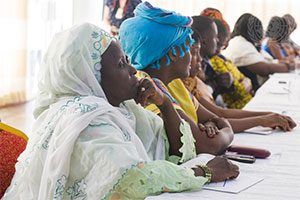 Representatives of Civil Society, Sierra Leone. Credit: UN Photo/Eskinder Debebe
Civil society faces mounting threats worldwide, even as it remains essential for democratic accountability, especially in countries struggling with economic instability and social inequality. However, at the same time, nations with weak democratic governance structures also systemically suppress the power of civil society. Human rights activists across the Global South frequently challenge issues such as political persecution and gender oppression, but in return face state-sanctioned punishment for their advocacy. Imprisonment and exile are common mechanisms of punishment that seek to erode the strength of civil society. The 2026 World Press Freedom Index has reached its lowest level in 25 years, with more than half of the world’s countries now falling into the "difficult" or “very serious” category for press freedom. IPS seeks to highlight the work of civil society across the Global South as well as the challenges that they face.
Updated by Yilan Batista and Shuli Wong August 2026

The Week with IPS

NEXT STOP - SDGs
Tracking global progress towards a sustainable world
Tracking global progress towards a sustainable world
