Languages
Friday, November 6, 2026



News and Views from the Global South
Education
Latin America’s Youth Face Hurdles to Jobs and Safe Sex
Shortcomings in the educational system in Latin America and the Caribbean fuel inequalities that remain hurdles to access to the labour market and safe sex for a large part of the region’s youth.
Targeting Hard-core Urban Poverty with a Female Face
A new social programme launched by the Argentine government to fight hard-core poverty is providing unemployed mothers who are heads of households with education, training, work and an income.
Music as Social Inclusion Shines in Salzburg
A sea of white-gloved hands swaying gracefully to the rhythm of tropical music shows the audience in the hallowed Mozarteum concert hall in this Austrian city how Venezuela is combining musical education and social inclusion.
Woman President Shows Malawi the Way
Malawi’s President Joyce Banda knows a thing or two about women’s empowerment. After all she is the first female southern African head of state.
Groups Call for U.S. to Fight Harder Against Child Marriages
Advocacy groups are urging for partnerships between governmental organisations and private sector businesses to better prevent child marriage and combat the economic, development and health problems it causes.
Chinese Built Port Leaves Cameroonians Adrift
The Kribi Seaport on the coast of southern Cameroon is destined to become a mega harbour to serve all of Central Africa. But there is little chance that locals, particularly engineers and scientists, will benefit much from the 567 million dollar development.
Report Finds Pattern of Inequity in Development Aid
Despite global efforts to provide development aid, the world’s poorest are getting poorer, says a new report by the Catholic Agency for Overseas Development (CAFOD).
Nepal Moves to Curb Child Labour
Last December, Pradeep Dongol, child protection officer at the Kathmandu-based Children and Women in Social Service and Human Rights (CWISH), received an urgent call from one of the NGO’s many offices in Nepal’s sprawling capital city.
Indonesia Comes under Fire for Fires
With a propensity to devour everything in their path and spiral quickly out of control, leaving behind swathes of scorched earth, forest fires are considered a hazard in most parts of the world. In Indonesia, however, fires are the preferred method for clearing large areas of land for massive plantations of commercial crops.
Expanding Access to University to Boost Social Mobility
Nine of the 47 tuition-free public universities in Argentina were created in the last decade, with the aim of improving access to higher education in low-income areas. But despite the expansion and strategies to provide support for students, the drop-out rate has proven difficult to combat.
Are Middle Class Protests Fallout from Poverty Alleviation?
The rise of the "global middle class" is widely attributed to the gradual eradication of extreme poverty in the developing world, even as the United Nations says that millions of people in countries such as India, China and Brazil have graduated from the ranks of the indigent.
Stronger Laws to Deter Acid Attacks on Women
Preeti Rathi was just 25 years old when she passed away in a Mumbai hospital exactly a month after a man threw acid on her while she stood waiting on a railway platform.Need to Protect DRC’s School Girls from Sexual Assault
In some Democratic Republic of Congo schools, teachers and senior authorities are using their status to abuse girls who do not know their rights, according to the African Association for the Defence of Human Rights.
Children of Conflict
Malala Yousafzai and Muhammad Qasim have a lot in common.
When Children Give Birth to Children
Radhika Thapa was just 16 years old when she married a 21-year-old boy three years ago. Now, she is expecting a baby and is well into the last months of her pregnancy. This is not the first time she has been with child – her first two pregnancies ended in miscarriages.Technical Education Competes with University: Study
Technology education programmes are increasingly becoming a viable alternative to the standard four-year undergraduate university programme, according to the OECD, a major international grouping of rich countries.
Nepal Scores Low on Quality Education
Sabitri Kumari Das, a middle-aged mother of two, is rightfully worried about her two young daughters: both girls attend a public primary school in Nepal’s capital, Kathmandu, and neither one of them seems to be advancing academically.
The Classrooms Are Full – but the Students Can’t Read
Many Pacific Island nations are celebrating the success of rising school enrolment rates, with 14 members of the 16-member Pacific Island Forum on target to meet Millennium Development Goal 2: achieving universal primary education by 2015.
Girls Fight Back Against Child Marriage
Shirin Aktar was just 13 years old when her parents decided it was time for her to get married.
A Latin America With Opportunity for All
Latin America has had a good decade. Over the last 10 years, economic growth averaged 4.2 percent, and 70 million people escaped poverty. Macroeconomic stability, open trade policies and pro-business investment climates have supported and will continue to support strong growth in the years to come.
China Leads Battle Against Poverty, Says U.N.
The United Nations has singled out China - the world's most populous country with over 1.3 billion people - as one of the key success stories in the longstanding battle against poverty.« Previous Page — Next Page »





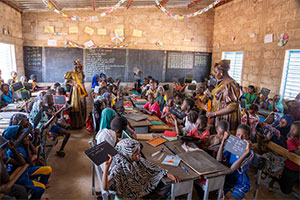 Two teachers work in a classroom in Forces Vives School in Dori, Burkina Faso. Credit: UNICEF/UNI978361
Safe and uninterrupted education is a fundamental right for all children. Education is paramount to global development, as it has been proven that investing in education – especially for girls and children – contributes significantly to economic growth and prosperity. Although more than 1 billion children go to school, many are subjected to conditions that are not conducive to a proper learning environment, including makeshift facilities, a lack of supplies, violence in classrooms, inadequate sanitation, untrained instructors, and widespread school closures. Since 2015, there have been immense gains in education with an increase of 109 million children in school. However, as of 2023, 272 million children are still out of school.
High poverty levels in developing countries also impede children’s access to a proper education. For example, from the early to mid 2000s, Sub-Saharan African nations witnessed a dramatic decline in trained teachers due to inadequate funding in the education sector. Furthermore, major cuts to United States international aid threaten an estimated 23 million additional children's access to education, as USAID‑funded school programmes across Africa and Asia face closure.
Various other factors contribute to the decline of education, notably hunger, which has increased as conflict and climate change interfere with global food production and dissemination. Meanwhile, certain social and cultural practices also impede children’s access to education, with gender inequality, discrimination, child labour, and child marriages preventing millions of children from attending school. Economic conditions such as the inaccessibility of higher education also affect disenfranchised communities across the world. In extreme situations, such as warfare where educational facilities are destroyed in their totality, notably in Gaza and Sudan, entire generations of children might grow up without access to education. Rebuilding educational infrastructure is a long and arduous process, especially when violence persists across generations, and this significantly stunts the development of societal prosperity and stability.
IPS is dedicated to telling the shocking truths about worldwide education through impassioned opinion pieces and comprehensive articles, highlighting global issues that impede worldwide education and the courses of action being taken by organizations such as UNICEF and Education Cannot Wait.

The Week with IPS

NEXT STOP - SDGs
Tracking global progress towards a sustainable world
Tracking global progress towards a sustainable world
