Languages
Saturday, November 7, 2026



News and Views from the Global South
Education

Taliban Can’t Beat This Act
The applause has continued long after the curtain came down on the last performance of Khushal Khan Khattak in the northern Pakistan city of Peshawar last month. The enthusiastic reception should have the Taliban worried.
Women Struggle for a Place in the Pacific
Women face greater odds in achieving equal political representation in the Pacific Islands than in any other region of the world, holding just 3 percent of seats in national parliaments, compared to 20 percent in Sub-Saharan Africa and 18.5 percent in South East Asia.
ALEC-Backed Laws Promote Controversial Charter Schools
The right-wing American Legislative Exchange Council (ALEC) and private education management firms are pushing for new “parent trigger” laws in states across the U.S. by lobbying many Republican and some Democratic legislators to make it easier to convert more traditional public schools to charter schools.
Q&A: Radio Gives Voices to South African Youth
Lesedi Mogoatlhe has dedicated her life to empowering African youth by helping them to find their voices through radio journalism.
Agriculture on the Air
The sun is just beginning its descent as a knot of farmers gathers around a small, portable radio in the grounds of the Nachol Pilot High School in Bangladesh’s northwestern Chapainawabganj district, about 300 kilometres from the capital, Dhaka.Golf Plays Against Local Democracy
More than 10,000 people living in the coastal Adriatic town Dubrovnik have done what many others in the region could never. They are holding a referendum on a controversial development project that they believe endangers their city.Timbuktu Reclaims Its Treasures
Despite uncertainty and the ongoing conflict, Mali will work to rebuild and safeguard its cultural heritage, says the West African country’s minister of culture Bruno Maïga.
The Struggle to Keep Swaziland’s Primary Schools Free
As the Swazi government struggles to guarantee a no-cost nationwide primary school system, it finds itself sparring against school principals over the question if it is a lack of funds or an abundance of corruption that is standing in the way of its success.India Tightening Child Labour Laws
After one of the six males under trial for the rape and subsequent death of a 23-year-old woman was deemed an adolescent and therefore entitled to leniency, juvenile rights activists have found themselves pitted against irate members of the public demanding death sentences for all the perpetrators.
Empty Promises Behind Haitian Govt’s “Free School” Program
Ever since his election in 2011, Haitian President Michel Martelly has touted his "free school" program as one of the government's major accomplishments. "A victory for students!" banners and posters boast.
Indigenous Youth Step up to Protect Their Roots
Indigenous youth from some of the world's oldest living cultures are stepping forward to steer their communities past the threat of disappearance and into an age of coexistence with an increasingly globalised world.
Obama Pushes Universal Preschool Coverage for U.S.
Following on a surprise announcement supporting a universal preschool guarantee during his annual State of the Union address earlier this week, President Barack Obama spent much of Thursday pushing a suite of new policy initiatives aimed at vastly increasing access to high-quality education and development programmes for a child’s first few years of life.
Investing in Kids Isn’t Rocket Science
The Millennium Development Goals challenged the world to cut extreme poverty in half, dramatically reduce child mortality, and make primary education universal, but Jody Heymann and Kristen McNeill say the world can do more.This Is What a Humane Economy Looks Like
The severe crisis crippling Spain is also sparking some creative responses, such the Okonomía project, a teaching initiative that helps individuals and communities to understand the workings of the economy and make more informed decisions to manage their finances.
The Open and Rocky Road Post-2015
What values does a Yemeni journalist who fuelled the Arab Spring hold in common with a former principal of the U.S. National Security Council? And how in turn will they see eye to eye with a Jordanian queen, or the president of Indonesia?
Summit of the Peoples Demands Solidarity and Sovereignty
More than 400 social organisations from Europe and Latin America and the Caribbean will gather on Jan. 25-27 at a Summit of the Peoples called as an alternative to the bi-regional meeting of heads of state and government to be held at the same time in the Chilean capital.
Q&A: “There is Nothing Worse Than Holding a Dying Woman in Your Arms”
Despite staggering advances in medical science and technology over the years, women around the world continue to suffer gravely as a result of inadequate access to basic reproductive health services.
Iraqi Women Seek a New Liberation
From full literacy declared in the seventies, Iraq is down to 40 percent literacy for women. From the first woman prime minister and the first woman judge in the Middle East in 1959, Iraq has slipped to a place where an abnormal number of widows struggle, and where child marriages are on the rise. Hanaa Edwar is putting up a fight to win Iraqi women their freedoms again.Fighting for a Future in Rio’s Toughest Neighbourhoods
Teachers at a local primary school here, the Escola Municipal IV Centenário, are trained to help their pupils find cover in case of gun battles.
Education Fights Militants and Military
Eight-year-old Muhammad Akram was forced to quit school when he was in the second grade, when the Taliban destroyed the small, government-run school that he and his brother had been attending.Uzbekistan Tries to Keep Culture from Going Pop
Mahfuza, a mother of three in a small town in the Ferghana Valley, has better things to do than spend her afternoons at crowded, smoke-filled Internet clubs. But as a high-school algebra teacher, she has an extracurricular assignment from her bosses: she must monitor the clubs’ clientele – many of them her students – while they play computer games, surf social networking websites, and watch music videos.« Previous Page — Next Page »





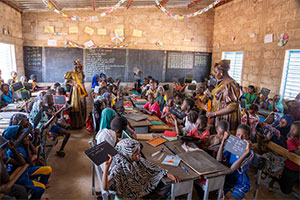 Two teachers work in a classroom in Forces Vives School in Dori, Burkina Faso. Credit: UNICEF/UNI978361
Safe and uninterrupted education is a fundamental right for all children. Education is paramount to global development, as it has been proven that investing in education – especially for girls and children – contributes significantly to economic growth and prosperity. Although more than 1 billion children go to school, many are subjected to conditions that are not conducive to a proper learning environment, including makeshift facilities, a lack of supplies, violence in classrooms, inadequate sanitation, untrained instructors, and widespread school closures. Since 2015, there have been immense gains in education with an increase of 109 million children in school. However, as of 2023, 272 million children are still out of school.
High poverty levels in developing countries also impede children’s access to a proper education. For example, from the early to mid 2000s, Sub-Saharan African nations witnessed a dramatic decline in trained teachers due to inadequate funding in the education sector. Furthermore, major cuts to United States international aid threaten an estimated 23 million additional children's access to education, as USAID‑funded school programmes across Africa and Asia face closure.
Various other factors contribute to the decline of education, notably hunger, which has increased as conflict and climate change interfere with global food production and dissemination. Meanwhile, certain social and cultural practices also impede children’s access to education, with gender inequality, discrimination, child labour, and child marriages preventing millions of children from attending school. Economic conditions such as the inaccessibility of higher education also affect disenfranchised communities across the world. In extreme situations, such as warfare where educational facilities are destroyed in their totality, notably in Gaza and Sudan, entire generations of children might grow up without access to education. Rebuilding educational infrastructure is a long and arduous process, especially when violence persists across generations, and this significantly stunts the development of societal prosperity and stability.
IPS is dedicated to telling the shocking truths about worldwide education through impassioned opinion pieces and comprehensive articles, highlighting global issues that impede worldwide education and the courses of action being taken by organizations such as UNICEF and Education Cannot Wait.

The Week with IPS

NEXT STOP - SDGs
Tracking global progress towards a sustainable world
Tracking global progress towards a sustainable world
