Languages
Sunday, November 8, 2026



News and Views from the Global South
Education

Poverty Plagues Children in Bangladesh
 Nearly 50 percent of Bangladesh’s primary school students drop out before they complete fifth grade, as crushing poverty drives them into the informal employment sector.

Thousands Orphaned by Poverty in Kashmir
Seventeen-year-old Afzal is an unusual orphan. Though his father died many years ago, his mother is still alive and living with Afzal’s grandparents and younger siblings in a house not far from the orphanage where the boy has spent most of his teenage years.
Occupation Can’t Stifle Innovation
Afnan Hamad stands proudly in front of a booth at the Ramallah Cultural Palace exhibition hall, three plastic bottles filled with discoloured liquid on the table in front of her.
Q&A: The Challenges of Women’s Empowerment and Equality
Today, approximately 125 countries have laws that penalise domestic violence - a great advance from a decade ago. Yet 603 million women around the world still live in countries where domestic violence is not a crime, and up to seven in ten women are targeted for physical or sexual violence, or both.
Crisis Hits Spain’s Roma Hard
Daniel introduces himself as a “gypsy and guitarist,” Francisco José wants to become a doctor, Yomara timidly says she likes to cook, and María has no idea what she wants to study.
Students Stuck With Shoddy Textbooks in Afghanistan
New textbooks, printed as part of an ambitious multi-million dollar exercise to reform the curriculum in Afghan public schools, have been found to contain glaring mistakes, adding yet another burden on a cash- and resource-strapped sector of this war-torn country.
Venezuela’s Youth Orchestra Shines in U.S.
A group of young people walk down the streets of Chicago, broad grins on their faces. They have good reason to be happy: the ovations received by their repertoire of Latin American music when they played in the Simón Bolívar Symphony Orchestra of Venezuela still echo in their ears.
Qatar Launches Schooling for Children in Crisis Zones
When the U.N. Educational, Scientific and Cultural Organisation (UNESCO) launched its inaugural meeting on "Global Education for All" last month, Secretary-General Ban Ki-moon warned that most developing nations are likely to miss the 2015 deadline to achieve universal primary education.
State Failing as Parent
Governments in Eastern Europe and Central Asia are being urged to end the institutionalisation of babies as more than 15,000 children a year in the region continue to be subjected to a practice experts say often leaves them physically and mentally scarred for life.
Q&A: Education Is Where HIV Care Begins
When Shorai Chitongo founded Ray of Hope, a support group for female survivors of domestic violence in 2005, she discovered that three-quarters of the survivors in the group were HIV-positive. [caption id="attachment_114724" align="alignright" width="250"]Tajik NGOs Feeling Heat in Winter
As the leader of a civil rights-related non-governmental organisation, Dilrabo Samadova said she was used to getting hassled by authorities about her group’s activities. But recent government actions to put the clamps on civil society groups like hers in Tajikistan took her by surprise.
Q&A: “War Helped Unify Angola”
A visitor to Angola might be surprised at the calm surrounding Angola’s accelerated rehabilitation and construction of infrastructure a decade after the end of so many years of war, and at the lack of after-effects like ethnic violence, armed gangs, or the settling of accounts.
Cold and Dusty But Safe
No other camp for Syrians match the size of Za’atari. Equal rows of tents marked with the UNHCR logo spread to the horizon, dotted with lanterns and water tanks. Only a handful of people remain in sight, mostly on their way to or from the bathrooms.
Sex Education Is Also a Right
Learning about respect in a relationship, sexual orientation, sexuality, gender equality and family planning forms part of the right to sex education that is still not enjoyed by all children and adolescents in Latin America.
Getting an Education – a Heroic Feat for Native Children in Bolivia
Even before the sun comes up, Reinaldo starts out on the two-hour journey to the school he attends in a small native village in Bolivia, hiking along steep, narrow paths that take him across ravines and rivers.
Parents Worry After Malala Attack
Young schoolgirls seemed undeterred by the attempt to kill Malala Yousafzai, but parents in northern Pakistan are becoming increasingly concerned over their children going to school.Students Torn Between School and Work in DR Congo
Hanging from the door of a mini-bus taxi as it jerks and jinks through traffic, 16-year-old Gires Manoka calls out the van's destination to potential passengers as it crosses Kinshasa, the capital of the Democratic Republic of Congo.
Wrangling Begins Over New Sustainable Development Blueprint
As the Millennium Development Goals (MDGs) limp towards their target date of 2015, the United Nations is shifting its focus to another long-term action plan: a new set of Sustainable Development Goals (SDGs).CENTRAL ASIA: Disabled Citizens Find Avenues to Advancement Blocked
As a child, Feruza Alimova dreamed of becoming a lawyer so she could help disabled people.
‘Malala’s Cause Is Our Cause’
Less than two weeks after being left for dead by the Taliban, Malala Yousafzai is standing up on her own two feet.Congo Capital’s Schools Still Shattered From March Explosion
Three weeks after the new school year began in Brazzaville, many students in the capital of the Republic of the Congo have yet to attend a single class. The city is still trying to recover from a huge explosion at an arms dump in March.« Previous Page — Next Page »





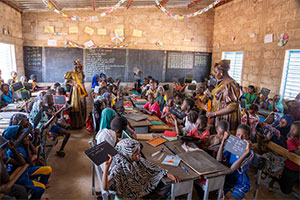 Two teachers work in a classroom in Forces Vives School in Dori, Burkina Faso. Credit: UNICEF/UNI978361
Safe and uninterrupted education is a fundamental right for all children. Education is paramount to global development, as it has been proven that investing in education – especially for girls and children – contributes significantly to economic growth and prosperity. Although more than 1 billion children go to school, many are subjected to conditions that are not conducive to a proper learning environment, including makeshift facilities, a lack of supplies, violence in classrooms, inadequate sanitation, untrained instructors, and widespread school closures. Since 2015, there have been immense gains in education with an increase of 109 million children in school. However, as of 2023, 272 million children are still out of school.
High poverty levels in developing countries also impede children’s access to a proper education. For example, from the early to mid 2000s, Sub-Saharan African nations witnessed a dramatic decline in trained teachers due to inadequate funding in the education sector. Furthermore, major cuts to United States international aid threaten an estimated 23 million additional children's access to education, as USAID‑funded school programmes across Africa and Asia face closure.
Various other factors contribute to the decline of education, notably hunger, which has increased as conflict and climate change interfere with global food production and dissemination. Meanwhile, certain social and cultural practices also impede children’s access to education, with gender inequality, discrimination, child labour, and child marriages preventing millions of children from attending school. Economic conditions such as the inaccessibility of higher education also affect disenfranchised communities across the world. In extreme situations, such as warfare where educational facilities are destroyed in their totality, notably in Gaza and Sudan, entire generations of children might grow up without access to education. Rebuilding educational infrastructure is a long and arduous process, especially when violence persists across generations, and this significantly stunts the development of societal prosperity and stability.
IPS is dedicated to telling the shocking truths about worldwide education through impassioned opinion pieces and comprehensive articles, highlighting global issues that impede worldwide education and the courses of action being taken by organizations such as UNICEF and Education Cannot Wait.

The Week with IPS

NEXT STOP - SDGs
Tracking global progress towards a sustainable world
Tracking global progress towards a sustainable world
