Languages
Sunday, November 8, 2026



News and Views from the Global South
Education

Violence Arising From Madrassas
The increasing numbers of religious schools is being cited as the main reason behind violent protests in the northern Khyber Pakhtunkhwa province of Pakistan bordering Afghanistan.
OP-ED: What We Owe Our Youth
On Wednesday, we kick off a three-day meeting in Mexico City to discuss how to boost the involvement of young people in politics and expand their role in consolidating democracy in Latin America and the Caribbean.
Q&A: Disaster Resilience Starts with Grassroots Women
Women and girls can be powerful agents of change, but they are disproportionately affected by disasters because of social roles, discrimination and poverty.
Girls Determined to Fight Guns With Books
Shazia Begum, one of three girls injured in the attack on the Pakistani schoolgirl Malala Yousafzai says the Taliban had sought to silence a very influential schoolgirl.
U.N. Launches Global Campaign to Abolish Child Marriages
The United Nations has launched a global campaign to abolish an anachronistic social practice still prevalent in some communities around the world: child marriages.
Reduce Poverty in Africa – Educate a Girl
While in the last decade an additional 52 million of sub-Saharan Africa’s children enrolled in primary schools, with girl’s enrolment increasing from 54 percent to 74 percent, a large majority of girls - 16 million – are still being denied access to education.
Child Marriage Defies Laws in Nepal
Social activists in Nepal agree that the one reason why this impoverished country will miss the gender-linked Millennium Development Goals (MDGs) of the United Nations is the persistence of child marriage.
Bounty Offered in Pakistan Activist Shooting
The Pakistani government has offered a Rs10 million (105,000-dollar) bounty for the capture of the Pakistani Taliban assailants who shot Malala Yousafzai, a teenage rights and education activist in the northwestern Swat Valley, officials say.
Garifuna Women, Custodians of Culture and the Environment in Honduras
Hurricane Mitch, which devastated Honduras 14 years ago, prompted a group of Garifuna women to start organising, to help the people in greatest need of assistance.
Uruguayan Schools Slowly Say Goodbye to Junk Food
Uruguayan schoolchildren are learning that cookies, candy, potato chips and soft drinks are bad for their health. Some schools have taken the initiative and banned junk food from school snacks.
Israeli Academics Fight for Freedom
As the political science department at a major Israeli university has been threatened with closure in the 2013 school year, professors and students say the move reflects the politicisation of Israeli academia, and threatens basic freedoms.
Co-ops Offer Ray of Hope for Youth Facing Bleak Job Market
Youth worldwide are facing limited job prospects in the traditional channels of employment, and in the midst of the job crunch, cooperatives are seeking ways to connect with this untapped pool of talent.
Q&A: In Pakistan, Youth Participation Key to Progress
The burgeoning youth population in Pakistan plays a vital role in addressing the country's major challenges and in shaping its future, both for young people today and for generations to come.
Q&A: “The Children Take on an Artist’s Lovely Identity, from a Young Age”
Venezuela’s youth symphony orchestras that have enamoured audiences on several continents are a social programme aimed at fighting poverty and marginalisation, more than an artistic endeavour, says the founder of the initiative, José Antonio Abreu.
Task Force to Kick Start Cairo Population Goals
Gathered at the Ford Foundation in New York Monday, international luminaries, family planning experts and women's rights activists repeatedly expressed a common sentiment: “I cannot believe that we are still having this discussion today."
For Development, Jobs May Outweigh Growth, World Bank Says
The World Bank warned Monday that over the next decade and a half, the world will need to create 600 million new jobs, particularly in Asia and Sub-Saharan Africa, just to maintain current employment rates.
Caracas Youth Orchestra Conquers Europe
Venezuela’s youth orchestras have gotten used to wild applause and standing ovations in Europe. But this time the warm reception was not for the Simón Bolívar Symphony Orchestra, the most visible face of the National System of Youth and Children’s Orchestras of Venezuela (FESNOJIV), a network of youth and children’s orchestras that has put instruments and music scores in the hands of 400,000 children and young people.
Private Sector, U.N. Unite to Bring Millions into Classrooms
U.N. Secretary-General Ban Ki-moon Wednesday launched a new initiative aimed at giving education the highest political priority in the global agenda and ensuring progress towards the U.N.’s Millennium Development Goals (MDGs).
Keeping Girls in School in Uganda
Three years ago, after Irene Kamyuka finished her sixth year of primary school in Uganda, her father ran short of money. With four siblings ahead of her in school, Kamyuka’s father told her she would have to drop out until his finances turned around.
Cuba’s Reforms Shift Focus to Training Skilled Workers
His carpenter’s certificate has made Antonio Tejero into a passionate champion of the trades, because, he says, he works “directly for society.” That attitude is in line with the government’s plan to train more technicians and skilled workers to give a boost to the economy.
Occupy Marks Anniversary Amid Grim Economic Climate
Amid a heavy police presence, thousands of anti-capitalist activists in marked the one-year anniversary of the Occupy Wall Street movement against the U.S. political and economic system, which they say favours billionaires at the expense of the middle and working class.« Previous Page — Next Page »





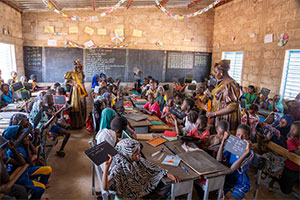 Two teachers work in a classroom in Forces Vives School in Dori, Burkina Faso. Credit: UNICEF/UNI978361
Safe and uninterrupted education is a fundamental right for all children. Education is paramount to global development, as it has been proven that investing in education – especially for girls and children – contributes significantly to economic growth and prosperity. Although more than 1 billion children go to school, many are subjected to conditions that are not conducive to a proper learning environment, including makeshift facilities, a lack of supplies, violence in classrooms, inadequate sanitation, untrained instructors, and widespread school closures. Since 2015, there have been immense gains in education with an increase of 109 million children in school. However, as of 2023, 272 million children are still out of school.
High poverty levels in developing countries also impede children’s access to a proper education. For example, from the early to mid 2000s, Sub-Saharan African nations witnessed a dramatic decline in trained teachers due to inadequate funding in the education sector. Furthermore, major cuts to United States international aid threaten an estimated 23 million additional children's access to education, as USAID‑funded school programmes across Africa and Asia face closure.
Various other factors contribute to the decline of education, notably hunger, which has increased as conflict and climate change interfere with global food production and dissemination. Meanwhile, certain social and cultural practices also impede children’s access to education, with gender inequality, discrimination, child labour, and child marriages preventing millions of children from attending school. Economic conditions such as the inaccessibility of higher education also affect disenfranchised communities across the world. In extreme situations, such as warfare where educational facilities are destroyed in their totality, notably in Gaza and Sudan, entire generations of children might grow up without access to education. Rebuilding educational infrastructure is a long and arduous process, especially when violence persists across generations, and this significantly stunts the development of societal prosperity and stability.
IPS is dedicated to telling the shocking truths about worldwide education through impassioned opinion pieces and comprehensive articles, highlighting global issues that impede worldwide education and the courses of action being taken by organizations such as UNICEF and Education Cannot Wait.

The Week with IPS

NEXT STOP - SDGs
Tracking global progress towards a sustainable world
Tracking global progress towards a sustainable world
