Languages
Sunday, November 8, 2026



News and Views from the Global South
Education

India Coaxes Tribal Girls Into Schools
The deafening din of the lunch gong is sweet music to the 200-odd tribal girls rushing down the stairway, clutching stainless steel plates and tumblers.
Amid Tension in Islamic World, U.N. Chief Pleads for Harmony
Amidst growing political tensions in the Islamic world over a video caricature of the Prophet Muhammad originating in the United States, U.N. Secretary-General Ban Ki-moon is making an “urgent “plea for political harmony worldwide.
Syrian Kurds Find the Language of Freedom
"I want to learn how to read and write in my own language," says Manal, a young Kurd from Syria. Neither she nor any of Manal’s 30 classmates have ever been so close to achieving their goal.
Taliban Need No Education
Samina Afridi, a lecturer at the University of Peshawar, regrets that down history the leaders of the Pashtun (also Pakhtun) tribes have conspired to keep them away from education and literacy. The Taliban are only the latest example.
Côte d’Ivoire’s Universities – Shedding a Legacy of Violence and Corruption
Yacouba Coulibaly was pursuing a doctorate in education at Cocody University in Abidjan before Côte d’Ivoire’s post-election violence started in 2010. But his classes were routinely disrupted by armed members of a powerful student federation that wished to hold meetings instead.
Women Spend 40 Billion Hours Collecting Water
As the weeklong international conference on water concluded Friday, it was left to one of the keynote speakers from the United Nations to focus on a much neglected perspective on water and food security: the role of women.
Q&A: “Another Chile Is Possible, with Greater Democracy and Social Rights”
It is essential for young people in Chile to assume a more active role in politics, especially in two key electoral processes: the municipal elections in October and the legislative and presidential vote in 2013, says student leader Camila Vallejo, who has not ruled out running for a seat in parliament herself.
Q&A: The Undying Legacy of Dambudzo Marechera
Legendary and controversial Zimbabwean writer Dambudzo Marechera, who once famously told people to let him write and drink his beer, has been dead for 25 years. However, interest in the life and work of the author, who has become a cult icon to aspiring young writers in Zimbabwe and abroad, will not die.
Q&A: Rescuing Child Soldiers in CAR
The protection of children remains critical in the Central African Republic, where parents willingly give their children to armed groups in exchange for protection and services.
School Bullying, a Reflection of Society in Latin America
Because “schools reflect what is going on in society,” an analysis of what is behind the high rates of bullying in Latin America is urgently needed, says Marcela Román, an expert on education in the region.
Quotas in Brazil’s Public Universities to Democratise Education
A new law about to enter into effect in Brazil will reserve half of all admission slots in public universities for students who attended public primary and secondary schools. But the measure, aimed at expanding access to the country’s best universities, will require structural reforms.
Cuban Higher Education Changing in Times of Reform
Enrolment in Cuban universities fell by 25.8 percent during the past school year, as young people are being oriented toward fields with more employment opportunities, such as agriculture, in the context of sweeping economic reforms that are also affecting public education.
Pakistan Faces a ‘Youth Bomb’
“This is just a trailer of the horror that awaits us,” says noted demographer Farid Midhet, referring to Pakistan’s bulging population and the possibly corresponding link to rising crime, including murders, robberies, rioting and extremist activity.
When the Lights Go Out, Talk
When the lights go out, Gazans look for generators to switch on. And, they find people to talk to. With so many power cuts over so long now, people are giving themselves the somewhat dubious comfort that human relations may have improved as a result of these power cuts.
Teachers’ Strike Does Not Mean Political Liberation for Swaziland
Swazis should not see the ongoing nationwide one-month teachers’ strike as a movement capable of overthrowing the political regime here, despite the fact that civil servants and nurses have joined the action, according to political analyst Dr. Sikelela Dlamini.
Pouring Edible Oil on Pakistan’s Troubled Areas
PESHAWAR, Jul 28 2012 (IPS) -Taking turns to lug a heavy can of edible oil, Mushtari and Sheema Gul, twin sisters aged nine, trip home happily from their school in Ghareebabad village in Pakistan’s troubled Bajaur Agency.
Schoolgirls Beat Taliban
Far from fears that female education is on the decline after the Taliban campaign against girls’ schools, female students outclassed their male counterparts in the secondary school examination for 2012.
In the Pursuit of Education: Burkina Faso’s School for Shepherds
Salou Bandé is proud to stand at the front of the only classroom in the village of Bénnogo, 90 kilometres north of the Burkina Faso capital, Ouagadougou, sharing his knowledge with his students. He is part of an initiative to improve education for nomadic children in the West African country.
Malnutrition Implicated in Child Killer Epidemic
Health experts are blaming high malnutrition levels for an outbreak of hand, foot and mouth disease (HFMD) that has killed more than 54 children in impoverished Cambodia since April.
Prison Study Programme Shuns Argentine “Dirty War” Criminals
A group of prisoners convicted of crimes against humanity committed during Argentina's last dictatorship (1976-1983) have put university and prison authorities in a difficult position by asking to enrol in an academic study programme for inmates financed by the state.To Reduce Teen Pregnancies, Start with Educating Girls
Each year, 16 million girls aged 15-19 give birth. 50,000 of them die from complications related to pregnancy and childbirth. And 95 percent of those births occur in developing countries.« Previous Page — Next Page »





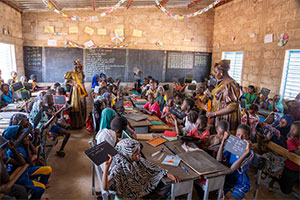 Two teachers work in a classroom in Forces Vives School in Dori, Burkina Faso. Credit: UNICEF/UNI978361
Safe and uninterrupted education is a fundamental right for all children. Education is paramount to global development, as it has been proven that investing in education – especially for girls and children – contributes significantly to economic growth and prosperity. Although more than 1 billion children go to school, many are subjected to conditions that are not conducive to a proper learning environment, including makeshift facilities, a lack of supplies, violence in classrooms, inadequate sanitation, untrained instructors, and widespread school closures. Since 2015, there have been immense gains in education with an increase of 109 million children in school. However, as of 2023, 272 million children are still out of school.
High poverty levels in developing countries also impede children’s access to a proper education. For example, from the early to mid 2000s, Sub-Saharan African nations witnessed a dramatic decline in trained teachers due to inadequate funding in the education sector. Furthermore, major cuts to United States international aid threaten an estimated 23 million additional children's access to education, as USAID‑funded school programmes across Africa and Asia face closure.
Various other factors contribute to the decline of education, notably hunger, which has increased as conflict and climate change interfere with global food production and dissemination. Meanwhile, certain social and cultural practices also impede children’s access to education, with gender inequality, discrimination, child labour, and child marriages preventing millions of children from attending school. Economic conditions such as the inaccessibility of higher education also affect disenfranchised communities across the world. In extreme situations, such as warfare where educational facilities are destroyed in their totality, notably in Gaza and Sudan, entire generations of children might grow up without access to education. Rebuilding educational infrastructure is a long and arduous process, especially when violence persists across generations, and this significantly stunts the development of societal prosperity and stability.
IPS is dedicated to telling the shocking truths about worldwide education through impassioned opinion pieces and comprehensive articles, highlighting global issues that impede worldwide education and the courses of action being taken by organizations such as UNICEF and Education Cannot Wait.

The Week with IPS

NEXT STOP - SDGs
Tracking global progress towards a sustainable world
Tracking global progress towards a sustainable world
