Languages
Sunday, November 8, 2026



News and Views from the Global South
Education

Understanding the Roots of Ghana’s Child Labour
At eleven years old, Thema, a native of Kumasi, hopes to be a nurse when she grows up. Currently, however, she is employed wandering between taxis and tro-tros or minibus taxis at rush hour, carrying packs of ice water on her head and selling them for 10 pesewas apiece. She manoeuvres through traffic in Ghana’s second-largest city with practiced ease; she has been doing this for four years.
Poverty Drives Child Labour
In an informal settlement of 10,000 people on the outskirts of Papua New Guinea’s capital, Port Moresby, Tembari Children’s Care – a new grassroots initiative – is providing protection, food and education to orphans and abandoned children who would otherwise join the high numbers of child labourers in this Melanesian country.
Women’s Inequality Linked to Soaring Population
The world’s population now stands at about seven billion, and by 2050, this figure will hit a whopping nine billion.
South Sudan Celebrates a Troubled First Birthday
The streets have been swept clean and lined with flags to mark the first anniversary of South Sudan’s independence. But cosmetic changes in the capital, Juba, mask deep concerns about the future of the world’s newest nation.
South Sudan’s Women Await Independence From Poverty
One year after the formation of South Sudan, the country’s women say that independence has not resulted in the positive political, economic and social changes that they had hoped for.
Liberia’s Baby Blues – No Policy for Pregnant School Girls
Patricia Kollie should be at school today but instead she is at home in Gbarnga, Liberia, pounding a pile of cassava leaves in a wooden mortar. Her entire body is slightly swollen. Her dress fits a little too snug at the stomach.Genetic Research Gives a Ray of Hope in Guatemala
Cases like that of a little boy with an undetected metabolic disorder whose parents sold everything they owned to cover the costs of medical treatment that was ineffective prompted a doctor to create a vanguard institute of human genetics in Guatemala.
Success of Remedial Education in DRC
The government of the Democratic Republic of Congo is enjoying success with the remedial education centres set up to give children from underprivileged backgrounds a free education and vocational training.
Green, Cyclone-Resistant Schools for Madagascar
This year, the cyclone season's heavy rains did not mean the usual days off school for children in Marolondo, a village in the Fénérive-Est district, 450 kilometres northeast of Antananarivo, the capital of Madagascar.Israeli Guns Hold University Degrees Away
After more than 25 years spent fighting for women’s rights in the Gaza Strip, Andaleeb Shehadeh is now struggling for the right to complete her university education.No Human Rights – in Theory or Practice
Since the adoption of the Universal Declaration of Human Rights on Dec. 10, 1948, in the aftermath of the Second World War, world leaders embarked on a process of ensuring the rights of every individual in the world.
Rio+20: Creating a Future Girls Want
On a wall in the Rio conference centre is an unusual, brightly coloured tree. It is made of sticky notes, arranged so that the tree's branches extend down and out. On these notes, delegates passing by the World Association of Girl Guides and Girls Scouts (WAGGGS) have been asked to write down the futures they envision.
Learning from Argentina’s Formula to Improve Education
Argentina’s success in improving the quality of education in primary schools in low-income areas has awakened the interest of other countries in Latin America, which are keen on learning more about the experience and applying it themselves.Students Flock to Online Black Market
Former university graduates, current students and professors are embroiled in an unusual scandal this exam season, as news reports filtering in from around the Balkans reveal a major online trade in stolen final papers.
Quebec Student Strike Ignites Broader Protest Movement
The student movement that erupted in February following the announcement of a 75-percent rise in university tuition fees is now becoming a violent struggle for democracy in Quebec.
Distribution of Laptops Expands in Latin America’s Classrooms
In Latin America, the distribution of laptops in public schools, an effort that has enjoyed success in countries like Argentina, Uruguay and Venezuela, is being studied by the governments of other nations interested in learning from their experience about the challenges that can be expected.For Minorities in U.S. Public Schools, Risk of a Dismal Future
As the United States struggles to level the racial disparities in its education system, the birth rate of minorities has been rising steadily. Experts say this confluence of statistics should compel Americans to seriously address the flaws and failures of the country's public education system.
Taliban Seek Support ‘in Rushdie’s Name’
Taliban members have resorted to invoking fictitious links of academics with writer Salman Rushdie in a bid to boost their popularity.
Schools Plant Seeds of Sectarianism
Though most Lebanese take great pride in their national education system, deep sectarian rifts in public schools have made it impossible to ignore the political and religious fragmentation of society or its long-term impacts on youth.
Climate Change and Family Planning – Twin Issues for LDCs
The reproductive rights agenda, from improving women’s access to education to systematic family planning to reducing birth rates and combating poverty, has become a cornerstone of most industrialised nations’ development policies toward the least developed countries (LDCs), comprised primarily of sub-Saharan African states.Malaysia Applies Lessons Learned from U.S. Education System
The United States has simultaneously some of the highest quality and most troubled educational systems in the world. The dichotomy is inspiring countries like Malaysia to learn from examples in the United States in order to help them figure out how to turn the worst into the best.« Previous Page — Next Page »





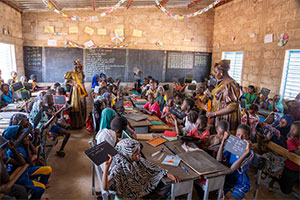 Two teachers work in a classroom in Forces Vives School in Dori, Burkina Faso. Credit: UNICEF/UNI978361
Safe and uninterrupted education is a fundamental right for all children. Education is paramount to global development, as it has been proven that investing in education – especially for girls and children – contributes significantly to economic growth and prosperity. Although more than 1 billion children go to school, many are subjected to conditions that are not conducive to a proper learning environment, including makeshift facilities, a lack of supplies, violence in classrooms, inadequate sanitation, untrained instructors, and widespread school closures. Since 2015, there have been immense gains in education with an increase of 109 million children in school. However, as of 2023, 272 million children are still out of school.
High poverty levels in developing countries also impede children’s access to a proper education. For example, from the early to mid 2000s, Sub-Saharan African nations witnessed a dramatic decline in trained teachers due to inadequate funding in the education sector. Furthermore, major cuts to United States international aid threaten an estimated 23 million additional children's access to education, as USAID‑funded school programmes across Africa and Asia face closure.
Various other factors contribute to the decline of education, notably hunger, which has increased as conflict and climate change interfere with global food production and dissemination. Meanwhile, certain social and cultural practices also impede children’s access to education, with gender inequality, discrimination, child labour, and child marriages preventing millions of children from attending school. Economic conditions such as the inaccessibility of higher education also affect disenfranchised communities across the world. In extreme situations, such as warfare where educational facilities are destroyed in their totality, notably in Gaza and Sudan, entire generations of children might grow up without access to education. Rebuilding educational infrastructure is a long and arduous process, especially when violence persists across generations, and this significantly stunts the development of societal prosperity and stability.
IPS is dedicated to telling the shocking truths about worldwide education through impassioned opinion pieces and comprehensive articles, highlighting global issues that impede worldwide education and the courses of action being taken by organizations such as UNICEF and Education Cannot Wait.

The Week with IPS

NEXT STOP - SDGs
Tracking global progress towards a sustainable world
Tracking global progress towards a sustainable world
