Languages
Saturday, October 10, 2026



News and Views from the Global South
Energy
Israeli Licence to Cheney-Linked Energy Firm on Golan Heights Raises Eyebrows
In a potential new source of contention between President Barack Obama and Israeli Prime Minister Benjamin Netanyahu, Israel has reportedly granted a U.S. energy firm with heavyweight political connections to explore for oil and gas in the occupied Golan Heights.
Biofuels Converting U.S. Prairielands at Dust Bowl Rates
The rush for biofuels in the United States has seen farmers converting the United States' prairie lands to farms at rates comparable with deforestation levels in Brazil, Malaysia and Indonesia – rates not seen here since the Dust Bowl of the 1930s.
Carnival Food Carts Go Solar in Northern Argentina
It’s carnival time in sunny northwest Argentina, and as usual, food vending carts are everywhere. But some of the carts are different this year: they offer food cooked on the spot – by the sun.
In Conservatives’ Canada, It’s Not Easy Being Green
Canada's police and security agencies think citizens concerned about the environment are threats to national security, and some are under surveillance, documents reveal.
Saving Heat from Going Down the Drain
Whenever hot water from the kitchen tap or the bathroom shower goes down the plughole, a substantial amount of heat energy goes with it. In some German buildings this is being recovered and used to heat buildings in the winter and run air conditioning systems in the summer, representing a real energy-saver.
Climate Rally Draws “Line in the Sand” on Canadian Pipeline
The largest climate rally in U.S. history is expected Sunday in Washington DC with the aim of pressuring President Barack Obama to reject the Keystone XL tar sands pipeline.
Climate Change Added to U.S. Government “High Risk” List
For the first time, a U.S. government auditor has added climate change to a list of issues that pose the greatest financial risk to the government and country. It is also warning that Washington is markedly unprepared to deal with the scope of the problem.
Brazilian Ethanol in the Slow Lane to Global Market
Following a promising start, Brazil's dream of positioning ethanol in the global market on an equal standing with petroleum-based fuels is hindered by new and old challenges.
Q&A: Venerable Sierra Club Gets Radical on Tar Sands
The term “civil disobedience” takes its roots from an 1849 essay by U.S. poet, philosopher and environmentalist, Henry David Thoreau, originally entitled “Resistance to Civil Government”.
Thawing Permafrost May Be “Huge Factor” in Global Warming
Thawing permafrost is emitting more climate-heating carbon faster than previously realised. Scientists have now learned that when the ancient carbon locked in the ice thaws and is exposed to sunlight, it turns into carbon dioxide 40 percent faster.
Energy, Economy Key in Major Obama Address
In a major annual address Tuesday night, President Barack Obama offered further details on a broad and ambitious range of policy priorities, taking advantage of perhaps his single most significant opportunity to guide the public conversation on his second-term agenda.
Brazilian President Stumbles on Energy
Brazilian President Dilma Rousseff, whose political career was fuelled by her stellar performance in the energy sector, is now faced with an ironic challenge: how to bring down the unusually high price of electricity predominantly generated by hydropower – the cheapest source – in this South American country of 196.6 million people.The Energy Is in the Nuclear Talk
Nuclear energy and defence deals will be high on the agenda when French President François Hollande makes a state visit to India this week, but few analysts expect any solid contracts to result from the two-day trip Thursday and Friday.In the Land of Gas, the Residents Have None
The 19,000 inhabitants of the municipality of Caraparí, the area supplying a third of Bolivia’s gas exports, do not have access to gas or petrol, six years after the nationalisation of the mega deposit and almost a quarter century after its discovery.
U.S. Environment Agency Releases First Climate Adaptation Plan
For the first time, the U.S. Environmental Protection Agency (EPA) has publicly released a draft plan on how the department’s programmes will adapt to global warming, in a move that could lay additional groundwork for important new emissions rulemaking the agency may announce in coming months.
Retooling New York for Apocalyptic Storms
During World War II, a German U-boat made its way into New York Harbour. It fired two torpedoes at a British tanker, splitting the hull in three places and igniting it in flames. The captain and 35 members of his crew burned to death.
U.S. ‘Divestment’ Movement Gaining Momentum
A months-old national campaign to convince U.S. colleges, universities and city governments to withdraw investments from the world’s largest oil and gas companies has seen some notable initial successes.
U.S. Missing Goal on Critical Emission Cuts
Environmentalists here are warning that the United States is not on track to meet a target of a 17-percent reduction in carbon emissions by 2020, despite President Barack Obama’s stated commitment.
New Era of Food Scarcity Echoes Collapsed Civilisations
The world is in transition from an era of food abundance to one of scarcity. Over the last decade, world grain reserves have fallen by one third. World food prices have more than doubled, triggering a worldwide land rush and ushering in a new geopolitics of food.

Draft Arctic Oil Spill Agreement “Inadequate”
Environmentalists are warning that a meeting of environment ministers that took place Monday in Sweden has agreed on a weak and inadequate response plan in case of an oil spill in the Arctic Ocean.
Hydroelectric Project Threatens Chile’s Lake Neltume
“This is paradise and they want to destroy it. This has had an enormous psychological impact on us,” says Guido Melinao, leader of the Mapuche indigenous community of Valeriano Cayicul, referring to the Neltume hydroelectric power plant project planned by the Spanish-Italian consortium Endesa-Enel.« Previous Page — Next Page »





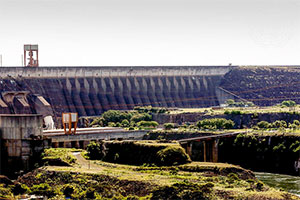 UN Power Plant, Paraguay. Credit: UN Photo/Evan Schneider
Energy has posed a great challenge for economies around the world. As global energy consumption skyrockets throughout the years, so does the need for sustainable solutions. The Sustainable Development Goals are essential in providing people with access to safe, affordable, and sustainable energy sources that minimize harm on the planet. Progress towards these goals opens the door for an advancement in modernization for communities on a global level and allows for a potential mitigation of tensions between nations.
The UN’s Summit of the Future in 2024 offered new initiatives that are being taken to achieve these goals, including a decreased reliance on fossil fuels, a switch to renewable energy sources, and improved climate financing.
IPS is well positioned to provide relevant, insightful, and compelling analysis of recent updates and measures being taken around the world to achieve a cleaner future.

The Week with IPS

NEXT STOP - SDGs
Tracking global progress towards a sustainable world
Tracking global progress towards a sustainable world
