Languages
Friday, October 2, 2026



News and Views from the Global South
Food and Agriculture
Grabbed
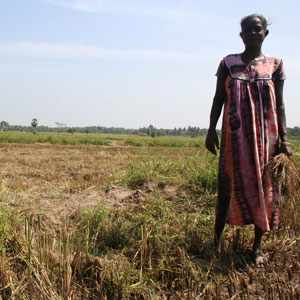
“Imagine that the land your family has worked for generations is suddenly stripped away from you, purchased by wealthy companies or governments to produce food or bio-fuels or simply as a profitable investment for other people, often far away. You watch on helplessly as vast tracts of land are cleared for mono-culture crops and rivers are polluted with run-off and chemicals.”
COP26: Building Climate Resilience Will Require a Focus on Those Furthest Behind
As the United Nations Climate Change Conference, also known as COP26, approaches (31 October -12 November in Glasgow, Scotland), climate action is more urgent than ever. Yes, we need climate change mitigation.
Guess Who’s Behind Paralysis on COVID19 in the UN Committee on World Food Security
‘COVID 19 has multiplied hunger and malnutrition challenges. We need transformative action!’ The first speaker at the UN Committee on World Food Security’s (CFS) 49th Plenary Session, the Secretary-General of the United Nations, turned the spotlight on the disastrous impacts of the pandemic that have afflicted communities around the world for close to two years.
What Fate for Three Billion of Humans Who Are Born Equals?
While more than a third of all purchased food is wasted in rich, mostly Western States, and a similar percentage is lost in poor countries due to the lack of appropriate harvesting, storage and transportation facilities, over three billion people --or some 40 percent of world population-- cannot afford a healthy diet. Add to these figures --which were released by UN's Food and Agriculture Organization (FAO) on 16 October this year, marking the World Food Day-- another dramatic fact.
A School & Cultural Institution Aims to Level the Playing Field for Women & Girls in Rural Uganda
As we honored women and girls last week, on the annual International Day of Rural Women on October 15, we want to highlight how a community is coming together to change the lives and livelihoods of rural women and girls in Uganda.
Table Banking Helping Women in Kenya to Put Food on the Table
Pascaline Chemutai’s five acres of land located in the country’s breadbasket region of Rift Valley recently produced 115 bags of maize, each weighing 90 kilograms. She tells IPS that of these, 110 bags will be transported to traders in Nairobi and neighbouring Kiambu County at a negotiated price of $23 per bag.
Argentina’s Small Farming Communities Reach Consumers Online
"The biggest problem for family farmers has always been to market and sell what they produce, at a fair price," says Natalia Manini, a member of the Union of Landless Rural Workers (UST), a small farmers organisation in Argentina that has been taking steps to forge direct ties with consumers.
World Food Day 2021
 Our lives depend on the world’s agri-food system.
Every time we eat, we participate in the system.
A sustainable agri-food system is one in which sufficient, nutritious and safe foods are available to everyone.
Our lives depend on the world’s agri-food system.
Every time we eat, we participate in the system.
A sustainable agri-food system is one in which sufficient, nutritious and safe foods are available to everyone.

How Land Management Can Restore Hope to Women in Rural Kenya
Jenifer Kamba, 33, has always loved farming – a love passed on to her by her late husband after they married 14 years ago. The young farmer duo grew maise, pepper and vegetables on their two-acre farm in Kivandini of Kenya’s Machakos county. Even after her husband died five years ago, Kamba didn’t stop farming. However, of late, the soil looks dry, and her production has declined considerably.
Atoll Nation of Tuvalu Adopts ‘Cubes’ to Step Up Nutritious Food Production
Tuvalu, a small atoll island nation in the Central Pacific Ocean, is one of few countries in the world to have so far evaded the pandemic. But, while it has achieved a milestone with no recorded cases of COVID-19, its population of about 11,931 continues to battle food uncertainties and poor nutrition. These challenges, present long before the pandemic emerged, have been exacerbated by lockdown restrictions and economic hardships during the past year and a half.
World Food Day: Climate Change is Exacerbating Hunger & Conflict—it’s Time to Break the Cycle
Hunger, violent conflict and the visible impacts of climate change are all on the rise. World Food Day, October 16, is a reminder that we need to talk about the intricate ways that these challenges are connected—and how to tackle them together.
Where on Earth is a Water-Secure World?
It is not uncommon for a water-centric research, policy or development organization or network to declare its long-term vision of the “water-secure world”. It reads nicely and feels great.
Multilateral Financial Institutions Can Catalyze Public Development Banks (PDB) to Deliver SDGs
There is broad consensus that realizing the Sustainable Development Goals (SDGs) and the Paris Agreement on climate change require a transformative agenda for agriculture and food systems. In this context, the importance of mobilizing more investments and aligning them to sustainable development and inclusive rural transformation objectives, is widely acknowledged.
Zero Hunger Campaign in Vietnam Targets Remote Areas and Cities
Amidst the verdant hills and remote corners of Vietnam’s rural regions, the growth that has transformed the economy in this part of Southeast Asia in recent decades can be hard to see. Undernourishment among children still results in stunting – even in cities too where overweight/obesity is also on the rise.
The Plight of Haiti
I assume channel surfing and internet browsing contribute to a decrease in people’s attention span. I am not familiar with any scientific proof, though while working as a teacher I found that some students may be exhausted when five minutes of a lesson has passed and begin fingering on their smartphones. They might also complain if a text is longer than half a page, while finding it almost impossible to read a book.
Transforming Global Food Systems Equitably & Sustainably Requires the Private Sector
In the days following the UN Food Systems Summit I have read a number or articles questioning whether there is a role for the private sector in transforming global food systems into something healthier, more sustainable and more equitable. Frankly, I don’t see how food systems transformation is possible without meaningful participation of the private sector.
Seizing the Post-Pandemic Opportunity to Transform Food Systems
The global food system needs a massive overhaul – this was clear before the Covid pandemic and it is even more true today. Feeding the world in a sustainable and healthy way is entirely possible but it is also inextricably linked to tackling the climate crisis by reaching net zero emissions, and to halting the dizzying decline in bio-diversity which is currently threatening the survival of one million plant and animal species.
Rural Water Boards Play Vital Role for Salvadoran Farmers
After climbing a steep hill along winding paths, you reach a huge water tank at the top that supplies peasant farmer families who had no water and instead set up their own community project on this coastal strip in central El Salvador.
Scientific Panel’s Scoping Report Instructive for Global Food Systems Transformation
On September 10th, on a sweltering summer afternoon, three fishers drove a van around the residential community of Castle Comfort in Dominica, blowing forcefully into their conch shells – the traditional call that there is fresh fish for sale in the area.
On the Verge of Change
Current food systems are no longer fit for the 21st century. Inequitable distribution, poor nutritional habits, and climate change are three issues breaking down our global food systems today, forcing us to look for solutions to transform them. Food aid – very much part of our global food systems – needs to be responsive to the challenges that lie ahead.
How Transforming Food Systems Could Unlock a $12 Trillion Global Windfall
With the world still counting the social and economic costs of the Covid-19 pandemic, amid a fresh “code red” on the climate crisis, food may not seem like the most pressing threat to humanity.« Previous Page — Next Page »


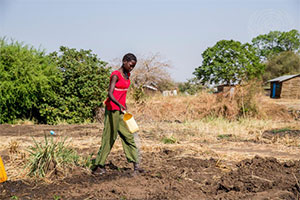 Farming on the Outskirts of Juba. Credit: UN Photo/JC McIlwaine
Promoting human and planetary health is a central focus of the United Nations, as laid out in the 2030 Sustainable Development Goals (SDGs). World hunger and unsustainable farming practices continue to be pressing concerns for the world. According to the 2025 State of Food Security and Nutrition in the World report by the Food and Agriculture Organization (FAO), 673 million people faced hunger in 2024. There are stark regional disparities, with the FAO projecting that 60% of the world population facing hunger will reside in Africa by 2030. Globally, the prevalence of food insecurity has remained consistently higher for women than men.
Sustainable and efficient national food systems are essential in preserving health, education, environmental well-being, peace, economy, and security. However, creating sustainable food systems can be a challenging endeavor, as food production takes a heavy toll on the environment. The agricultural sector accounts for a significant portion of greenhouse gases. Finding safe, sustainable, and ethical strategies to feed the world is crucial in ensuring planetary longevity. A recent initiative from 2023, the EU Regulation on Deforestation-free Products (EUDR), seeks to advocate for sustainable food systems. The main driver of deforestation is the expansion of agricultural land used to produce commodities like cattle, wood, cocoa, coffee, etc. The EUDR is part of the 2020 European Green New Deal and the EU Biodiversity Strategy for 2030 and aims to limit Europe’s consumption of products linked with deforestation by requiring that companies prove that their products are deforestation-free. Despite aiming to achieve major strides in sustainability, policies such as EUDR also raise socioeconomic concerns for targeted countries. Many emerging Latin American economies are impacted by the policy, and have raised the question of how developing countries can grapple with the tensions between economic development and advancing sustainability.
IPS has been at the forefront of providing compelling and insightful stories on communities facing hunger as well as the cost of food production. IPS uses statistics from FAO, the World Food Programme (WFP) and the International Fund for Agricultural Development (IFAD) to bring relevant and hard-hitting facts to readers. This gathering of information and data from such organizations helps bring the best stories from IPS journalists working in the different regions in consultation with experts on the ground.

The Week with IPS

NEXT STOP - SDGs
Tracking global progress towards a sustainable world
Tracking global progress towards a sustainable world