Languages
Monday, November 9, 2026



News and Views from the Global South
Humanitarian Emergencies

Nepali Children in Dire Need of Mental Health Services
On the night of Aug. 14, 2014, 10-year-old Hari Karki woke up to his grandfather’s loud yelling in the family’s home in Paagma, a small village in east Nepal.
“Drastic Decline” Seen in World Press Freedom
A leading advocacy group warns of a "worldwide deterioration in freedom of information" last year.
Mass Rapes Reported in Darfur as Conflict Escalates
More than 200 Darfurian women were reportedly raped by Sudanese troops in one brutal assault on a town in October 2014, with the conflict in war-torn Darfur escalating to new heights.
Conflict-Related Displacement: A Huge Development Challenge for India
 The tarpaulin sheet, when stretched and tied to bamboo poles, is about the length and breadth of a large SUV. Yet, about 25 women and children have been sleeping beneath these makeshift shelters at several relief camps across Kokrajhar, a district in the north-eastern Indian state of Assam.

OPINION: The Plight of Women and Girls in Zambezi’s Floods
The flooding of the Zambezi River has had devastating consequences for three countries in Southern Africa. The three worst affected countries are Malawi, Mozambique and Zimbabwe.
Conflict-Related Displacement: A Huge Development Challenge for India
The tarpaulin sheet, when stretched and tied to bamboo poles, is about the length and breadth of a large SUV. Yet, about 25 women and children have been sleeping beneath these makeshift shelters at several relief camps across Kokrajhar, a district in the north-eastern Indian state of Assam.
Children Starving to Death in Pakistan’s Drought-Struck Tharparkar District
The main entrance to the Civil Hospital in Mithi, headquarters of the Tharparkar district in Pakistan’s southern Sindh Province, is blocked by a couple of men clad in traditional dress and turbans. They are trying to console a woman who is sobbing so heavily she has to gasp for breath.

In the Shadow of Glacial Lakes, Pakistan’s Mountain Communities Look to Climate Adaptation
Khaliq-ul-Zaman, a farmer from the remote Bindo Gol valley in northern Pakistan’s Khyber Pakhtunkhwa province, has long lived under the shadow of disaster.
Boko Haram Insurgents Threaten Cameroon’s Educational Goals
“I’d quit my job before going to work in a place like that.” That is how a primary school teacher responded when IPS asked him why he had not accepted a job in Cameroon’s Far North region.
European Citizens Call for Increased Aid to Developing World
An overwhelming majority of citizens in the 28-member European Union (EU) - which has been hamstrung by a spreading economic recession, a fall in oil prices and a decline of its common currency, the Euro - has expressed strong support for development cooperation and increased aid to developing nations.Syrian Students on the Frontline of Conflict
While millions around the world are celebrating the dawn of a new year and the promise of change, hundreds of thousands of Syrian children have little reason to hope that 2015 will bring better days.
OPINION: Doubling Down on Dictatorship in the Middle East
For a moment, four years ago, it seemed that dictators in the Middle East would soon be a thing of the past.
Syrian Refugees Between Containers and Tents in Turkey
“We ran as if we were ants fleeing out of the nest. I moved to three different cities in Syria to try to be away from the conflict, but there was no safe place left in my country so we decided to move out.”
Children Starving to Death in Pakistan’s Drought-Struck Tharparkar District
The main entrance to the Civil Hospital in Mithi, headquarters of the Tharparkar district in Pakistan’s southern Sindh Province, is blocked by a couple of men clad in traditional dress and turbans. They are trying to console a woman who is sobbing so heavily she has to gasp for breath.
Sri Lanka Still in Search of a Comprehensive Disaster Management Plan
About six months after a massive tsunami slammed the island nation of Sri Lanka on Dec. 26, 2004, large plumes of smoke could be frequently seen snaking skywards from the beach near the village of Sainathimaruthu, just east of Kalmunai town, about 300 km from the capital, Colombo.
Poverty and Fear Still Rankle, Ten Years After the Tsunami
It took just 30 minutes for the killer waves to leave 350,000 dead and half a million displaced. Less than one hour for 100,000 houses to be destroyed and 200,000 people to be stripped of their livelihoods.
Years in the Making, Arms Trade Treaty Enters into Force
A new Arms Trade Treaty (ATT) beginning on Dec. 24 represents a historic moment in global efforts to keep weapons proliferation in check.
‘Cyclone College’ Raises Hopes, Dreams of India’s Vulnerable Fisherfolk
Ten years have now passed, but Raghu Raja, a 27-year-old fisherman from the coastal village of Nemmeli in southern India’s Kanchipuram district, still clearly remembers the day he escaped the tsunami.
OPINION: Give Peace a Chance – Run with Youth
Rambang “Raymond” Tot Deng was 18 and attending his final year of school when fighting erupted in South Sudan’s capital Juba, one year ago. In the ensuing violence, as Raymond’s schoolbooks burned, thousands of South Sudanese were killed, including two of his cousins.
What Future for the ACP-EU Partnership Post-2015?
“There are still prospects for a meaningful ACP-EU partnership, capable of contributing and responding concretely and effectively to the objectives of promoting and attaining peace, security, poverty eradication and sustainable development,” according to the top official of the African, Caribbean and Pacific Group of States (ACP).
OPINION: Climate Change and Inequalities: How Will They Impact Women?
Among all the impacts of climate change, from rising sea levels to landslides and flooding, there is one that does not get the attention it deserves: an exacerbation of inequalities, particularly for women.« Previous Page — Next Page »





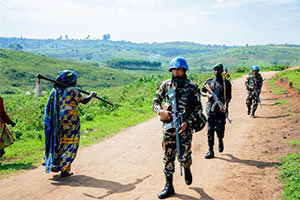 MONUSCO Peacekeepers and FARDC Soldiers Patrol Fataki Area. Credit: UN Photo/Jorkim Jotham Pituwa
Conflict, human rights violations, natural disasters, and famine have been at the forefront of concerns for humanitarian organizations. The escalation of humanitarian crises has led to over 239 million people in need of humanitarian assistance at the start of 2026, as estimated by OCHA’s Global Humanitarian Overview. The 2025 humanitarian appeal received only $12 billion, the lowest funding in over a decade, which has left 24 million fewer people reached in comparison to 2024. Conflict has remained the primary driver of crisis.
Humanitarian emergencies massively impact progress towards the Sustainable Development Goals (SDGs), adversely affecting economic development, inequality, education, planetary well-being, and poverty. Millions of people are faced with reduced access to essential services, including shelter, food, healthcare, and access to clean drinking water. UN Organizations such as UNHCR and the United Nations Children’s Fund (UNICEF) are committed to providing direct relief to affected communities when state governments cannot.
The United Nations 2024 Summit of the Future discussed measures that will be taken to reduce global inequality and promote peacekeeping efforts around the world. The recent UN Climate Change Conference (COP30) in Belém, Brazil, agreed to mobilize $1.3 trillion annually for climate action by 2035, operationalize the loss and damage fund, and triple adaptation finance. However, a fossil fuel transition commitment was not secured, despite climate change and the greenhouse effect being major contributors to humanitarian crises worldwide.
Countries across the world have also rallied to end humanitarian crises, as witnessed in conflicts such as Palestine and Ukraine. IPS is committed to providing relevant and in-depth reports of humanitarian emergencies around the world and their implications.

The Week with IPS

NEXT STOP - SDGs
Tracking global progress towards a sustainable world
Tracking global progress towards a sustainable world