Languages
Monday, November 9, 2026



News and Views from the Global South
Humanitarian Emergencies

Afghan Concern Over Western Disengagement
The U.S./NATO International Security Assistance Force Joint Command lowered its flag for the last time in Afghanistan on Dec. 8, after 13 years. The ISAF mission officially ends on Dec. 31, and will be replaced on Jan. 1, 2015 by “Resolute Support”, a new, narrow-mandate mission to train, advise and assist the Afghan National Security Forces.
Groups Push Obama to Clarify U.S. Abortion Funding for Wartime Rape
Nearly two dozen health, advocacy and faith groups are calling on President Barack Obama to take executive action clarifying that U.S. assistance can be used to fund abortion services for women and girls raped in the context of war and conflict.
U.N. Urged to Ban Nuke Strikes Against Cities
Civil society groups are urging the U.N. General Assembly to pass a resolution declaring nuclear strikes on cities to be a clear-cut violation of international humanitarian law.
Hiroshima, Nagasaki Cast Shadow Over Nuclear Conference in Vienna
When Secretary-General Ban Ki-moon was at Harvard University early this week to pick up the 'Humanitarian of the Year' award, his thoughts transcended the city of Cambridge, Massachusetts, to the Austrian capital of Vienna which will be the venue of a key international conference on nuclear weapons next week.
Football Stars Join ‘Africa United’ Campaign to Stop Spread of Ebola
The Confederation of African Football (CAF) has joined a number of football stars, celebrities, international health organisations and corporations in the ‘Africa United’ global health communications campaign aimed at preventing the spread of Ebola in West Africa.
Athens Sit-in Highlights Catch-22 for Refugees
A sit-in protest by Syrian refugees on Syntagma Square opposite the Greek parliament in the heart of Athens has turned into a demonstration of the stalemate faced by both Greek as well as European immigration policy.
OPINION: How Ebola Could End the Cuban Embargo
When was the last time in recent memory a top U.S. official praised Cuba publicly? And since when has Cuba’s leadership offered to cooperate with Americans?
Refugees Between a Legal Rock and a Hard Place in Lebanon
Staring at the floor, Hassan, a 21-year-old Syrian refugee from Idlib in northwestern Syria, holds a set of identification papers in his hands. He picks out a small pink piece of paper with a few words on it stating that he must obtain a work contract, otherwise his residency visa will not be renewed.
U.N. Concerned Over Ebola Backlash
The United Nations, which is working on an emergency footing to battle the outbreak of Ebola, is worried about the potential for further isolation of the hardest-hit nations in West Africa.
Building Disaster Resilience Amidst Rampant Poverty
Of the thousands of landslide-prone villages he has visited and worked with, R M S Bandara, a high-ranking official from Sri Lanka’s National Building Resources Organisation (NBRO), says only one has made him sit up and take note.
Ebola Outbreak Affects Key Development Areas in Sierra Leone
The outbreak of the deadly Ebola epidemic in Sierra Leone has badly affected the West African country’s move towards meeting key development goals.
War-ravaged South Sudan Struggles to Contain AIDS
Dressed in a flowered African print kitenge and a blue head scarf, Sabur Samson, 27, sits pensively at the HIV centre at Maridi Civil Hospital in South Sudan’s Western Equatoria state.
U.S. Proposes Major Debt Relief for Ebola-Hit Countries
The United States proposed Tuesday that the international community write off 100 million dollars in debt owed by West African countries hit hardest by the current Ebola outbreak. The money would be re-invested in health and other public programming.
Ebola and ISIS: A Learning Exchange Between U.N. and Faith-based Organisations
The simultaneity presented by the outbreak of the deadly Ebola virus on one hand and militant barbarism ostensibly in the name of Islam on the other present the international development community - particularly the United Nations and international NGOs – with challenges, as well as opportunities.
Braving Dust storms, Women Plant Seeds of Hope
In the world’s largest refugee complex – the sprawling Dadaab settlement in Kenya’s North Eastern Province – women listen attentively during a business management workshop held at a hospital in one of its newest camps, Ifo 2.
Filipinos Take to the Streets One Year After Typhoon Haiyan
People covered their bodies with mud to protest against government ineptitude and abandonment; others lighted paper lanterns and candles and released white doves and balloons to remember the dead, offer thanks and pray for more strength to move on; while many trooped to a vast grave site with white crosses to lay flowers for those who died, and to cry one more time.
Trapped Populations – Hostages of Climate Change
Climate change is projected by many scientists to bring with it a range of calamities – from widespread floods, to prolonged heatwaves and slowly but relentlessly rising seas – taking the heaviest toll on those already most vulnerable.
Disciples of John the Baptist also flee ISIS
"Going back home? That would be suicide. The Islamists would cut our throats straight away," says Khalil Hafif Ismam. The fear of this Mandaean refugee sums up that of one of the oldest yet most decimated communities in Mesopotamia.
Women Challenged by Rising Extremism and Militarism
Ongoing military conflicts in the strife-torn Middle East - specifically in Iraq, Syria, Libya and Palestine - have resulted in widespread civilian casualties, impacting heavily on the most vulnerable in besieged communities: women and children.
Choosing Between Death and Death in Pakistan
Residents of the Khyber Agency, one of seven administrative districts that comprise northern Pakistan’s Federally Administered Tribal Areas (FATA), are in the worst possible predicament: either course of action they choose now, they say, could result in death.
Children in Aleppo Forced Underground to Go to School
Winter has not yet hit this nearly besieged city, but children are already attending classes in winter coats and stocking hats.« Previous Page — Next Page »





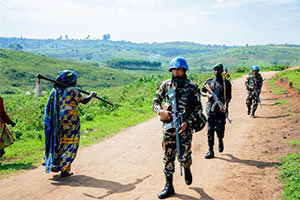 MONUSCO Peacekeepers and FARDC Soldiers Patrol Fataki Area. Credit: UN Photo/Jorkim Jotham Pituwa
Conflict, human rights violations, natural disasters, and famine have been at the forefront of concerns for humanitarian organizations. The escalation of humanitarian crises has led to over 239 million people in need of humanitarian assistance at the start of 2026, as estimated by OCHA’s Global Humanitarian Overview. The 2025 humanitarian appeal received only $12 billion, the lowest funding in over a decade, which has left 24 million fewer people reached in comparison to 2024. Conflict has remained the primary driver of crisis.
Humanitarian emergencies massively impact progress towards the Sustainable Development Goals (SDGs), adversely affecting economic development, inequality, education, planetary well-being, and poverty. Millions of people are faced with reduced access to essential services, including shelter, food, healthcare, and access to clean drinking water. UN Organizations such as UNHCR and the United Nations Children’s Fund (UNICEF) are committed to providing direct relief to affected communities when state governments cannot.
The United Nations 2024 Summit of the Future discussed measures that will be taken to reduce global inequality and promote peacekeeping efforts around the world. The recent UN Climate Change Conference (COP30) in Belém, Brazil, agreed to mobilize $1.3 trillion annually for climate action by 2035, operationalize the loss and damage fund, and triple adaptation finance. However, a fossil fuel transition commitment was not secured, despite climate change and the greenhouse effect being major contributors to humanitarian crises worldwide.
Countries across the world have also rallied to end humanitarian crises, as witnessed in conflicts such as Palestine and Ukraine. IPS is committed to providing relevant and in-depth reports of humanitarian emergencies around the world and their implications.

The Week with IPS

NEXT STOP - SDGs
Tracking global progress towards a sustainable world
Tracking global progress towards a sustainable world