Languages
Wednesday, October 7, 2026



News and Views from the Global South
Population
Amid Coronavirus Pandemic, SDGs are Even More Relevant Today Than Ever Before
Our world today is dealing with a crisis of monumental proportions. The vicious, novel coronavirus is wreaking havoc across the globe, destroying lives and ruining livelihoods.
A Gender-equal Ethiopian Parliament can Improve the Lives of all Women
Recent gains by women in the Ethiopian political landscape offer a chance to improve gender equality around the country and put an end to long-standing societal iniquities. Since coming to power in 2018, Prime Minister Abiy Ahmed has reorganised the cabinet to ensure that 50 percent of the government’s top ministerial positions have been given to women.
**Correction**How the COVID-19 Pandemic is Affecting Women’s Sexual and Reproductive Health
A little over half of women across the globe are able to freely make choices about their sexual and reproductive health, according to a latest report based on data from 57 countries. However, as much of the world has gone into lockdown because of the coronavirus pandemic, with countries implementing social distancing and restricting the free movement of people, experts are concerned that even this small gain in sexual and reproductive health may suffer negatively.
Latin America Has Weak Defences Against the Pandemic
Health systems in Latin America, already falling short in their capacity to serve the population, especially the poor, are in a weak position and face serious risks when it comes to addressing the COVID-19 pandemic.
U.N. Releases Report on Socio-economic Effects of Coronavirus
As the number of coronavirus cases continues to grow, concerns are simultaneously growing about the current and long-term effects this will have on certain demographics -- specifically, women, the youth, migrant workers, and many employees around the world.
Can Eswatini’s Traditional Healers Encourage HIV Testing Among People Not Accessible via Routine Healthcare Systems?
Doctor Khalishwayo is a traditional healer based in Nhlangano, a town in the Shiselweni Region, in southern Eswatini. His clients are people who consult him when they are suffering from different ailments. And he in turn diagnoses them using divine methods.
Djibouti Intensifies Awareness-raising Efforts Against FGM
Female Genital Mutilation (FGM) is still widely practised in the African country of Djibouti. Despite efforts by the government and development agencies to curb this practice, culture, tradition and religion continue to slow down progress.
Why Empowering National Human Rights Institutions Helps on the Quest for Healthy Earth?
We are living in a critical time. As we face existential environmental challenges from climate crises to the mass extinction of species, it is difficult sometimes to see solutions and new ideas. This is why we all need to celebrate and give visibility to creative and courageous efforts of people and organizations striving towards a healthy planet for all.
Young People Bring Solar Energy to Schools in the Argentine Capital
"The idea came to a group of schoolmates and me in 2014, but we never thought it could become a reality," says Sebastián Ieraci, 23, as he points to a multitude of photovoltaic solar panels shining on the roof of the Antonio Devoto High School in the Argentine capital.
Why Nigeria Knows Better How to Fight Corona Than the US
The coronavirus disease, otherwise known as COVID-19, was first reported in Wuhan, China on the last day of December 2019. When it began to spread rapidly, the World Health Organisation (WHO) declared it a public health emergency of international concern on 30 January 2020.
Population 2020: Demographics can be Potent Driver of Pace & Process of Economic Development
“Demography is destiny” is an oft-cited phrase that suggests the size, growth, and structure of a nation’s population determines its long-term social, economic, and political fabric.
Why Rich Countries must Protect Developing Nations from Coronavirus Pandemic
Governments in wealthy, first world countries must not ignore the plight of poorer nations battling the coronavirus or the disease will not be brought under control, global development experts have said.
Fight, Not Flight, Must Be the Strategy for Flattening the COVID-19 Curve
The number of coronavirus cases in Kenya has jumped to three after the government confirmed two more cases. President Uhuru Kenyatta has announced a raft of proactive measures to prevent the spread of the virus.
Air Pollution in South Asia: Biomass Burning Emissions & its Impact
A young adult man requires 15 m3 or 15 kg of air, 1.5 liters or 1.5 kg of water and 0.75 kg of solid food every day. This indicates around 87% of our everyday basic requirement is air.
Realising Women’s Rights Difficult for Africa’s Fragile States
Pokot girls are expected to face the knife stark naked and with courage. To inspire confidence, their fathers sit a few metres away from them with a spear in hand.
Indonesia’s Laws Ineffective against Human Trafficking
When her uncle offered her an opportunity to work in Jakarta almost a decade ago, the then 15-year-old Afra Burga Ambui immediately agreed and soon she was boarding a two-hour flight to the country’s capital and away from her village on Flores Island in East Nusa Tenggara, southern Indonesia.
SDGs Corporate Tracker to Monitor Progress of UN’s Development Agenda
This year marks just ten years ahead of the deadline for completing the UN Sustainable Development Goals (SDGs) by 2030. These universally supported targets were always ambitious in their scope – yet what is clearer now than ever before is that quicker progress is crucial in the decade to come.
Why Paraguay Can Be a “Beacon State” for Forest Management
Imagine a forest that covered half of your entire country. A biodiverse forest which supports thousands of species from giant anteaters to armadillos to jaguars. A forest that is home to one the world’s last uncontacted tribes.1
Female Genital Mutilation: Not just an Emotional and Health Impact on Women but a $1.4 Billion Dollar Cost to Communities
When society doesn't act to prevent Female Genital Mutilation (FGM) it has a massive economic cost -- over $1 billion -- on communities globally. And while the practice is starting to become less common over time, experts say a large number of women and girls still remain affected.
Restoring Competition in ”Winner-took-All” Digital Platform Markets
Digital platforms are at the centre of the global economy and daily lives of consumers. A handful of these platforms have become dominant in specific markets without facing meaningful competition. They include Amazon as a marketplace, Facebook in social networking, Google in search engines and Apple and Google in application stores.
Inequalities in Human Development in the 21st Century
Inequalities. The evidence is everywhere. And although they may be hard to measure and summarize, there is a sense in many countries that many are approaching a precipice beyond which it will be difficult to recover.« Previous Page — Next Page »





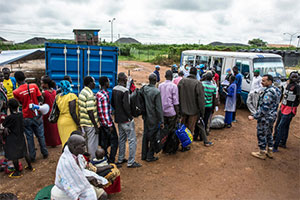 One Thousand Internally Displaced Persons (IDPs) Relocated from Tomping Camp in South Sudan. Credit: UN Photo/Isaac Billy
It took hundreds of thousands of years for the world’s human population to cross one billion in 1804. Approximately 200 years later, the population has multiplied sevenfold. In 2023, the global population crossed 8 billion, and is expected to reach 9 billion before 2050. With the planet more crowded than ever, it is essential to keep track of population trends, urbanization, migration, and reproduction across the world.
Life expectancy has seen significant strides in the past century, largely due to economic development and increased standards of living. On the contrary, trends in global fertility are shifting, with certain regions in Africa and Asia reporting higher rates, while parts of Europe and North America report stagnant or lower rates. This is in part due to differences in sexual and reproductive healthcare, as well as societal and economic conditions around the world. For example, child marriage is prevalent in certain societies, where childbearing is also considered a familial duty. Meanwhile, stagnating economies frequently experience lower marriage and childbearing rates.
The increase in migration and urban development around the world is also linked to global population trends. By 2050, it is expected that approximately 66 percent of all people will live in cities. Furthermore, global crises such as warfare and natural disasters also prompt transnational migration. Transnational migration is linked to a variety of socioeconomic issues in both host and receiving countries: migrants often leave developing countries with less access to educational and economic opportunities and arrive in developed countries where they are frequently the targets of ethnic, racial, and cultural discrimination, and economic exploitation. Recent crises in Europe and the United States demonstrate the importance of advocating for migrants worldwide. As migrants from the Global South are increasingly stripped of their legal and civic rights in unlawful deportations, or targeted in acts of identity-based violence, it is essential to keep track of population trends and protect the human rights of migrant populations. Climate-related disasters are now a major driver of displacement, with nearly half of all new internal displacements in 2025 being disaster-related.
IPS is devoted to covering issues surrounding population trends, migration, and reproduction through its compelling articles, which use both statistics and human stories to provide readers with robust and informative viewpoints.

The Week with IPS

NEXT STOP - SDGs
Tracking global progress towards a sustainable world
Tracking global progress towards a sustainable world
