Languages
Thursday, October 1, 2026



News and Views from the Global South
Population

As SDGs Falter, the UN Turns to the Rich and Famous
The Sustainable Development Goals (SDGs) are in trouble. United Nations officials are concerned and say so publicly. Secretary-General António Guterres joined in raising an alarm in mid-July when he introduced the most recent official UN report.
Malnutrition in Humanitarian Settings
As the rain hammers down, Aparo Dorin sits on the damp floor of her one-room hut in zone 12, block 5A, of the Palabek refugee camp in northern Uganda.
Will a Global Fund Help Deliver UN’s Development Agenda?
The United Nations, which has been tracking both the successes and failures of its highly-ambitious Agenda for Sustainable Development, has warned that “progress has been slow” in many of the 17 Goals after four years of implementation.
US Leads Donor Funding to Fight HIV/AIDS Amidst Overall Decline
Since 2010, donor funding to fight HIV/AIDS in low-and middle-income countries has dropped significantly, according to a new report released here.
How China’s Africa Alliance is Shifting World Order
When the United Nations General Assembly met in 2007 to vote on North Korea’s human rights record, only 10 of the 56 African countries voted with the U.S.-led western coalition.
How Skills Can Change Lives of World’s Youth
When the United Nations commemorated World Youth Skills Day, there was one stark reality that emerged out of the event: the world’s youth account for over a third of the global population of more than 7.7 billion people, and they also account for over a third of those unemployed across the globe.
The Road to Zero Hunger
Over 820 million people across the globe are currently undernourished, according to a new report released here.
Growing African Agriculture One Byte at a Time
Ella Mazani is a mobile phone farmer. “My mobile phone is part of my farming. It supports my farming and my family’s welfare through the services I get via the phone,” the smallholder maize farmer from Shurugwi in central Zimbabwe quips.
US Defunds UNFPA for Third Consecutive Year– on Misconceived Assumptions
The Trump administration, in its continued hostility towards the United Nations-- and as part of its policy aimed at undermining multilateral institutions and international commitments-- has withheld its annual contributions to the UN Population Fund (UNFPA) – for the third consecutive year.
Spirit of Olympics & UN’s Development Agenda
As I reflect on the varied views and perspectives that emerged during the Human Rights Council’s Social Forum 2018--- where the theme of Olympic ideal and inclusive sports and their contribution to the promotion of the human rights, peace and development through sports were extensively deliberated on-- I observed an immediate connect with the preparations that are currently underway for the hosting of the Olympics 2024 in France.
Rwanda Prepares the Foundations for Climate-Resilient Cities
How do you plan a resilient city? A city that can withstand climate change impacts, and the natural disasters that it produces at increased frequencies. And how do you protect the city, its individuals and communities, its business and institutions from either the increased flooding or prolonged droughts that result? It’s a complex question with an even more complex solution, but one that the central African nation of Rwanda is looking to answer.
A Relentless Battle Against Poverty & Hunger in World’s Most Populous Region
The world’s two most populous nations-– China and India—have been making steady progress in eradicating extreme poverty, but have fallen short in their attempts to eliminate extreme hunger, according to the Bangkok-based UN Economic and Social Commission for Asia and the Pacific (ESCAP).
Prejudice and Discrimination, the Uncured Ills of Leprosy
“The ambulance team refused to take my sick friend to the hospital because he had had Hanseniasis years before," said Yohei Sasakawa, president of the Nippon Foundation, at one of the meetings held during his Jul. 1-10 visit to Brazil.
Avoiding the Mistakes of the Asian Green Revolution in Africa
Research scientists are studying groundwater resources in three African countries in order to understand the renewability of the source and how people can use it sustainably towards a green revolution in Africa.
Let’s Talk About Sex – and Why Power Matters
Every year on World Population Day (July 11), UNFPA receives queries from journalists about the total number of people around the world. Numbers are indeed important because they help governments develop policies that respond to evolving needs for services such as education and health.
Drought, Disease and War Hit Global Agriculture, Says U.N.
The United Nations has warned of drought, disease and war preventing farmers from producing enough food for millions of people across Africa and other regions, leading to the need for major aid operations.
A Lifelong Battle Against the “Disease of Silence”
Yohei Sasakawa has dedicated half of his 80 years of life to combating the "disease of silence" and is still fighting the battle, as president of the Nippon Foundation and World Health Organisation (WHO) goodwill ambassador for elimination of leprosy, formally known as Hansen's Disease.
Africa’s Megacities a Magnet for Investors
Megacities, cities with a population of at least 10 million, are sprouting everywhere in Africa. Cairo in Egypt, Kinshasa in the Democratic Republic of the Congo (DRC) and Lagos in Nigeria are already megacities, while Luanda in Angola, Dar es Salaam in Tanzania and Johannesburg in South Africa will attain the status by 2030, according the United Nations.
Of Leaders Then and Now
Richard Dossevi parks his motorcycle taxi on one of the busiest street corners in Cotonou, Benin's commercial capital, to wait for commuters amid the summer heat.
Solar Collectors and Solidarity Change Lives in Argentina
"This is the best thing ever invented for the poor," says Emanuel del Monte, pointing to a tank covered in black tarps protruding from the roof of his house. It forms part of a system built mostly from waste materials, which heats water through solar energy and is improving lives in Argentina.
We Can Get the 2030 Agenda Back on Track – With More Empowered, Inclusive, & Equal Partnerships
The 2030 Agenda for Sustainable Development, universally adopted in 2015, is a plan to create a better and more sustainable future for all in just 15 years, through 17 Sustainable Development Goals (the SDGs). It sounds implausible.« Previous Page — Next Page »


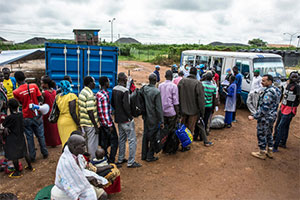 One Thousand Internally Displaced Persons (IDPs) Relocated from Tomping Camp in South Sudan. Credit: UN Photo/Isaac Billy
It took hundreds of thousands of years for the world’s human population to cross one billion in 1804. Approximately 200 years later, the population has multiplied sevenfold. In 2023, the global population crossed 8 billion, and is expected to reach 9 billion before 2050. With the planet more crowded than ever, it is essential to keep track of population trends, urbanization, migration, and reproduction across the world.
Life expectancy has seen significant strides in the past century, largely due to economic development and increased standards of living. On the contrary, trends in global fertility are shifting, with certain regions in Africa and Asia reporting higher rates, while parts of Europe and North America report stagnant or lower rates. This is in part due to differences in sexual and reproductive healthcare, as well as societal and economic conditions around the world. For example, child marriage is prevalent in certain societies, where childbearing is also considered a familial duty. Meanwhile, stagnating economies frequently experience lower marriage and childbearing rates.
The increase in migration and urban development around the world is also linked to global population trends. By 2050, it is expected that approximately 66 percent of all people will live in cities. Furthermore, global crises such as warfare and natural disasters also prompt transnational migration. Transnational migration is linked to a variety of socioeconomic issues in both host and receiving countries: migrants often leave developing countries with less access to educational and economic opportunities and arrive in developed countries where they are frequently the targets of ethnic, racial, and cultural discrimination, and economic exploitation. Recent crises in Europe and the United States demonstrate the importance of advocating for migrants worldwide. As migrants from the Global South are increasingly stripped of their legal and civic rights in unlawful deportations, or targeted in acts of identity-based violence, it is essential to keep track of population trends and protect the human rights of migrant populations. Climate-related disasters are now a major driver of displacement, with nearly half of all new internal displacements in 2025 being disaster-related.
IPS is devoted to covering issues surrounding population trends, migration, and reproduction through its compelling articles, which use both statistics and human stories to provide readers with robust and informative viewpoints.

The Week with IPS

NEXT STOP - SDGs
Tracking global progress towards a sustainable world
Tracking global progress towards a sustainable world
