Languages
Tuesday, October 6, 2026



News and Views from the Global South
Population

Humanitarian Emergencies Lend Urgency to World Population Day
On the eve of World Population Day, the United Nations is fighting a virtually losing battle against growing humanitarian emergencies triggered mostly by military conflicts that are displacing people by the millions – and rendering them either homeless or reducing them to the status of refugees.Social Safety Net Not Wide Enough to Protect World’s Poor
Fifty-five percent of the world’s poor still have limited protection from hunger and economic, social or political crises despite expansion of social safety programmes in developing countries in recent years.
Opinion: Unlocking the Potential of Mali’s Young Women and Men
The recent peace agreements in Mali offer grounds for optimism. It’s now time to capitalise on the accord to accelerate recovery, reconciliation and development. An important part of that process will entail placing the country’s youth at the center of the country’s agenda for peace and prosperity.
Will the New BRICS Bank Break with Traditional Development Models, or Replicate Them?
Just days ahead of a summit of the BRICS group of emerging economies (Brazil, Russia, India, China and South Africa) in which the five countries are expected to formally launch their New Development Bank (NDB), 40 NGOs and civil society groups have penned an open letter to their respective governments urging transparency and accountability in the proposed banking process.
Ebola Recovery Focuses on Strengthening Africa’s Health Systems
Secretary-General Ban Ki-moon, addressing delegates in a run-up to an international Ebola recovery conference, said last month that “all of the investments, all of the sacrifices and all of the risks by relief workers” would be squandered if an outbreak of the disease recurs.
Putting the “Integrity of the Earth’s Ecosystems” at the Centre of the Sustainable Development Agenda
By 2050, we will be a world of nine billion people. Not only does this mean there’ll be two million more mouths to feed than there are at present, it also means these mouths will be consuming more – in the next 20 years, for instance, an estimated three billion people will enter the middle class, in addition to the 1.8 billion estimated to be within that income bracket today.
Despite Scepticism, U.N. Hails Its Anti-Poverty Programme
The United Nations, which launched one of its most ambitious anti-poverty development programmes back in 2000, has hailed it as a riveting success story – despite shortcomings.
Opinion: Religion and the SDGs – The ‘New Normal’ and Calls for Action
In 2007, an op-ed in the International Herald Tribune argued that you “gotta have faith in the U.N”.
Equality, a Hard Game to Win for Women Footballers in Argentina
During a women’s football match in a poor neighbourhood in Buenos Aires, team manager Mónica Santino has to stop the game and ask a group of boys and young men not to invade the pitch where they’re playing. This frequent occurrence is just one symbol of a struggle being played out, centimeter by centimeter, on Argentina’s pitches.
Child Labour: A Hidden Atrocity of the Syrian Crisis
In a conflict that has claimed over 220,000 lives and injured a further 840,000 people as of January 2015, it is sometimes hard to see beyond the death toll.
Syrian Refugees Face Hunger Amidst Humanitarian Funding Crisis
The United Nations’ food aid organisation, the World Food Programme (WFP), said on Jul. 1 that up to 440,000 refugees from war-torn Syria might have to go hungry if no additional funds are received by August.
Poor Bear the Brunt of Corruption in India’s Food Distribution System
Chottey Lal, 43, a daily wage labourer at a construction site in NOIDA, a township in the northern Indian state of Uttar Pradesh, is a beleaguered man. After a gruelling 12-hour daily shift at the dusty location, he and his wife Subha make barely enough to feed a family of seven.
Toilets with Piped Music for Rich, Open Defecation on Rail Tracks for Poor
As most developing nations fall short of meeting their goals on sanitation, the world’s poorest countries have been lagging far behind, according to a new U.N. report released here.
Cuba: Blazing a Trail in the Fight Against HIV/AIDS
In 2013, an estimated 240,000 children were born with HIV. This was an improvement from 2009, when 400,000 babies tested positive for the infection, but still a far cry from the global target of reducing total child infections to 40,000 by 2015.
Bangladeshi Migrants Risk High Seas and Smugglers to Escape Poverty
Though he is only 16 years old, Mohammad Yasin has been through hell and back. He recently survived a hazardous journey by sea, crammed into the cargo-hold of a rudimentary boat along with 115 others.
Black Women in the Americas Launch Decade of Struggle
They say they are tired of waiting for justice after centuries of neglect and contempt due to the color of their skin. Black women leaders from 22 countries of the Americas have decided to create a political platform that set a 10-year target for empowering women of African descent and overcoming discrimination.
U.S. Urged to Ramp up Aid for Agent Orange Clean-Up Efforts in Vietnam
A key senator and a D.C.-based think tank are calling for Washington to step up its aid in cleaning up toxic herbicides sprayed by the United States in Vietnam during the war that ended 40 years ago.
Afghanistan: No Place for Children
No one will deny that when a child – any child – is killed, it is a tragedy. Imagine, then, the extent of the tragedy in Afghanistan where, in just four years, 2,302 children have lost their lives as a result of ongoing fighting in this country of 30 million people.
Donors Pledge Over 4.4 Billion Dollars to Nepal – But With a Caveat
Blessed with more than 4.4 billion dollars in pledges at an international donor conference in Kathmandu on Thursday, the government of Nepal is expected to launch a massive reconstruction project to rebuild the earthquake-devastated South Asian nation.
Ghosts Of War Give Way to Development in Sri Lanka
It is an oasis from the scorching heat outside. The three-storey, centrally air-conditioned Cargills Square, a major mall in Sri Lanka’s northern Jaffna town, is the latest hangout spot in the former warzone, where everyone from teenagers to families to off-duty military officers converge.Billions Pledged for Nepal Reconstruction – But Still No Debt Relief
A major donor conference in Nepal’s capital, Kathmandu, came to a close on Jun. 25 with foreign governments and aid agencies pledging three billion dollars in post-reconstruction funds to the struggling South Asian nation.« Previous Page — Next Page »





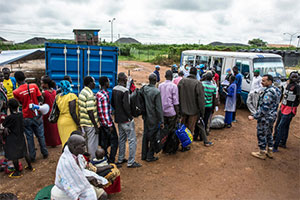 One Thousand Internally Displaced Persons (IDPs) Relocated from Tomping Camp in South Sudan. Credit: UN Photo/Isaac Billy
It took hundreds of thousands of years for the world’s human population to cross one billion in 1804. Approximately 200 years later, the population has multiplied sevenfold. In 2023, the global population crossed 8 billion, and is expected to reach 9 billion before 2050. With the planet more crowded than ever, it is essential to keep track of population trends, urbanization, migration, and reproduction across the world.
Life expectancy has seen significant strides in the past century, largely due to economic development and increased standards of living. On the contrary, trends in global fertility are shifting, with certain regions in Africa and Asia reporting higher rates, while parts of Europe and North America report stagnant or lower rates. This is in part due to differences in sexual and reproductive healthcare, as well as societal and economic conditions around the world. For example, child marriage is prevalent in certain societies, where childbearing is also considered a familial duty. Meanwhile, stagnating economies frequently experience lower marriage and childbearing rates.
The increase in migration and urban development around the world is also linked to global population trends. By 2050, it is expected that approximately 66 percent of all people will live in cities. Furthermore, global crises such as warfare and natural disasters also prompt transnational migration. Transnational migration is linked to a variety of socioeconomic issues in both host and receiving countries: migrants often leave developing countries with less access to educational and economic opportunities and arrive in developed countries where they are frequently the targets of ethnic, racial, and cultural discrimination, and economic exploitation. Recent crises in Europe and the United States demonstrate the importance of advocating for migrants worldwide. As migrants from the Global South are increasingly stripped of their legal and civic rights in unlawful deportations, or targeted in acts of identity-based violence, it is essential to keep track of population trends and protect the human rights of migrant populations. Climate-related disasters are now a major driver of displacement, with nearly half of all new internal displacements in 2025 being disaster-related.
IPS is devoted to covering issues surrounding population trends, migration, and reproduction through its compelling articles, which use both statistics and human stories to provide readers with robust and informative viewpoints.

The Week with IPS

NEXT STOP - SDGs
Tracking global progress towards a sustainable world
Tracking global progress towards a sustainable world
