Languages
Friday, October 16, 2026



News and Views from the Global South
Population
Tackling Ebola: Give Autonomy to Local African Communities, Says International Rescue Committee
Recommendations on how to eradicate Ebola and avoid future outbreaks were released in a report on Tuesday by the International Rescue Committee (IRC).
Opinion: It’s Time to Step It Up for Gender Equality
If we look at the headlines or the latest horrifying YouTube clip, Mar. 8 – International Women’s Day – may seem a bad time to celebrate equality for women.
Gaza Reconstruction, Hampered by Israeli Blockade, May Take 100 Years, Say Aid Agencies
Despite all the political hoopla surrounding an international pledging conference in Cairo last October to help rebuild Gaza, the reconstruction of the Israeli-devastated territory is apparently moving at the pace of paralytic snail.
Women Leaders Call for Mainstreaming Gender Equality in Post-2015 Agenda
Women leaders from every continent, brought together by U.N. Women and the Chilean government, demanded that gender equality be a cross-cutting target in the post-2015 development agenda. Only that way, they say, can the enormous inequality gap that still affects women and children around the world be closed.
For Women in Asia, ‘Home’ Is a Battleground
Nearly half of the four billion people who reside in the Asia-Pacific region are women. They comprise two-thirds of the region’s poor, with millions either confined to their homes or pushed into the informal labour market where they work without any safeguards for paltry daily wages. Millions more become victims of trafficking and are forced into prostitution or sexual slavery.Namibian President Wins $5 Million African Leadership Prize
Outgoing Namibian President Hifikepunye Pohamba was Monday named winner of the Ibrahim Prize for Achievement in African Leadership, believed to be the most lucrative individual award in the world.

Everyone Benefits from More Women in Power
Women’s participation in decision-making is highly beneficial and their role in designing and applying public policies has a positive impact on people’s lives, women leaders and experts from around the world stressed at a high-level meeting in the capital of Chile.
Syrian Conflict Has Underlying Links to Climate Change, Says Study
Was the four-year-old military conflict in Syria, which has claimed the lives of over 200,000 people, mostly civilians, triggered at least in part by climate change?
Environmental Damage to Gaza Exacerbating Food Insecurity
Extensive damage to Gaza’s environment as a result of the Israeli blockade and its devastating military campaign against the coastal territory during last year’s war from July to August, is negatively affecting the health of Gazans, especially their food security.
Opinion: Manipulate and Mislead – How GMOs are Infiltrating Africa
The most persistent myth about genetically modified organisms (GMOs) is that they are necessary to feed a growing global population.
Tobacco Workers in Cuba Dubious About Opening of U.S. Market
“We have to wait and see,” “There isn’t a lot of talk about it,” are the responses from tobacco workers in this rural area in western Cuba when asked about the prospect of an opening of the U.S. market to Cuban cigars.
Opinion: Goals for Gender Equality Are Not a ‘Wish List’ – They Are a ‘To Do List’
This weekend, at the invitation of President Michelle Bachelet and myself, women leaders from across the world are meeting in Santiago de Chile. We will applaud their achievements. We will remind ourselves of their contributions. And we will chart a way forward to correct the historical record. History has not been fair to women – but then, women usually didn’t write it.
Rousseff’s Brazil – No Country for the Landless
In Brazil, one of the countries with the highest concentration of land ownership in the world, some 200,000 peasant farmers still have no plot of their own to farm – a problem that the first administration of President Dilma Rousseff did little to resolve.
From the Police Station Back to the Hellhole: System Failing India’s Domestic Violence Survivors
“One time my husband started slapping me hard on the face because I had not cooked the rice to his satisfaction,” Suruchi* told IPS. “He hit me so hard that my infant daughter fell from my arms to the ground.”Study Shows Shift in Level of Social Hostility Involving Religion
Social hostilities involving religion have declined worldwide, according to a new report released on Wednesday by the Washington-based Pew Research Center.
Sometimes a Single Tree Is More Effective than a Government
Every morning, Raj Kumari Chaudhari walks from her home to the other end of Padnaha village, located in the Bardiya district of mid-west Nepal, to a big mango tree to offer prayers.
Families of ‘Desaparecidos’ Take Search into Their Own Hands
Carlos Trujillo refuses to give up, after years of tirelessly searching hospitals, morgues, prisons, cemeteries and clandestine graves in Mexico, looking for his four missing brothers.
Human Rights in Asia and the Pacific: A “Regressive” Trend, Says Amnesty International
The cradle of some of the world’s most ancient civilizations, home to four out of the planet’s six billion people, and a battleground for the earth’s remaining resources, Asia and the Pacific are poised to play a defining role in international affairs in the coming decade.
Opinion: Water and the World We Want
We have entered a watershed year, a moment critical for humanity.
Better to Die at Sea, than Languish in Poverty
Weerasinghearachilage Ruwan Rangana had it all planned out last year in September: the big break that would change his life and those of his extended family had finally arrived.
Mega-Cities, Mortality and Migration
As the international community marks the 70th anniversary of the founding of the United Nations, one question worthy of some reflection is: Is world population better or worse off demographically since the establishment of the U.N.?« Previous Page — Next Page »





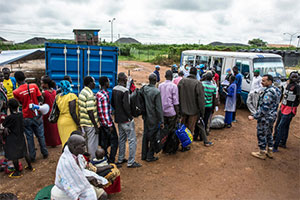 One Thousand Internally Displaced Persons (IDPs) Relocated from Tomping Camp in South Sudan. Credit: UN Photo/Isaac Billy
It took hundreds of thousands of years for the world’s human population to cross one billion in 1804. Approximately 200 years later, the population has multiplied sevenfold. In 2023, the global population crossed 8 billion, and is expected to reach 9 billion before 2050. With the planet more crowded than ever, it is essential to keep track of population trends, urbanization, migration, and reproduction across the world.
Life expectancy has seen significant strides in the past century, largely due to economic development and increased standards of living. On the contrary, trends in global fertility are shifting, with certain regions in Africa and Asia reporting higher rates, while parts of Europe and North America report stagnant or lower rates. This is in part due to differences in sexual and reproductive healthcare, as well as societal and economic conditions around the world. For example, child marriage is prevalent in certain societies, where childbearing is also considered a familial duty. Meanwhile, stagnating economies frequently experience lower marriage and childbearing rates.
The increase in migration and urban development around the world is also linked to global population trends. By 2050, it is expected that approximately 66 percent of all people will live in cities. Furthermore, global crises such as warfare and natural disasters also prompt transnational migration. Transnational migration is linked to a variety of socioeconomic issues in both host and receiving countries: migrants often leave developing countries with less access to educational and economic opportunities and arrive in developed countries where they are frequently the targets of ethnic, racial, and cultural discrimination, and economic exploitation. Recent crises in Europe and the United States demonstrate the importance of advocating for migrants worldwide. As migrants from the Global South are increasingly stripped of their legal and civic rights in unlawful deportations, or targeted in acts of identity-based violence, it is essential to keep track of population trends and protect the human rights of migrant populations. Climate-related disasters are now a major driver of displacement, with nearly half of all new internal displacements in 2025 being disaster-related.
IPS is devoted to covering issues surrounding population trends, migration, and reproduction through its compelling articles, which use both statistics and human stories to provide readers with robust and informative viewpoints.

The Week with IPS

NEXT STOP - SDGs
Tracking global progress towards a sustainable world
Tracking global progress towards a sustainable world
