Languages
Wednesday, October 14, 2026



News and Views from the Global South
Population
Women Walk for Peace in the Korean Peninsula
A group of international women peacemakers announced on Wednesday at the United Nations their intention to walk across the two mile De-Militarized Zone (DMZ), in a call for peace and reunification of Korea.U.N. Audience Shocked by Sexual Health, Abortion Statistics
Audible gasps echoed through the United Nations' Trusteeship Council chamber on Tuesday, with audiences told the grim impacts of unsafe reproductive practices on women worldwide.
Humanitarian Aid Under Fire Calls for New Strategies
In the face of the growing number of crises taking place at the same time worldwide, humanitarian aid organisations – many of which have already reached their financial and logistic limits – are in desperate need of global coordination.
What’s Driving the Merciless Asylum Seeker Policies in Australia?
As conflicts in the Middle East and elsewhere pushed the number of refugees to 13 million last year, the international community is struggling to shoulder the humanitarian responsibility of protecting those fleeing violence and persecution in their homelands.
Coal: Burning Up Australia’s Future
With less than a year to go before the United Nation’s annual climate change meeting scheduled to take place in Paris in November 2015, citizens and civil society groups are pushing their elected leaders to take stock of national commitments to lower carbon emissions in a bid to cap runaway global warming.
Brazil – from the Droughts of the Northeast to São Paulo’s Thirst
Six million people in Brazil’s biggest city, São Paulo, may at some point find themselves without water. The February rains did not ward off the risk and could even aggravate it by postponing rationing measures which hydrologists have been demanding for the last six months.
200 Million Fewer Women than Men Online
Two hundred million fewer women have access to the internet than men, according to a report released Monday.
First the Taliban, then the Army, now Hunger: The Woes of Pakistan’s Displaced
A doctor shakes his head in despair as he examines a 10-year-old child at the Jalozai refugee camp, about 35 km by road from Peshawar, capital of Pakistan’s northern Khyber Pakhtunkhwa (KP) province.
Opinion: The World Sees Progress Against Undernutrition, but it’s Uneven
In 2014, an estimated 805 million people – one in nine people worldwide – were estimated to be chronically hungry. All but 14 million of the world’s hungry live in developing countries, i.e., 791 million are in developing countries, where the share of the hungry has declined by less than half – from 23.4 per cent (1990-1992) to 13.5 per cent (2012-2014).
Bolivia’s School Meals All About Good Habits and Eating Local
A successful school meals programme that serves breakfast and lunch with Andean flavours to 140,000 students in La Paz gave rise to a new law aimed at promoting healthy diets based on local traditions and products in Bolivia’s schools, while combating malnutrition and bolstering food sovereignty.
From the Mountains to the Sea, Timorese Women Fight for More
In Timor-Leste, the gap between rich and poor is most keenly felt by rural women and children. But while women are working hard to help rebuild Timor-Leste, their contributions are not always recognised, in a country where men’s narratives still heavily dominate.
The 15 Journalists Putting Women’s Rights on the Front Page
Media coverage of maternal, sexual and reproductive health rights is crucial to achieving international development goals, yet journalists covering these issues often face significant challenges.
In India, an Indoor Health Crisis
For years, Kehmli Devi, a middle-aged woman from the village of Chachadeth in India’s northern Himalayan state of Uttarakhand, has prepared her family’s meals on a wood-burning stove.
World Misses Its Potential by Excluding 50 Percent of Its People
The meeting is billed as one of the biggest single gatherings of women activists under one roof.
Newly Recognised Indigenous Rights a Dead Letter?
Nearly three years after the rights of El Salvador’s indigenous people were recognised in the constitution, there are still no public policies and laws to translate that historic achievement into reality.
Opinion: Bridging the Gap – How the SDG Fund is Paving the Way for a Post-2015 Agenda
The countdown has begun to September’s Summit on the Sustainable Development Goals (SDGs), with world leaders discussing the 17 goals and 169 targets proposed by the United Nations Open Working Group.
Opinion: Reforming Mental Health in India
India is not only poised for greatness, some say it is already on its way. The events that have shaped the nation's dialogue over the past month showcase an India with a bold vision – to transform industry, to close the gap on inequality and ultimately, to redefine its place as a leader among the world.Prominent Lawyer Defending the Poor Gunned Down in Mozambique
As billions pour into Mozambique from foreign investors scooping up fields of coal and natural gas, the signs of newfound wealth are impossible to miss.
By Girls, For Girls – Nepal’s Teenagers Say No to Child Marriage
If not for a group of her school friends coming to her rescue, Shradha Nepali would have become a bride at the tender age of 14.
Tech-Savvy Women Farmers Find Success with SIM Cards
Jawadi Vimalamma, 36, looks admiringly at her cell phone. It’s a simple device that can only be used to send or receive a call or a text message. Yet to the farmer from the village of Janampet, located 150 km away from Hyderabad, capital of the southern Indian state of Telangana, it symbolises a wealth of knowledge that changed her life.Tackling Ebola: Give Autonomy to Local African Communities, Says International Rescue Committee
Recommendations on how to eradicate Ebola and avoid future outbreaks were released in a report on Tuesday by the International Rescue Committee (IRC).« Previous Page — Next Page »





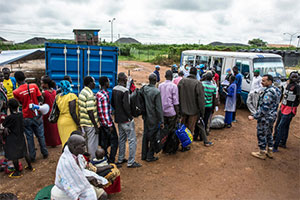 One Thousand Internally Displaced Persons (IDPs) Relocated from Tomping Camp in South Sudan. Credit: UN Photo/Isaac Billy
It took hundreds of thousands of years for the world’s human population to cross one billion in 1804. Approximately 200 years later, the population has multiplied sevenfold. In 2023, the global population crossed 8 billion, and is expected to reach 9 billion before 2050. With the planet more crowded than ever, it is essential to keep track of population trends, urbanization, migration, and reproduction across the world.
Life expectancy has seen significant strides in the past century, largely due to economic development and increased standards of living. On the contrary, trends in global fertility are shifting, with certain regions in Africa and Asia reporting higher rates, while parts of Europe and North America report stagnant or lower rates. This is in part due to differences in sexual and reproductive healthcare, as well as societal and economic conditions around the world. For example, child marriage is prevalent in certain societies, where childbearing is also considered a familial duty. Meanwhile, stagnating economies frequently experience lower marriage and childbearing rates.
The increase in migration and urban development around the world is also linked to global population trends. By 2050, it is expected that approximately 66 percent of all people will live in cities. Furthermore, global crises such as warfare and natural disasters also prompt transnational migration. Transnational migration is linked to a variety of socioeconomic issues in both host and receiving countries: migrants often leave developing countries with less access to educational and economic opportunities and arrive in developed countries where they are frequently the targets of ethnic, racial, and cultural discrimination, and economic exploitation. Recent crises in Europe and the United States demonstrate the importance of advocating for migrants worldwide. As migrants from the Global South are increasingly stripped of their legal and civic rights in unlawful deportations, or targeted in acts of identity-based violence, it is essential to keep track of population trends and protect the human rights of migrant populations. Climate-related disasters are now a major driver of displacement, with nearly half of all new internal displacements in 2025 being disaster-related.
IPS is devoted to covering issues surrounding population trends, migration, and reproduction through its compelling articles, which use both statistics and human stories to provide readers with robust and informative viewpoints.

The Week with IPS

NEXT STOP - SDGs
Tracking global progress towards a sustainable world
Tracking global progress towards a sustainable world
