Languages
Wednesday, October 14, 2026



News and Views from the Global South
Population

Victims of Clerical Sex Abuse Join Forces in Latin America
Victims of sexual abuse by Catholic priests in Latin America are taking the first steps towards grouping together in order to bolster their search for justice – a struggle where they have found a new ally: filmmaking.
Women in the Philippines at the Forefront of the Health Food Movement
When Tinay Alterado’s team from ARUGAAN, an organisation of women healthcare advocates, visited Eastern Visayas, a region of the Philippines devastated by Typhoon Haiyan in November 2013, they noticed that the relief and rescue sites were flooded with donated milk formula, which nursing mothers were feeding to their babies in vast quantities.
UNDP Unveils Blueprint for Swift, Unified Crisis Response
The United Nations Development Programme (UNDP) has announced a new 10-year global plan to support country efforts to reduce the risk of disasters that kill people and destroy livelihoods. The plan was unveiled at the Third World Conference on Disaster Risk Reduction which ended on Mar. 18.
World’s Richest One Percent Undermine Fight Against Economic Inequalities
The growing economic inequalities between rich and poor – and the lopsided concentration of wealth and power in the hands of the world’s one percent - are undermining international efforts to fight global poverty, environmental degradation and social injustice, according to a civil society alliance.
In Thrall to the Mall Crawl and Urban Sprawl
There's little argument about the basic facts: It's ugly (think strip malls and big box stores). It's not very convenient (hours spent behind the wheel to get to work). And it wreaks havoc on the natural environment (lost farmland and compromised watersheds).
Unseen and Unheard: Afghan Baloch People Speak Up
Balochistan, divided by the borders of Iran, Pakistan and Afghanistan, is a vast swathe of land the size of France. It boasts enormous deposits of gas, gold and copper, untapped sources of oil and uranium, as well as a thousand kilometres of coastline near the entrance to the Strait of Hormuz.
Key to Preventing Disasters Lies in Understanding Them
The Third World Conference on Disaster Risk Reduction concluded on Wednesday after a long drawn-out round of final negotiations, with representatives of 187 U.N. member states finally agreeing on what is being described as a far-reaching new framework for the next 15 years: 2015-2030.
Banana Workers’ Strike Highlights Abuses by Corporations in Costa Rica
A strike that has brought activity to a halt since January on three major banana plantations on Costa Rica’s southern Caribbean coast, along the border with Panama, has highlighted the abuses in a sector in the hands of transnational corporations and has forced the governments of both countries to intervene.
Middle Income Nations Home to Half the World’s Hungry
Nearly half of the world’s hungry, amounting to about 363 million people, live in some of the rising middle income countries, including Brazil, China, India, Indonesia and Mexico, according to a new report released Wednesday by the Washington-based International Food Policy Research Institute (IFPRI).Millions of Children Impacted by Ebola Outbreak
Nine million children live in areas affected by the Ebola outbreak in West Africa, while thousands have lost parents to the virus, according to a new report from The United Nations Children's Fund (UNICEF).
Unseen and Unheard: Afghan Baloch People Speak Up
 Balochistan, divided by the borders of Iran, Pakistan and Afghanistan, is a vast swathe of land the size of France. It boasts enormous deposits of gas, gold and copper, untapped sources of oil and uranium, as well as a thousand kilometres of coastline near the entrance to the Strait of Hormuz.
Despite the wealth under their sandals, the Baloch people inhabit the most underdeveloped regions of their respective countries; Afghanistan is no exception.
Balochistan, divided by the borders of Iran, Pakistan and Afghanistan, is a vast swathe of land the size of France. It boasts enormous deposits of gas, gold and copper, untapped sources of oil and uranium, as well as a thousand kilometres of coastline near the entrance to the Strait of Hormuz.
Despite the wealth under their sandals, the Baloch people inhabit the most underdeveloped regions of their respective countries; Afghanistan is no exception. 
Women Turn Drought into a Lesson on Sustainability
When a group of women in the remote village of Sadhuraks in Pakistan’s Thar Desert, some 800 km from the port city of Karachi, were asked if they would want to be born a woman in their next life, the answer from each was a resounding ‘no’.Pro-Democracy Activists at U.S. Event Jailed in DR Congo
Journalists, activists, hip hop artists and a United States diplomat were rounded up by police at a pro-democracy event on Sunday in Kinshasa in the Democratic Republic of the Congo, sponsored in part by the U.S. government. Security forces charged them with threatening stability, according to a government spokesperson.
Sendai Conference Stresses Importance of Women’s Leadership
Women play a critical role in reducing disaster risk and planning and decision-making during and after disasters strike, according to senior United Nations, government and civil society representatives.
Indonesia’s Palm Oil Industry in Need of a Makeover
Over the past three decades, 50 percent of the 544,150 square kilometres that comprise Kalimantan, the Indonesian portion of the island of Borneo, has been taken over by the palm oil industry.
Opinion: Gender Equality, the Last Big Poverty Challenge
It is estimated that women account for two-thirds of the 1.4 billion people currently living in extreme poverty. They also make up 60 per cent of the world’s 572 million working poor.
Canada’s Waste Still Rotting in a Philippine Port
Filipino Catholic priest and activist Reverend Father Robert Reyes, dubbed by media as the “running priest”, joined a protest of environmental and public health activists last week by running along the streets of the Makati Business District, the Philippines’ financial capital, to urge the government to immediately re-export the 50 Canadian containers filled with hazardous wastes that have been in the Port of Manila for 600 days now.
Meet the 10 Women Who Will Stop at Nothing
On Apr. 6, 2013, Nadia Sharmeen, a crime reporter, was assigned to cover a rally organised by Hefazat-e-Islam, an association of fundamentalist Islamic groups in Bangladesh whose demands included a call to revoke the proposed National Women Development Policy.
Sendai Conference to Move From Managing Disasters to Risk Prevention
As the world inched towards a crucial United Nations Conference in Sendai, Japan, Margareta Wahlström, head of the U.N. Office for Disaster Risk Reduction (UNISDR), assured that there was “general agreement” on the need to “move from managing disasters to managing disaster risk”.
Feeding a Warmer, Riskier World
Artificial meat. Indoor aquaculture. Vertical farms. Irrigation drones. Once the realm of science fiction, these things are now fact. Food production is going high tech – at least, in some places.
The Dilemma of Soy in Argentina
Industrial soy production continues to expand in Argentina, pushing small farmers out of the countryside and replacing other crops and cattle. It presents a challenge in a country where 70 percent of the food consumed comes from family farms, but which also needs the foreign exchange brought in by what has been dubbed “green gold”.« Previous Page — Next Page »





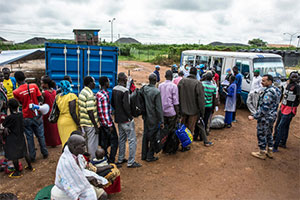 One Thousand Internally Displaced Persons (IDPs) Relocated from Tomping Camp in South Sudan. Credit: UN Photo/Isaac Billy
It took hundreds of thousands of years for the world’s human population to cross one billion in 1804. Approximately 200 years later, the population has multiplied sevenfold. In 2023, the global population crossed 8 billion, and is expected to reach 9 billion before 2050. With the planet more crowded than ever, it is essential to keep track of population trends, urbanization, migration, and reproduction across the world.
Life expectancy has seen significant strides in the past century, largely due to economic development and increased standards of living. On the contrary, trends in global fertility are shifting, with certain regions in Africa and Asia reporting higher rates, while parts of Europe and North America report stagnant or lower rates. This is in part due to differences in sexual and reproductive healthcare, as well as societal and economic conditions around the world. For example, child marriage is prevalent in certain societies, where childbearing is also considered a familial duty. Meanwhile, stagnating economies frequently experience lower marriage and childbearing rates.
The increase in migration and urban development around the world is also linked to global population trends. By 2050, it is expected that approximately 66 percent of all people will live in cities. Furthermore, global crises such as warfare and natural disasters also prompt transnational migration. Transnational migration is linked to a variety of socioeconomic issues in both host and receiving countries: migrants often leave developing countries with less access to educational and economic opportunities and arrive in developed countries where they are frequently the targets of ethnic, racial, and cultural discrimination, and economic exploitation. Recent crises in Europe and the United States demonstrate the importance of advocating for migrants worldwide. As migrants from the Global South are increasingly stripped of their legal and civic rights in unlawful deportations, or targeted in acts of identity-based violence, it is essential to keep track of population trends and protect the human rights of migrant populations. Climate-related disasters are now a major driver of displacement, with nearly half of all new internal displacements in 2025 being disaster-related.
IPS is devoted to covering issues surrounding population trends, migration, and reproduction through its compelling articles, which use both statistics and human stories to provide readers with robust and informative viewpoints.

The Week with IPS

NEXT STOP - SDGs
Tracking global progress towards a sustainable world
Tracking global progress towards a sustainable world
