Languages
Saturday, October 10, 2026



News and Views from the Global South
Green Economy

An Ambitious, Stakeholder-Driven Climate Change Commitment Ahead of COP26: Eswatini’s Revised Nationally Determined Contribution (NDC) Process
There is no country today that has not experienced the effects of climate change, from changing weather patterns to extreme, devastating weather events.
COP26: Building Climate Resilience Will Require a Focus on Those Furthest Behind
As the United Nations Climate Change Conference, also known as COP26, approaches (31 October -12 November in Glasgow, Scotland), climate action is more urgent than ever. Yes, we need climate change mitigation.
Turning Carriers of Water into Managers of Water
Each morning, Langelihle Tshuma checks her taps to confirm the water supply before preparing for the day ahead. Despite living in the city, the married housewife and mother of four has become accustomed to what in most cities would be considered an essential service.
Table Banking Helping Women in Kenya to Put Food on the Table
Pascaline Chemutai’s five acres of land located in the country’s breadbasket region of Rift Valley recently produced 115 bags of maize, each weighing 90 kilograms. She tells IPS that of these, 110 bags will be transported to traders in Nairobi and neighbouring Kiambu County at a negotiated price of $23 per bag.
Argentina’s Small Farming Communities Reach Consumers Online
"The biggest problem for family farmers has always been to market and sell what they produce, at a fair price," says Natalia Manini, a member of the Union of Landless Rural Workers (UST), a small farmers organisation in Argentina that has been taking steps to forge direct ties with consumers.
How Land Management Can Restore Hope to Women in Rural Kenya
Jenifer Kamba, 33, has always loved farming – a love passed on to her by her late husband after they married 14 years ago. The young farmer duo grew maise, pepper and vegetables on their two-acre farm in Kivandini of Kenya’s Machakos county. Even after her husband died five years ago, Kamba didn’t stop farming. However, of late, the soil looks dry, and her production has declined considerably.
Atoll Nation of Tuvalu Adopts ‘Cubes’ to Step Up Nutritious Food Production
Tuvalu, a small atoll island nation in the Central Pacific Ocean, is one of few countries in the world to have so far evaded the pandemic. But, while it has achieved a milestone with no recorded cases of COVID-19, its population of about 11,931 continues to battle food uncertainties and poor nutrition. These challenges, present long before the pandemic emerged, have been exacerbated by lockdown restrictions and economic hardships during the past year and a half.
GGGI and Qatar MME sign an MoU and funding agreement to promote climate resilience and green growth in Qatar
The Global Green Growth Institute (GGGI) and the Ministry of Municipality and Environment (MME) of the State of Qatar have signed a Memorandum of Understanding (MoU) to formalize their joint cooperation to promote climate resiliency and green growth in the State of Qatar.
Zero Hunger Campaign in Vietnam Targets Remote Areas and Cities
Amidst the verdant hills and remote corners of Vietnam’s rural regions, the growth that has transformed the economy in this part of Southeast Asia in recent decades can be hard to see. Undernourishment among children still results in stunting – even in cities too where overweight/obesity is also on the rise.
Rwanda’s Rainforest Conservation Wins Praise from Indigenous Community
Laurent Hategekimana, a villager from Nyabihu, a district from Western Rwanda, recalls the terrible condition of the Gishwati natural forest a few years ago when it was overrun by illegal loggers and invading farmers.
The End of World Bank’s “Doing Business Report”: A Landmark Victory for People & Planet
The September 16, 2021 announcement from the World Bank that it had discontinued publication of the Doing Business Report (DBR) marked a major victory for people and planet.
Extreme Weather the New Normal if Global Warming Increases at Current Speed
Rondrotiana Barimalala is a climate researcher at the University of Cape Town in South Africa and a lead author for the IPCC report to the recently released Intergovernmental Panel on Climate Change (IPCC) report titled Climate Change 2021: The Physical Science Basis.
Data Drought in the Global South
In 2020, every human on Earth created an average of at least 1.7 megabytes of data per second, collectively amassing 2.5 quintillion data bytes. Some 90% of the world’s total data was created in the last two years alone.
‘Building Back Better’: Jordan’s Road to Green Economic Recovery
For the first time in decades, Jordan’s economy contracted in 2020. COVID-19 took a heavy toll on the economy, and it was concerning for the country, particularly because Jordan had managed to grow at an average rate of 2%, despite regional and international shocks to its economy amounting to 44% of Gross Domestic Product (GDP) over the past decade.
Scientific Panel’s Scoping Report Instructive for Global Food Systems Transformation
On September 10th, on a sweltering summer afternoon, three fishers drove a van around the residential community of Castle Comfort in Dominica, blowing forcefully into their conch shells – the traditional call that there is fresh fish for sale in the area.
Food Experts’ Expectations for Global Food Systems Transformation
Dubbed ‘the People’s Summit, the United Nations Food Systems Summit (UNFSS) hopes to put the world back on a path to achieve the Sustainable Development Goals by 2030, through food systems overhauling. From the tempered to the extremely optimistic, experts in various food system sectors share their expectations of transformation.
If Women Farmers were Politicians, the World Would be Fed, says Danielle Nierenberg
Women, key contributors to agriculture production, are missing at the decision table, with alarming consequences, says Food Tank President Danielle Nierenberg in an exclusive interview with IPS.
Barilla Foundation Report Highlights Need for Food Companies to Align with Sustainable Development Goals
In the backdrop of rising hunger, half of the world’s population living on unhealthy diets, a third of agricultural produce lost to postharvest events, and waste, poverty in farming communities, a pandemic that laid bare the vulnerability of food systems to external shocks and unsustainable food production, the Barilla Foundation for Food and Nutrition has published a report which introduces guidelines for the private sector to fulfil its role in transforming global food systems.
GGGI and KOGAS Join Forces to Promote Green Hydrogen
The Global Green Growth Institute (GGGI) and the Korea Gas Corporation (KOGAS), a public natural gas company, signed a Memorandum of Understanding (MoU) today to promote green hydrogen in developing and emerging countries, including Indonesia. The two organizations have agreed to share knowledge and cooperate to develop joint projects through the provision of technical assistance.
Even as IUCN Congress Closes, Conservation Debate Hots Up
One of the most hotly debated issues at the recently concluded IUCN Congress in Marseilles was about designating 30 percent of the planet's land and water surface as protected areas by 2030.
Southeast Asian Farmers Adapt, Insure against Growing Climate Risks
As incidents of drought and extreme rainfall increase, farmers in Southeast Asia are partnering with experts to develop targeted weather forecasts to work around the threats and, when adaptation becomes too costly, buy specially designed insurance to protect their livelihoods.« Previous Page — Next Page »





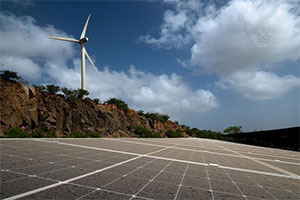 Renewable Energy in Cabo Verde. Credit: UN Photo/Mark Garten
A green economy is an economic model that aims to reduce environmental risks and build a sustainable future. Many of the UN SDGs seek to facilitate a green economy, such as ensuring access to affordable and reliable clean energy, building sustainable cities and communities, and implementing urgent action to combat climate change. Various key negotiations have strived to achieve a green economy, such as the Green New Deal and the Inflation Act of 2022. COP30, held in Belém, Brazil in 2025, agreed to mobilize $1.3 trillion annually for climate action and launched the Belém Mission to 1.5°C. However, the conference was not able to develop a fossil fuel reduction roadmap. Recent years have witnessed a sharp transformation in the geopolitical landscape of international sustainability cooperation. In March 2025, the United States stepped back from formal multilateral support for the SDGs, while China is on the rise as an international leader in renewable energy production. The actions of these global powers may shape shifting alliances on environmental governance. IPS is dedicated to sharing timely news on international developments in building a sustainable future.

The Week with IPS

NEXT STOP - SDGs
Tracking global progress towards a sustainable world
Tracking global progress towards a sustainable world
