Languages
Friday, October 2, 2026



News and Views from the Global South
Green Economy

In Hawaii, Concern Rises about Use of Farm Pesticides
Tammy Brehio stood on the back balcony of her home in Kihei on the island of Maui and pointed to a brown field a few hundred yards away.Opinion: Africa’s Agricultural Potential Begins on the Ground
My friend Kofi Boa is a Ghanaian agronomist who is probably the biggest advocate for conservation farming in Africa. For decades, Kofi has taught farmers how to increase their yields using no-till, cover crops and other techniques.
Opinion: Will African Leaders Fight for our Farmers?
Climate change is changing the world we know and love. Our land, homes and food are at risk. With nearly a billion people already living in poverty, it is also the single biggest threat to the fight against hunger.
ASEAN Agreement on Haze? As Clear as Smoke
A regional agreement on managing transboundary haze caused by fires raging in Indonesia’s forests and peatlands appears all but buried in the embers of frustration of its neighbouring countries.Opinion: It’s gettin’ hot in here…so take back all your carbon
Africa is getting hot fast. Already battling against the impacts of climate change, temperatures in Africa will rise faster than any other continent. In fact, they are expected to exceed 2 C and may reach as high as 6 C greater than 20th century levels. These rapidly rising temperatures foreshadow increased drought, famine and disease. The most vulnerable populations – of which millions are smallholder farmers – need solutions, and they need them now.Opinion: Five Key Takeaways from India’s New Climate Plan
Last week, India announced its new climate plan, also known as its Intended Nationally Determined Contribution, or INDC. As the world’s third-largest emitter and a country that’s highly vulnerable to the impacts of climate change, it is encouraging to witness India investing in actions to tackle climate change while addressing poverty, food security and access to healthcare and education.
Shale Drives Uncertain New Geoeconomics of Oil
The emergence of fracking has modified the global market for fossil fuels. But the plunge in oil prices has diluted the effect, in a struggle that experts in the United States believe conventional producers could win in the next decade.
The Global South Will Make Its Contribution to Fighting Climate Change
Seen for years as passive actors in the fight against global warming, more than 100 countries of the Global South have submitted their national contributions to reducing greenhouse gas emissions and decarbonising their economies.
Brazil’s Expanded Climate Targets Frustrate Environmentalists
Brazil’s greenhouse gas emissions reduction programme, hailed as bold, has nevertheless left environmentalists frustrated at its lack of ambition in key aspects.
Honduran Fishing Village Says Adios to Candles and Dirty Energy
A small fishing village on the Caribbean coast of Honduras has become an example to be followed in renewable energies, after replacing candles and dirty costly energy based on fossil fuels with hydropower from a mini-dam, while reforesting the river basin.
Chile’s Altiplano Region Seeks Sustainable Tourism
Chile’s altiplano or high plateau region, pounded by the sun of the Atacama desert, the driest place in the world, is home to dozens of indigenous communities struggling for subsistence by means of sustainable tourism initiatives that are not always that far removed from out-of-control capitalism.
Cuban Agroecological Project Foments Local Innovation
Armando Marcelino Pi divides his day between the university, where he teaches philosophy, work on his family farm, and coordinating a group of 33 agroecological farmers, in this mountainous rural municipality in western Cuba.
Opinion: Another U.N. General Assembly Talk Fest Begins
UNGA 70 formally commenced on Sep. 15. In accordance with custom, it elected a new President, Denmark's Mogens Lykketoft, who has picked as the theme for his tenure as the President, "The UN at 70 - A New Commitment to Action".
Africa Sees U.N. Climate Conference as “Court Case” for the Continent
As the clock ticks towards the United Nations climate change conference (COP21) in Paris in December, African experts, policy-makers and civil society groups plan to come to the negotiation table prepared for a legal approach to avoid mistakes made during formulation of the Kyoto Protocol.
G20 Finance Ministers Committed to Sustainable Development
Finance ministers and central bank governors of the world’s 20 major economies, accounting for 66 percent of world population, have pledged to “promote an enabling global economic environment for developing countries as they pursue their sustainable development agendas”.
Women Revolutionise Waste Management on Nicaraguan Island
A group of poor women from Ometepe, a beautiful tropical island in the centre of Lake Nicaragua, decided to dedicate themselves to recycling garbage as part of an initiative that did not bring the hoped-for economic results but inspired the entire community to keep this biosphere reserve clean.
Two Indigenous Solar Engineers Changed Their Village in Chile
Liliana and Luisa Terán, two indigenous women from northern Chile who travelled to India for training in installing solar panels, have not only changed their own future but that of Caspana, their remote village nestled in a stunning valley in the Atacama desert.
Plant in Chile Opens South America’s Doors to Geothermal Energy
Chile, a land of volcanoes and geysers, has started building South America’s first geothermal plant, which would open a door to this kind of renewable energy in this country that depends largely on fossil fuels.
UAE Wins Hearts and Minds at World Exhibition in Milan
She only turned nine last June. But Mahra Mustafa has become a celebrity at the Expo Milan. She stars as Sara in ‘The Family Tree’, a short film on the UAE’s heritage being screened at the United Arab Emirates pavilion. Sara is in fact the face of young, dynamic and innovative Emirates.
The Future Tastes Like Chocolate for Rural Salvadoran Women
Idalia Ramón and 10 other rural Salvadoran women take portions of the freshly ground chocolate paste, weigh it, and make chocolates in the shapes of stars, rectangles or bells before packaging them for sale.
Islamic Declaration Turns Up Heat Ahead of Paris Climate Talks
Following in the footsteps of Pope Francis, who has taken a vocal stance on climate change, Muslim leaders and scholars from 20 countries issued a joint declaration Tuesday underlining the severity of the problem and urging governments to commit to 100 percent renewable energy or a zero emissions strategy.« Previous Page — Next Page »


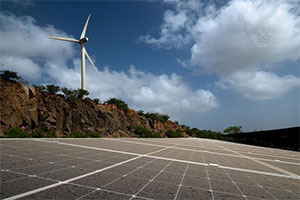 Renewable Energy in Cabo Verde. Credit: UN Photo/Mark Garten
A green economy is an economic model that aims to reduce environmental risks and build a sustainable future. Many of the UN SDGs seek to facilitate a green economy, such as ensuring access to affordable and reliable clean energy, building sustainable cities and communities, and implementing urgent action to combat climate change. Various key negotiations have strived to achieve a green economy, such as the Green New Deal and the Inflation Act of 2022. COP30, held in Belém, Brazil in 2025, agreed to mobilize $1.3 trillion annually for climate action and launched the Belém Mission to 1.5°C. However, the conference was not able to develop a fossil fuel reduction roadmap. Recent years have witnessed a sharp transformation in the geopolitical landscape of international sustainability cooperation. In March 2025, the United States stepped back from formal multilateral support for the SDGs, while China is on the rise as an international leader in renewable energy production. The actions of these global powers may shape shifting alliances on environmental governance. IPS is dedicated to sharing timely news on international developments in building a sustainable future.

The Week with IPS

NEXT STOP - SDGs
Tracking global progress towards a sustainable world
Tracking global progress towards a sustainable world
