Languages
Wednesday, October 28, 2026



News and Views from the Global South
Green Economy

The Time Has Come for Agroecology
"It is time for a new agricultural model that ensures that enough quality food is produced where it is most needed, that preserves nature and that delivers ecosystem services of local and global relevance" – in a word, it is time for agroecology.
Obama Mandates Climate Resilience in All U.S. Development Projects
All international development assistance and investments from the United States will now be required to take into account the potential impacts of climate change, according to a new rule signed Tuesday by President Barack Obama.
Climate-Smart Agriculture is Corporate Green-Washing, Warn NGOs
On the sidelines of the U.N.'s heavily hyped Climate Summit, the newly-launched Global Alliance for Climate-Smart Agriculture announced plans to protect some 500 million farmers worldwide from climate change and "help achieve sustainable and equitable increases in agricultural productivity and incomes."World Bank Reports Major Global Support for Carbon Pricing
Seventy-three countries and 22 lower-level governments offered formal support Monday for a global price on carbon dioxide emissions, including China, Russia and the European Union.
Climate Change an “Existential Threat” for the Caribbean
When it comes to climate change, Prime Minister Ralph Gonsalves doesn’t mince words: he will tell you that it is a matter of life and death for Small Island Developing States (SIDS).
Biodiversity Offsetting Advances in Latin America Amidst Controversy
Compensation for biodiversity loss, which is taking its first steps in Latin America, is criticised by social organisations for “commodifying” nature and failing to remedy the impacts of extractive industries and other activities that destroy natural areas and wildlife.
“No Planet B”: Marchers Demand Swift Action on Climate Change
 On Sunday, Sep. 21, at least 300,000 people filled the streets of New York City ahead of the U.N. General Assembly and special one-day Climate Summit Sep. 23 to protest the ongoing lack of political will to cut global CO2 emissions and kick-start a greener economy. They came by bus and bike and train. They came with their kids -- some in strollers, others old enough to proudly carry signs. By afternoon, it had become clear that the march in New York was the biggest climate-change gathering in history. Protesters also turned out in more than 150 other cities around the world.

Green Economy Isn’t Rocket Science – And It’s Not Even Costly
Acting on climate change will not hurt domestic economic growth, and in fact is more likely to boost growth, most analyses now show.
Boosting the Natural Disaster Immunity of Caribbean Hospitals
When floods overwhelmed the Eastern Caribbean in December last year, St. Vincent’s new smart hospital, completed just a few months earlier, stood the test of “remaining functional during and immediately after a natural disaster.”
Africa Seeks Commitment to Adaptation in Climate Deal
It is a critical time for international climate change negotiations. By December 2015, world leaders are due to decide on an international climate change agreement covering all countries that will take effect in 2020.
Rare Zambian Tree Faces Exploitation Because of Legal Loophole
Steven Nyambose used to sell charcoal for a living until he discovered that the trees could be more lucrative in another way - through cutting them down and selling the logs to international buyers.

Latin America at a Climate Crossroads
World leaders gathered at the Climate Change Summit during the United Nations General Assembly on Sep. 23 will have a crucial opportunity to mobilise political will and advance solutions to climate change.
Tackling Climate Change and Promoting Development: A “Win-Win”
A widespread perception exists that developing countries must make a choice between tackling climate change and fighting poverty. This assumption is incorrect, according to the authors of a new report on green growth.
Will the Upcoming Climate Summit Be Another Talkathon?
As the United Nations hosts a Climate Summit Sep. 23, the lingering question is whether the meeting of world leaders will wind up as another talk fest.
OPINION: A Climate Summit to Spark Action
On Sep. 23, I have invited world leaders from government, business, finance and civil society to a Climate Summit in New York so they can show the world how they will advance action on climate change and move towards a meaningful universal new agreement next year at the December climate negotiations in Paris.
Panama Turns to Biofortification of Crops to Build Food Security
Panama is the first Latin American country to have adopted a national strategy to combat what is known as hidden hunger, with a plan aimed at eliminating micronutrient deficiencies among the most vulnerable segments of the population by means of biofortification of food crops.
U.N. Climate Summit: Staged Parade or Reality Show?
The much-ballyhooed one-day Climate Summit next week is being hyped as one of the major political-environmental events at the United Nations this year.
Salvadoran Farmers Stake Their Bets on Sustainable Development
Peasant farmers from one of El Salvador’s most fragile coastal areas are implementing a model of sustainable economic growth that respects the environment and offers people education and security as keys to give the wetland region a boost.
Women – the Pillar of the Social Struggle in Chile’s Patagonia Region
In few places in Chile are women the pillars of community, grassroots rural and environmental movements as they are in the southern wilderness region of Patagonia. It is a social role that history forced them to assume in this remote part of the country.
Mexico’s Wind Parks May Violate OECD Rules
Four wind farm projects in the southern Mexican state of Oaxaca, operated or financed by European investors, could violate Organisation for Economic Cooperation and Development (OECD) rules, say activists.
Climate Policy Goes Hand-in-Hand with Water Policy
Concerned that climate change could lead to an intensification of the global hydrological cycle, Caribbean stakeholders are working to ensure it is included in the region's plans for Integrated Water Resources Management (IWRM).« Previous Page — Next Page »





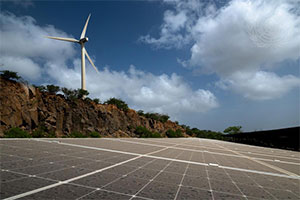 Renewable Energy in Cabo Verde. Credit: UN Photo/Mark Garten
A green economy is an economic model that aims to reduce environmental risks and build a sustainable future. Many of the UN SDGs seek to facilitate a green economy, such as ensuring access to affordable and reliable clean energy, building sustainable cities and communities, and implementing urgent action to combat climate change. Various key negotiations have strived to achieve a green economy, such as the Green New Deal and the Inflation Act of 2022. COP30, held in Belém, Brazil in 2025, agreed to mobilize $1.3 trillion annually for climate action and launched the Belém Mission to 1.5°C. However, the conference was not able to develop a fossil fuel reduction roadmap. Recent years have witnessed a sharp transformation in the geopolitical landscape of international sustainability cooperation. In March 2025, the United States stepped back from formal multilateral support for the SDGs, while China is on the rise as an international leader in renewable energy production. The actions of these global powers may shape shifting alliances on environmental governance. IPS is dedicated to sharing timely news on international developments in building a sustainable future.

The Week with IPS

NEXT STOP - SDGs
Tracking global progress towards a sustainable world
Tracking global progress towards a sustainable world
