Languages
Tuesday, October 27, 2026



News and Views from the Global South
Green Economy

Climate Negotiators “Sleepwalking” in Bonn
The 410,000 people who took to the streets for climate action in New York City during the U.N. Climate Summit would have been outraged by the 90-minute delay and same-old political posturing at the first day of a crucial round of climate treaty negotiations in Bonn at the World Congress Center.
OPINION: The Politics of Biodiversity Loss
To mainstream biodiversity concerns into development planning, we must offer a compelling rationale and demonstrate biodiversity’s relevance to wealth generation, job creation and general human wellbeing. Only a persuasive “why” resonating throughout society will successfully get us to urgently needed negotiations of who, what, where, when and how to halt disastrous biodiversity loss.
Panama’s Indigenous People Want to Harness the Riches of Their Forests
For indigenous people in Panama, the rainforest where they live is not only their habitat but also their spiritual home, and their link to nature and their ancestors. The forest holds part of their essence and their identity.
Ethiopia Moves in Right Direction with Climate Change Response But Challenges Remain
Ethiopia is widely regarded as an African success story when it comes to economic growth. According to the International Monetary Fund, the country’s economy is growing by seven percent annually. But there are concerns that climate change could jeopardise this growth.
Protecting Biodiversity in Costa Rica’s Thermal Convection Dome in the Pacific
The vast habitat known as the Costa Rican Thermal Convection Dome in the eastern Pacific Ocean will finally become a protected zone, over 50 years after it was first identified as one of the planet’s most biodiversity-rich marine areas.
Pacific Climate Change Warriors Block World’s Largest Coal Port
Climate Change Warriors from 12 Pacific Island nations paddled canoes into the world’s largest coal port in Newcastle, Australia, Friday to bring attention to their grave fears about the consequences of climate change on their home countries.
Bamboo Could Be a Savior for Climate Change, Biodiversity
Bamboo Avenue is a two-and-a-half mile stretch of road in Jamaica’s St. Elizabeth parish. It is lined with giant bamboo plants which tower above the road and cross in the middle to form a shady tunnel. The avenue was established in the 17th century by the owners of the Holland Estate to provide shade for travelers and to protect the road from erosion.
Ethiopia Shows Developing World How to Make a Green Economy Prosper
Ethiopia has experienced its fair share of environmental damage and degradation but nowadays it is increasingly setting an example on how to combat climate change while also achieving economic growth.
High-Tech, High Yields: Caribbean Farmers Reap Benefits of ICT
Farmers in the Caribbean are being encouraged to make more use of farm apps and other forms of ICT in an effort to increase the knowledge available for making sound, profitable farming decisions.
Curbing Biodiversity Loss Needs Giant Leap Forward
When political leaders from climate-threatened Small Island Developing States (SIDS) addressed the U.N. General Assembly last month, there was one recurring theme: the urgent need to protect the high seas and preserve the world's marine biodiversity.
Measuring How Climate Change Affects Africa’s Food Security
For the past 40 years Josephine Kakiyi, 55, has been cultivating maize, beans and vegetables on her small plot of land in the remote area of Kwa Vonza, in Kitui County, eastern Kenya.
Biodiversity, Climate Change Solutions Inextricably Linked
The remarkable biodiversity of the countries of the Caribbean, already under stress from human impacts like land use, pollution, invasive species, and over-harvesting of commercially valuable species, now faces an additional threat from climate change.
Family Farmers Don’t Need Climate-Smart Agriculture
Small farmers can look to options like agroecological intensification and innovation, without necessarily turning to climate-smart agriculture, which is promoted by the United Nations but has awakened doubts among global experts meeting in this Italian city.
Hotter Caribbean Poses Challenges for Livestock Farmers
Livestock farmers in the Caribbean are finding it increasingly difficult and expensive to rear healthy animals because of climate change, a situation that poses a significant threat to a region that is already too dependent on imports to feed its population.
Financing for Biodiversity: A Simple Matter of Keeping Promises
With governments, activists and scientists tearing their hair out over the world’s impending crisis in biodiversity, the outgoing president of the Convention on Biological Diversity (CBD) delivered a simple message to participants at the 12th Conference of the Parties to the CBD (COP12) currently underway in the Republic of Korea’s northern Pyeongchang county: honour the promises you made last year.
Antigua Faces Climate Risks with Ambitious Renewables Target
Ruth Spencer is a pioneer in the field of solar energy. She promotes renewable technologies to communities throughout her homeland of Antigua and Barbuda, playing a small but important part in helping the country achieve its goal of a 20-percent reduction in the use of fossil fuels by 2020.
OPINION: A Roadmap to Living – and Thriving – in Harmony with Nature
In Nagoya, Japan, in 2010, the international community made a commitment to future generations by adopting the Strategic Plan for Biodiversity 2011–2020 and 20 Aichi Biodiversity Targets.
Outgunned by Rich Polluters, Africa to Bring United Front to Climate Talks
As climate change interest groups raise their voices across Africa to call for action at the COP20 climate meeting in December and the crucial COP21 in Paris in 2015, many worry that the continent may never have fair representation at the talks.
Cuba’s Sugar Industry to Use Bagasse for Bioenergy
Cuba’s sugar industry hopes to become the main source of clean energy in the country as part of a programme to develop renewable sources aimed at reducing dependence on imported fossil fuels and protecting the environment.
Côte d’Ivoire Chokes on its Plastic Shopping Bags
In the middle of downtown Abidjan, Côte d’Ivoire, the aisles of a thriving supermarket are full of customers. But as they line up to pay for their items, there is one line to a cashier’s till that remains empty. It’s the “green cash register”, where the cashier does not provide plastic bags as this supermarket tries to implement a green policy.
Climate Summit: Much Talk, A Bit of Walk
Speaking to more than 120 heads of state at the U.N. Climate Summit, actor and newly appointed U.N. Messenger of Peace Leonardo DiCaprio made clear the long-ranging impact of the attendees’ decisions.« Previous Page — Next Page »





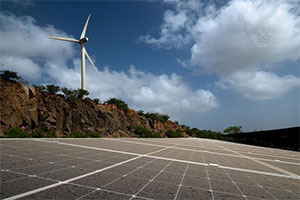 Renewable Energy in Cabo Verde. Credit: UN Photo/Mark Garten
A green economy is an economic model that aims to reduce environmental risks and build a sustainable future. Many of the UN SDGs seek to facilitate a green economy, such as ensuring access to affordable and reliable clean energy, building sustainable cities and communities, and implementing urgent action to combat climate change. Various key negotiations have strived to achieve a green economy, such as the Green New Deal and the Inflation Act of 2022. COP30, held in Belém, Brazil in 2025, agreed to mobilize $1.3 trillion annually for climate action and launched the Belém Mission to 1.5°C. However, the conference was not able to develop a fossil fuel reduction roadmap. Recent years have witnessed a sharp transformation in the geopolitical landscape of international sustainability cooperation. In March 2025, the United States stepped back from formal multilateral support for the SDGs, while China is on the rise as an international leader in renewable energy production. The actions of these global powers may shape shifting alliances on environmental governance. IPS is dedicated to sharing timely news on international developments in building a sustainable future.

The Week with IPS

NEXT STOP - SDGs
Tracking global progress towards a sustainable world
Tracking global progress towards a sustainable world
