Languages
Thursday, October 8, 2026



News and Views from the Global South
Labour

From Research to Entrepreneurship: Fishing Youth and Women out of Poverty
Ivy Nyambe Inonge, 35, is the treasurer of Mbeta Island Integrated Fish Farm in Senanga district. Her group won the first prize in Zambia under the Cultivate Africa’s Future (CultiAF) Expanding Business Opportunities for African Youth in Agricultural Value Chains in Southern Africa. She is excited at the prospect of what 5,000 dollars can do for her group, and ultimately, the whole community of Mbeta Island.
Humanity and Social Justice, a Must for the Future of Work – Ryder
“The future of work must be inspired by considerations of humanity, of social justice and peace. If it is not, we are going to a dark place, we are going to a dangerous place,” said the head of the leading world body specialised on labour issues.
Work, What Future? Seven Big Questions Needing Urgent Response
Around the world, profound changes in the nature of work are underway, that’s clear. So it is a fact that the on-going transformations in the world of labour are disrupting the connection between work, personal development and community participation.
The Challenge Ahead: Harnessing Gene Editing to Sustainable Agriculture
The role of genetic engineering in agriculture and food has generated enormous interest and controversies, with large-scale embrace by some nations and wholesale bans by others.
Slaves
For over 400 years, more than 15 million men, women and children were the victims of the transatlantic slave trade, one of the darkest chapters in human history. Slavery is, nevertheless, far from being just a chapter of the past—it still there, with estimated 21 million victims of forced labour and extreme exploitation around the world--nearly the equivalent to of the combined population of Scandinavian countries.
Free Education Helps Combat Child Labour in Fiji
In the South Pacific nation of Fiji, free and compulsory education, introduced three years ago, in association with better awareness and child protection measures, is helping to reduce children’s vulnerability to harmful and hazardous forms of work.
Fishing Villages Work for Food Security in El Salvador
After an exhausting morning digging clams out of the mud of the mangroves, Rosa Herrera, her face tanned by the sun, arrives at this beach in southeastern El Salvador on board the motorboat Topacio, carrying her yield on her shoulders.
The Robots are Coming, your Job is at Risk
Last year Uber started testing driver-less cars, with humans inside to make corrections in case something goes wrong. If the tests go well, Uber will presumably replace their present army of drivers with fleets of the new cars.
A Structural Theory of Aging
Wikipedia has much to offer under "aging". Highly recommended are the 10 points by the world's oldest living man, 114, Walter Breuning.
Ecco Subcontractor in Breach of the Law
Low wages, precarious employment, and lots of overtime. A recent report from the EU project ”Change Your Shoes” show that Indonesian subcontractors for several European footwear companies, including Ecco and Deichmann, are not in compliance with the law.
At 60, Ghana Looks to a Future Beyond Aid
Ghana turned 60 years old this week. The West African country gained independence from Britain on Mar. 6, 1957, and remains a study in contradictions.
Women’s Progress Uneven, Facing Backlash – UN Rights Chief
“The women’s movement has brought about tremendous change but we must also recognise that progress has been slow and extremely uneven and that it also brought its own challenges,” warned the UN High Commissioner for Human Rights Zeid Ra’ad Al Hussein.
Gender Disparity at UN: Three Out of 71, Zero out of Nine
The United Nations has frequently been accused of vociferously preaching gender empowerment and women’s rights to the outside world -- but failing miserably to practice what it preaches in its own political backyard.
Women in the Changing World of Work: Planet 50-50 by 2030
This year as the world commemorates International Women’s Day it is a time for all of us to celebrate and reflect on the progress made on Women’s rights globally. But more importantly, a day to call for an end to gender inequality in all its forms especially in the work spaces. Appropriately themed “Women in the Changing World of Work: Planet 50-50 by 2030” the commemoration comes against a backdrop of a world that is undergoing major changes with significant implications for women.
Let Women Speak and Give Them a Hearing
Basic rights always need champions, and that’s truer today than it ought to be as around the world we see an unwelcome pattern of reaction to modern complexities ranging from globalization and automation to austerity and dwindling wages. One alarming example is how the agenda of promoting women’s rights, so far from completion, is being pushed back rather than forward.
Time to Champion Women’s Empowerment: Implementation of SDGs in Bangladesh
The year 2015 was highly significant in relation to global convergence on ways forward towards achieving sustainable development at local, national, regional, and global levels.
Why a Feminist Foreign Policy Is Needed More than Ever
Lately, the world has tended to present itself in increasingly darker shades. In many places, democracy is questioned, women’s rights are threatened, and the multilateral system that has taken decades to build is undermined.
Barefoot Solar Warriors Take On Gender Injustice and Climate Change
On a summer morning in 2008, Magan Kawar decided to leave her village for a job. The very next day, her parents-in-law excommunicated her.
16-Hour Days for Zimbabwe’s Women
As the cock crows, Tambudzai Zimbudzana, 32, is suddenly awakened from sleep. She quickly folds her blankets and strides outside her three-room, sheet iron-roofed house in rural Masvingo.
Be Bold for Change–Empower Women, Empower Humanity
The world of work is changing for women across the globe and Bangladesh is no exception. Factors such as globalization, advancement in technology, and the digital revolution have ushered in new ways for women to enter into work. The theme for the International Women’s Day, 8 March, 2017, focuses on “Women in the Changing World of Work: Planet 50-50 by 2030” under which gender parity in the workforce is the critical prerequisite for inclusive and sustainable economic growth.
For Societies to Thrive, We Must Ensure Gender Equality
Consider this: gender inequality is costing sub Saharan Africa US$ 95 billion annually in lost revenue. In a corporate setting, that extent of losses would call for a serious reset of the business’s operational approach.« Previous Page — Next Page »





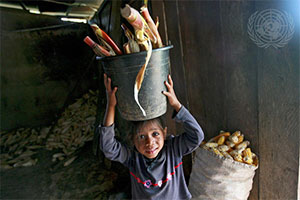 Timorese Girl with Fresh-Picked Corn. Credit: UN Photo/Martine Perret
A global common denominator is the need for a decent job. The economic realities of each country determine just how difficult it is to find one. Despite the labour movement's achievements, serious challenges persist: gender discrimination, child labour, worker migration, the digital divide and AI automation, evaporating pensions, unsafe workplaces, corporate pressure against union organising, negative impacts of trade agreements, and the precariousness of informal employment. The 2025 UN SDG Report identifies jobs and social protections as one of the six priority areas requiring urgent action, with progress either stalled or reversing in many developing nations.
In recent years, the fight to protect labour equality has taken on new dimensions with the rise of Environmental, Social and Governance standards. With the Social aspect aiming to promote equality and human rights, ESG principles have strengthened labour advocacy within corporate and governmental regulatory landscapes. In particular, ESG has become much more institutionalized in emerging economies such as Brazil and China. IPS follows the world’s workers as they confront these challenges - their setbacks and their successes.

The Week with IPS

NEXT STOP - SDGs
Tracking global progress towards a sustainable world
Tracking global progress towards a sustainable world
