Languages
Thursday, October 8, 2026



News and Views from the Global South
Labour

Unemployment and the Informal Economy – Key Challenges for Women in Latin America
The participation of women in the labour market in Latin America and the Caribbean has steadily grown over the last few decades. But in 2017, as unemployment and informal work are on the rise, there is a continued need to push hard for gender equality in order to create more and better employment for the 255 million women of working age in this region.
New land rights are changing women’s world of work
International Women’s Day this year focuses on economic empowerment in the changing world of work. The vision is to achieve gender equality and empowerment of women and girls by 2030. Girls’ aged three will become adults with a legal right to work in 2030. Together, with those aged up to 10, these girls are the prime target for gender equality by 2030.
Time to Close the Gender Gap in Africa with Bold Actions
International Women's Day (IWD) is an important opportunity to celebrate the achievements of women and to be bold in promoting gender parity.
Breaking Barriers for Women Is a Short Cut to Economic Growth and Development
In South Asian societies, as elsewhere, it is all too common for women to be held back, time and again Women's potential remains largely untapped - which is not only morally wrong, but also economically unwise. According to recent projections, harnessing women's full potential throughout South Asia would increase GNP by more than half by 2025. In absolute terms, women could earn countries in South Asia an additional 400 billion dollars in the next ten years! clearly, women hold the key to economic success for South Asia: their empowerment can fuel further development. The Netherlands has invested substantially in the economic empowerment of women in this region. Our successes, achieved in collaboration with many stakeholders, show what can be achieved if we keep up these efforts.
“Women in the Changing World of Work: Planet 50:50 by 2030.”
Yayi Bayam Diouf became the first woman to fish in her small rural fishing village in Senegal despite initially being told by the men in her community that the fish wouldn’t take bait from a menstruating woman. When she started practicing law, Ann Green, CEO of ANZ Lao, was asked to make coffee or pick up dry cleaning (by men and women), simply because she was a young woman. The difficulties faced by Yayi and Ann in entering the labour force and at the workplace are not only unique to them, but sadly is the reality for many women across the globe.
Seven Scary Facts About Widening Gender Gap
Women across the globe are facing new threats, which risk dismantling decades of hard-won rights and derailing the effort to end extreme poverty, an international confederation of civil society organisations has revealed ahead of International Women’s Day on March 8.
“Women in the UN Working Together to Improve the Lives of Women Worldwide”
This International Women’s Day we celebrate women in the changing world of work, recognizing the need to fully realize women’s working potential in order to achieve Agenda 2030. We know that when women earn money, they spend it on feeding their families and educating their children. It is estimated that if women farmers had the same access to resources as men, the number of hungry people in the world could be reduced by up to 150 million.
Valuing Women’s Unpaid Work
Women’s work remains unaccounted for even though the issue of unpaid work carried out by women is being discussed globally at the policy, academic as well as practitioners’ levels.
These Women Cannot Celebrate Their Day
This is a story that one would wish to never have to write—the story of hundreds of millions of life-givers whose production and productivity have systematically been ‘quantified’ in much detailed statistics, but whose abnegation, human suffering and denial of rights are subject to just words.
St Valentine’s Day: Celebrating Healthy Relationships; Challenging Violence
Today, many couples, in many countries will be celebrating Saint Valentine’s Day – or ‘El día de los enamorados’ (‘Day of Lovers’) in some Latin American countries.
Mistrust Hindering Global Solutions, says Secretary General
The global lack of confidence and trust is undermining the ability to solve the world’s complex problems, said UN Secretary-General during an international conference.
US Trade Hawks and the China Bogey
New US President Donald Trump has long insisted that its major trading partners having been taking advantage of it. Changing these trade terms and conditions will thus be top priority for his administration, and central to overall Trump economic strategy to ‘Make America Great Again’.
Why Kenya Must Create a Million New Jobs Annually
It is estimated that 3000 Kenyans are born every day, a million a year. With a median age of 18 years, Kenya is witnessing a massive youth bulge, which could either be a demographic dividend, or a disaster.
‘World Must Implement Pledges on Women’s Human Rights’
“Women’s economic empowerment in the changing world of work” will provide concrete, practical and action-oriented recommendations that will cover significant new ground, on overcoming structural barriers to gender equality, gender-based discrimination and violence against women at work, a senior United Nations official stressed.
Protecting the Rights of Women Migrant Workers
International migration is a complex phenomenon dealing with overlapping issues relating to the human rights of migrants, mixed migration flows, international protection, smuggling and trafficking, as well as other push and pull factors affecting migration.
Harvesting Peace: How Rural Development Works for Conflict Prevention
The year 2016 has seen a massive population flow, unprecedented in its range and reach. Millions of people have fled war-torn communities, natural disasters and violence, some overflowing neighboring countries’ refugee camps, some crossing perilous seas and walking hundreds of miles to reach safer grounds, others seeking refuge in countries half a world away. Thousands have died on their way to safety, countless more were victims of violence and abuse, among them many women and children.
Inequality (III): Less Employment… and More ‘Junk’ Jobs
While just eight men are enjoying their huge wealth, equivalent to that of half the world, new forecasts project darker shadows by predicting rising unemployment rates, more precarious jobs and worsening social inequality. To start with, there will be more than 1.4 billion people employed in vulnerable working conditions.
Inequality (II): “It Will Take 170 Years for Women to Be Paid as Men Are”
While just eight individuals, all of them men, own the same wealth as 3.6 billion people -- half of world’s total population -- it will take 170 years for women to be paid the same as men, warns a new major report on inequality.
Inequality (I): Half of World’s Wealth, in the Pockets of Just Eight Men
Just eight men own the same wealth as the 3.6 billion people who make up the poorest half of humanity, according to a major new report by an international confederation of 19 organisations working in more than 90 countries.
Looting and Unrest Spread in Mexico Over Gas Price Hike
“We are absolutely fed up with the government’s plundering and arbitrary decisions. We don´t deserve what they’re doing to us,“ said Marisela Campos during one of the many demonstrations against the government´s decision to raise fuel prices.
Poor Darwin – Robots, Not Nature, Now Make the Selection
When British naturalist Charles Darwin published in 1859 his theory of evolution in his work On the Origin of Species, he most likely did not expect that robots, not nature, would someday be in charge of the selection process.« Previous Page — Next Page »





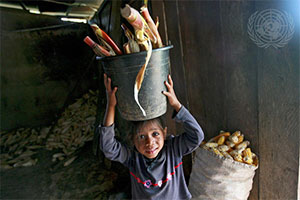 Timorese Girl with Fresh-Picked Corn. Credit: UN Photo/Martine Perret
A global common denominator is the need for a decent job. The economic realities of each country determine just how difficult it is to find one. Despite the labour movement's achievements, serious challenges persist: gender discrimination, child labour, worker migration, the digital divide and AI automation, evaporating pensions, unsafe workplaces, corporate pressure against union organising, negative impacts of trade agreements, and the precariousness of informal employment. The 2025 UN SDG Report identifies jobs and social protections as one of the six priority areas requiring urgent action, with progress either stalled or reversing in many developing nations.
In recent years, the fight to protect labour equality has taken on new dimensions with the rise of Environmental, Social and Governance standards. With the Social aspect aiming to promote equality and human rights, ESG principles have strengthened labour advocacy within corporate and governmental regulatory landscapes. In particular, ESG has become much more institutionalized in emerging economies such as Brazil and China. IPS follows the world’s workers as they confront these challenges - their setbacks and their successes.

The Week with IPS

NEXT STOP - SDGs
Tracking global progress towards a sustainable world
Tracking global progress towards a sustainable world
