Languages
Wednesday, November 18, 2026



News and Views from the Global South
Natural Resources

Las Pavas Extracts a Miracle from God
The rural community of Las Pavas in northern Colombia received this year’s National Peace Prize Wednesday in recognition of its peaceful struggle for land that is claimed by an oil palm company, in a case that became an international symbol of the conflict over land in this country.
Q&A: Indonesia Still at High Risk for Catastrophic Fires
In June, Singapore, Malaysia and Indonesia were enveloped in haze as hundreds of forest fires burned across the island of Sumatra, in the worst pollution crisis to hit Southeast Asia in more than a decade.
Oil Palm Expands on Deforested Land in Brazil’s Rainforest
The green of the oil palm plantations is unbroken along kilometre after kilometre of red soil, devastated in the past by loggers and ranchers. The oil palm, a sign of alarm for some and of hope for others, is here to stay in the Amazon rainforest state of Pará in the extreme north of this country.
St. Vincent’s Volcano Holds More Promise Than Peril
Weary of sky-high electricity prices, St. Vincent is following in the footsteps of another, decidedly un-tropical island nearly 4,000 miles away in its quest to harness clean geothermal power.
Gaps Threaten Conflict Minerals Certification
Countries in Africa’s Great Lakes region are moving too slowly on an international plan to certify the sourcing of “conflict minerals”, researchers here are warning, a failure that could threaten the entire certification process.
Small Islands Demand U.N. Protection
Threatened by rising seas, some of the world's small island developing states (SIDS) are demanding that the U.N.'s new set of Sustainable Development Goals place a high priority on the protection of oceans and marine resources.
Mining Takes a Bite Out of Guyana’s Amazon
Guyana is engaged in a balancing act to save its rainforest, regarded as a living treasure, from the destructive activities of miners digging their way to another kind of treasure buried beneath this fragile ecosystem.
OP-ED: A Global Green New Deal for Sustainable Development
Eight decades ago, during the Great Depression, newly elected U.S. President Franklin Delano Roosevelt introduced the New Deal consisting of a number of mutually supporting initiatives of which the most prominent were:
This Bird Has Flown – Forever
The extinction of a single species (a fish off the coast of Cuba, a bird in the Brazilian forest) creates a void that can trigger a whole series of repercussions, from the alteration of ecosystems to increased hunger.
Ethiopia’s Indigenous Excluded from Rapid Growth
As the construction of a major transmission line to export electricity generated from one of Ethiopia’s major hydropower projects gets underway, there are growing concerns that pastoralist communities living in the region are under threat.
Libya’s Berbers Close the Tap
"Oil tankers won´t get crude from this port until Tripoli finally meets our demands," says Younis, one of the Amazigh rebels today blocking one of Libya´s largest gas and crude oil plants.
World Headed for a High-Speed Carbon Crash
If global carbon emissions continue to rise at their current rate, humanity will eventually be left with no other option than a costly, world war-like mobilisation, scientists warned this week.
Uganda Needs to Exploit its Own Mineral Riches
This year, as Uganda gears up to start producing the nearly two billion barrels in oil reserves that were discovered near its western border, critics say that little is being done to exploit the rich mineral resources located in some of the country’s poorest areas.
The Sickest Places in the World
Parts of Indonesia, Argentina and Nigeria are among the top 10 most polluted places on the planet, according to a new report by U.S. and European environmental groups.
South America – From Granary to Megaprojects for the World
South America has gone from the world’s granary to the site of innumerable international infrastructure, energy and mining megaprojects. It is now facing a new dilemma: bolstering the economy with the promise of reducing inequality, in exchange for social and environmental costs that are taking their toll.
Zimbabweans Left Worse Off by Local Mining Companies
Ranganai Zimbeva, from the rural village of Mutoko, which lies about 200 km northeast of Zimbabwe’s capital Harare, plugs his ears with his fingers and shakes his head as he watches miners close to his village blast the hard rock to extract the black granite within.
South of the Border, Mining Is King
Civil society groups from throughout Latin America are urging “home countries” to take greater responsibility for the actions of their companies abroad, particularly those in the extractives industry.
Caught Between Two Sudans
When Chris Bak returned two weeks ago to the disputed border town of Abyei, which voted this week on whether to join Sudan or South Sudan, he barely recognised it as the place where he grew up. “Everything is dirty,” he told IPS. “We were just going around and around, but we didn’t [recognise] this place.”
Caribbean Looks to the Sky for Water Security
A centuries-old system for ensuring water security is making a comeback in the Caribbean.
Bangladesh Ailing After Aila
It has been four years since Cyclone Aila struck Bangladesh, triggering floods and widespread destruction. But the villagers of Koira subdistrict, among the worst affected of the 11 districts hit by the cyclone, are yet to recover from its impact.
India Illegal Mining Enquiry Cut Short
A nationwide enquiry into illegal mining in India was aborted before it completed its investigation into the failings of the country’s mining industry. The study had prompted the government to ban mining in two states and arrest high-ranking politicians.« Previous Page — Next Page »


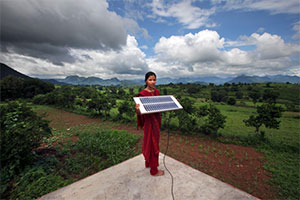 Bringing clean energy to rural India. Credit: Abbie Trayler-Smith / Panos Pictures / Department for International Development
Large reserves of oil, gas and minerals in developing countries generate opulent revenues. They could be used to stimulate economic growth and reduce poverty, but often result in environmental destruction and conflict, benefiting large companies and corrupt governments. Furthermore, competition over natural resources often manifests through geopolitical conflict. For example, before the US-Iraq war, Iraq’s domestic oil industry was nationalized. With US aggression came weakened Iraqi institutions and foreign intervention, thus eventually leading to the privatization of Iraqi oil, leaving the industry now largely dominated by Western companies. As another example, China’s rising investments within the lithium sector in South America are increasing the US-China rivalry across the Western Hemisphere. Notably, Bolivia has the largest reserves of lithium in the world, and the nation’s state-owned lithium extraction firm recently signed a contract with China’s CBC Consortium, while rejecting the entry of Western firms into the nation. In Bolivia’s case, rising Chinese investment in the nation’s lithium sector also raises concerns about environmental sustainability and the sociopolitical rights of Indigenous communities. More broadly, Sub-Saharan Africa holds nearly 30% of global reserves of critical minerals required for low-carbon technologies. Despite this, the region attracts less than 10% of global exploration investment, depicting a critical barrier to both the clean energy transitions and Sub-Saharan Africa’s economic development. Furthermore, resource wealth continues to fuel conflict like Sudan’s civil war, which has led to 9.1 million internally displaced people and is intensely connected to competition over gold, water, and agricultural land. IPS covers news about major oil, gas, and mining projects, their effects on the environment and local communities, and the ideas and actions of the interest groups involved.

The Week with IPS

NEXT STOP - SDGs
Tracking global progress towards a sustainable world
Tracking global progress towards a sustainable world
