Languages
Thursday, October 1, 2026



News and Views from the Global South
Economy & Trade

PPPs Fiscal Hoax Is a Blank Financial Silver Bullet
Public-private partnerships (PPPs) for infrastructure and service provision are both costly and risky. Worse, PPPs typically fail to ensure universal, let alone fair access to public amenities.
Argentina: Unpalatable Choices in Election Plagued with Uncertainty
For many of Argentina’s voters the choice in the 19 November presidential runoff is between the lesser of two evils: Sergio Massa, economy minister of a government that’s presiding over a once-in-a-generation economic meltdown with a whopping 140-per cent inflation rate, or Javier Milei, a far-right libertarian who admires Donald Trump, wants to shut down the Central Bank and wields a chainsaw in public as a symbol of his willingness to slash the state. Many will rue that it ever came to this.
Kashmir’s Apple Industry Faces Dire Threats as Climate Change Takes its Toll
Of Kashmir’s seven million inhabitants, a staggering one million rely directly on apple farming. The region is pivotal in India’s apple and horticulture production, contributing to over 70 percent of the country’s apple supply. This not only provides income to farmers but also sustains a vast network of laborers, traders, and transporters within the fruit economy.
Hurricane Otis and the Indifference Toward the Children of Acapulco
Acapulco is a paradise. A port of golden sunsets, toasted sand, and deep blue sea. Its dream beaches captivated the hearts of Elvis Presley and Elizabeth Taylor. US President John F. Kennedy chose its shores to spend his honeymoon with Jackie Kennedy. Its luxury hotels and the untamed sea made it the most famous tourist destination in Mexico.
Venezuela’s Young Women Particularly Vulnerable to the Crisis
Hemmed in by poverty, with barely two days of school a week, and often at risk of unwanted pregnancy or the uncertain prospect of emigration, young women and adolescents are among the main victims of the ongoing crisis in Venezuela.
Even Rich Nations Now Worried About ISDS
Governments the world over are worried about investor-state dispute settlement (ISDS) rules. These allow foreign investors to sue them for billions over new laws or policies reducing their profits.
Innovative Financial Services Transform Agricultural Entrepreneurship in Africa
Smallholder agricultural enterprises in Africa face a lot of challenges getting loans from financial institutions like banks due to the stringent requirements they can hardly fulfil. Investor confidence is usually lacking, given the risks involved in this sector of the economy.
Community Solutions Combat Water Shortages in Peru’s Highlands
The lack of water is so severe in Peru's highlands that farming families are forced to sell their livestock because they cannot feed them. "There is no grass or fodder to feed them," says Fermina Quispe, a Quechua farmer from a rural community located at 4,200 meters above sea level.
Uganda: When Climate Justice Becomes Climate Justice Denied
On December 4, 2019, landslides in the Bududa region of Uganda killed 20. The landslides occurred after heavy rains, and a Red Cross report estimated that 96 households were affected, with 49 houses destroyed. It displaced many, while others continued to live in high-risk areas that could "slide at any moment."
Climate Change Turns African Rivers into Epicentres of Conflict
Almost all major river basins in Africa have become the epicentres for conflicts over the last 20 years, and agricultural yields on the continent could drop by up to 50 percent in the coming years owing to the drying up of 'traditional' water sources, thanks in part to effects climate change and degradation of the environment, the inaugural edition of the State of Africa's Environment Report 2023 released in Nairobi finds.
Migration Puts the Brakes on Venezuela’s Vehicles
Diego has just enrolled to study journalism at a university in the Venezuelan capital and, with 2,000 dollars that his family members managed to gather, has bought his first car, a small 2007 Ford that can take him to class from his home in the neighboring Caribbean port city of La Guaira.
New Zealand: Political Volatility under Cost-of-Living Crisis
It’s a rapid reversal for New Zealand’s Labour Party, in power for six years. At the last election in 2020 it won an outright majority, the first party to do so under the current voting system. But three years on, it’s finished a distant second in the election held on 14 October. The result speaks to a broader pattern seen amid economic strife in many countries – of intense political volatility and the rejection of incumbents.
Seniors Thriving Through Plastic Waste in Zimbabwe
They do not have a pension nor financial support from families or relatives, but they have themselves. Now they have become collectors of plastic waste, which they turn into products as they battle for survival - earning money from the growing plastic pollution in Zimbabwe.
Big Changes Coming to the World Bank—But it’s Not Enough
It’s official: The World Bank officially has a mission to combat climate change. At least on paper. This week, the World Bank governing body approved a new vision statement that clarifies that the Bank can tackle climate change as part of its mission to alleviate global poverty on “a livable planet.” Also this week, the new World Bank President Ajay Banga suggested that he’ll be consider redirecting subsidies away from fossil fuels and towards climate action.
Insider Exposé of ESG Greenwashing
A senior manager of the world’s largest investment firm has ‘blown the whistle’ on ESG (environment, social and governance) ‘greenwashing’, especially on supposed climate finance.
Housing in Cuba, a Problem with no Solution in Sight
To emigrate to the United States and fulfill her hopes for a better life, Ana Iraida sold almost all of her belongings, including the apartment that, until her departure, saved her from the uncertainty of living in rented housing in Cuba, a country with an unresolved housing crisis.
WORLD FOOD DAY 2023

Water is essential for life on Earth. It makes up 50% of our human bodies. It covers about 70% of the planet’s surface.

Electric Transport Expands Slowly in Mexico
Maribel Ochoa takes less time and spends less money commuting from her home to her work in eastern Mexico City thanks to the use of the electric Cablebus, a cable car that has improved her quality of life since the service began operating two years ago.
Ecuadorians Vote to Preserve Yasuní National Park, but Implementation Is the Problem
The decision reached by Ecuadorians to put an end to oil production in Yasuní National Park, in a popular referendum in August, was a triumph for civil society and a global milestone in environmental democracy. But when it comes to implementation, the result is less promising.
Faced with Crushing Debts, World’s Poorest Nations to Slash Public Spending by Over 229 Billion Dollars
The World Bank and the International Monetary Fund (IMF) are returning to Africa, for the first time in decades, with the “same old failed message”. “Cut your spending, sack public service workers, and pay your debts-- despite the huge human costs,” says Oxfam International’s interim Executive Director Amitabh Behar, following the release of new Oxfam report.
Where is India Heading?
Some time ago I watched the Indian blockbuster RRR (Rise, Roar, Revolt). It received universal praise for direction, screenwriting, cast performances, soundtrack (which won an Oscar) and thrilling action sequences. RRR is filled with gore; bodies beaten, pierced and torn apart. An overblown combination of Quentin Tarantino and Bollywood, far away from Satyajit Ray’s emotionally moving films, as well as Bollywood’s romantic comedies and mythological dramas. RRR never pauses for breath. The two male protagonists are supermen, not exposing many recognizable human traits, even if they might occasionally sing and talk about love. Hard to understand, since the few women of the story are cut-out clichés.« Previous Page — Next Page »


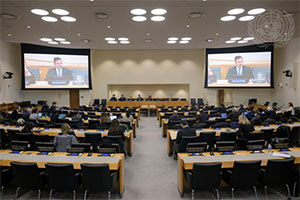 UN Commission on International Trade Law Holds Colloquium on Harmonizing Law in Age of Digital Trade and Finance. Credit: UN Photo/Manuel Elías
Trade has historically been a geopolitical tool that can both be used to propel development as well as entrench inequalities. In various nations in East Asia and Latin America, increased trade, as often seen in export booms, has allowed them to achieve influential standings within the global economy. On the other hand, many low-income countries in Sub-Saharan Africa, Asia, and Latin America struggle to maintain a robust trade performance, and oftentimes are subjugated to exploitative trade dynamics through intense extraction of their natural resources. In recent decades, international trade has reached a new era as emerging economies across the world are rising in economic preeminence. Stable international trade is crucial to world peace as global interconnectedness facilitates reliable diplomacy. Nevertheless, significant challenges are on the rise. Notably, a major wave of United States tariff escalations in January 2025 lifted US import taxes to their highest level since the 1930s, changing market dynamics and forcing renegotiations with global trading partners.These articles are aimed at informing readers about the complexities of trade and its varying effects on development, with a special focus on the consequences of the global economic crisis, the potential of fair trade and the gender implications of trade policies.
Updated by Yilan Batista and Shuli Wong August 2026

The Week with IPS

NEXT STOP - SDGs
Tracking global progress towards a sustainable world
Tracking global progress towards a sustainable world
